
What Is Molarity?
Molarity (M) is one of the most common ways chemists express the concentration of a solution. It measures how many moles of a dissolved substance (the solute) are present in one liter of solution. The unit is moles per liter (mol/L), often written simply as M. This calculator converts a known number of moles and a solution volume directly into molarity.
How to Use This Calculator
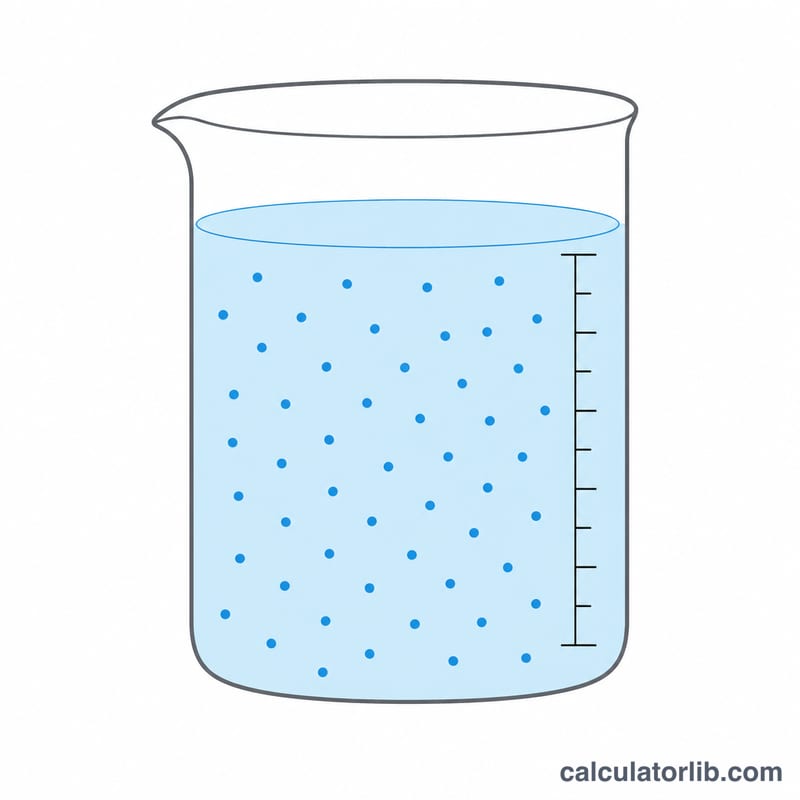
Enter the amount of solute in moles and the total volume of the solution in liters. The calculator divides the moles by the volume to return the molarity in mol/L. If your volume is in milliliters, divide it by 1000 first to convert to liters (for example, 250 mL = 0.25 L).
The Formula Explained
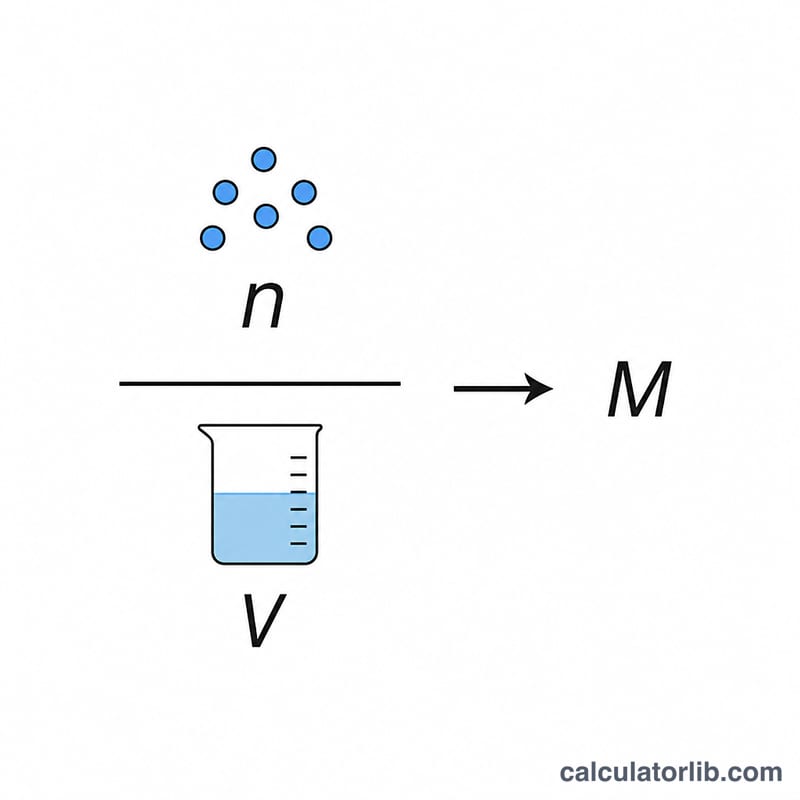
The relationship is straightforward: $$M = \frac{\text{Moles}}{\text{Volume (L)}}$$ where \(M\) is molarity in mol/L, \(n\) is the number of moles of solute, and \(V\) is the volume of solution in liters. Because molarity depends on the total solution volume rather than the solvent volume alone, always use the final volume after the solute is dissolved.
Worked Example
Suppose you dissolve 0.5 moles of sodium chloride in enough water to make 2 liters of solution. The molarity is $$M = \frac{0.5}{2} = 0.25 \text{ mol/L}$$ The solution is therefore 0.25 M.
FAQ
What is the difference between moles and molarity? Moles measure an absolute quantity of substance, while molarity measures concentration — moles per liter of solution.
Can I use milliliters? Not directly. Convert milliliters to liters by dividing by 1000 before entering the volume.
What if my volume is zero? Molarity is undefined when volume is zero because you cannot divide by zero; enter a positive volume.