What Is a 50% Off Calculator?
A 50% off calculator works out the final sale price when an item is discounted by half, and shows exactly how much money you keep in your pocket. Because 50 percent is half, the sale price and the amount you save are always equal — both are exactly half of the original price.
How to Use It
Enter the original price of the item and the calculator instantly returns three numbers: the original price, the amount saved, and the final sale price. It is perfect for clearance racks, flash sales, "buy one get one half off" deals, and quick mental-math checks at the register.
The Formula Explained
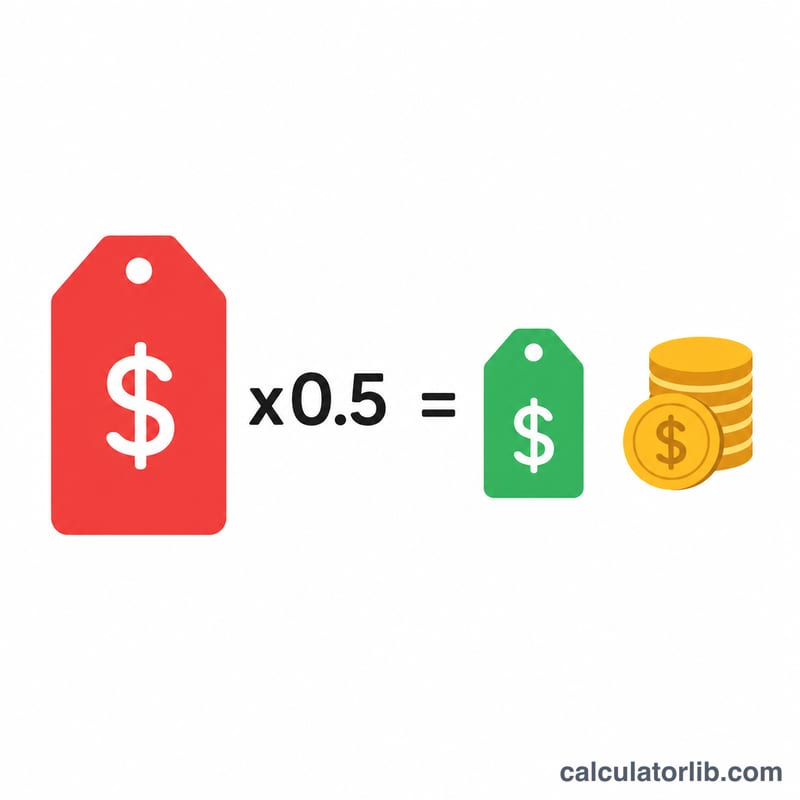
A 50% discount multiplies the price by the discount rate of 0.5. The amount saved is \(\text{Price} \times 0.5\), and the sale price is the original price minus that saving, which simplifies to \(\text{Price} \times 0.5\) as well. In short, at 50% off you pay half and save half.
$$\text{Sale Price} = \text{Original Price (\$)} \times (1 - 0.5)$$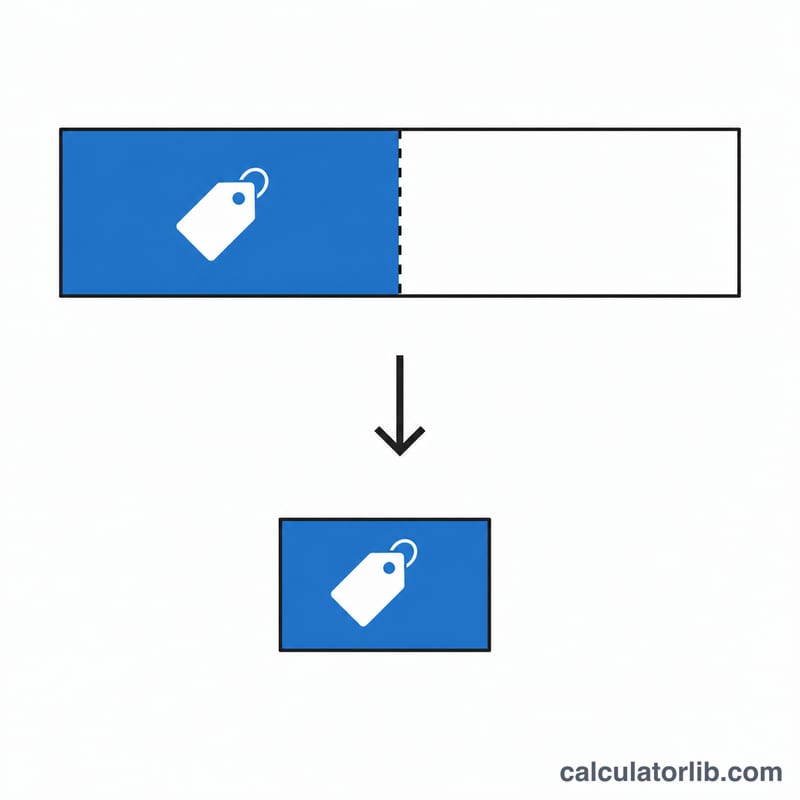
Worked Example
Suppose a jacket costs $80. The amount saved is \(80 \times 0.5 = \$40\). The sale price is \(80 - 40 = \$40\). So you pay $40 and save $40 — exactly half each way.
50% Off Price Examples at a Glance
Taking 50% off means you pay half of the original price, so the amount saved and the sale price are the same number. The last column adds an 8% sales tax purely as an illustrative rate; actual sales tax varies by location and by item.
| Original Price | You Save (50%) | Sale Price | Sale Price + 8% Tax (illustrative) |
|---|---|---|---|
| $10.00 | $5.00 | $5.00 | $5.40 |
| $19.99 | $10.00 (rounded from $9.995) | $10.00 (rounded from $9.995) | $10.79 |
| $25.00 | $12.50 | $12.50 | $13.50 |
| $49.99 | $25.00 (rounded from $24.995) | $25.00 (rounded from $24.995) | $26.99 |
| $80.00 | $40.00 | $40.00 | $43.20 |
| $120.00 | $60.00 | $60.00 | $64.80 |
| $250.00 | $125.00 | $125.00 | $135.00 |
| $500.00 | $250.00 | $250.00 | $270.00 |
Prices ending in 99 cents produce a half-cent, so a store may round the sale price up or down by one cent. The tax column uses the unrounded half price and then rounds the final amount.
50% Off vs Other Common Discounts
Here is how common discounts compare on one fixed original price of $100.
| Discount | You Save | Sale Price |
|---|---|---|
| 10% off | $10.00 | $90.00 |
| 20% off | $20.00 | $80.00 |
| 25% off | $25.00 | $75.00 |
| 30% off | $30.00 | $70.00 |
| 40% off | $40.00 | $60.00 |
| 50% off | $50.00 | $50.00 |
| 75% off | $75.00 | $25.00 |
Note: 50% off is the same as paying half the price. Because the original is $100, the savings in dollars equal the percentage, but on other prices you can scale the table: the sale price is always \(\text{Original Price} \times 0.5\).
Stacked and BOGO Half-Off Deals Explained
BOGO half off (second item 50% off)
In a "buy one, get one half off" deal, only the second item is discounted. Example with two items at $30 each:
- Pay full price for the first item: $30.
- Take 50% off the second item: \(\$30 \times 0.5 = \)$15.
- Add them together: \(\$30 + \$15 = \$45\).
- Compare with the regular total of \(\$30 + \$30 = \$60\). You save \(\$60 - \$45 = \$15\).
- Overall saving: \(\frac{15}{60} = 0.25\), which is 25% across both items, not 50%.
Check the deal terms: some stores apply the half-off to the lower-priced item when prices differ.
50% off plus an extra 20% off
Stacked percentages are normally applied one after the other, not added together. The second discount applies to the already reduced price:
$$\text{Final Price} = \text{Original Price} \times 0.5 \times 0.8 = \text{Original Price} \times 0.4$$
You pay 40% of the original, so the total discount is 60%, not 70%. On a $100 item: \(\$100 \times 0.5 = \$50\), then \(\$50 \times 0.8 = \$40\). Total savings: $60.
FAQ
Is 50% off the same as half price? Yes. Taking 50 percent off is identical to paying half of the original price.
How do I calculate 50% off in my head? Just divide the price by two. For $19.98, half is about $9.99.
Does this include sales tax? No. The calculator shows the pre-tax discounted price. Add any applicable tax to the sale price at checkout.