

What the Time Off Calculator does
The Time Off Calculator adds up the different categories of leave you take in a year and shows how that compares with the days you actually spend working. It assumes a standard 365-day year with 104 weekend days (52 weeks × 2 days), so the figures it returns describe time off taken from your working weekdays. Use it to see your total days off, your remaining working days, and what share of the year you spend on leave versus on the job.
The four inputs
- Annual Leave (days) — your paid vacation or holiday entitlement.
- Sick Leave (days) — days taken (or budgeted) for illness.
- Personal Days — discretionary days off for personal matters.
- Public Holidays — national or regional holidays you don't work.
Each is entered as a whole number of days. If you leave one blank it counts as zero.

The formula explained
The calculator runs a few simple sums:
- Total days off = $$\text{Annual Leave} + \text{Sick Leave} + \text{Personal Days} + \text{Public Holidays}$$
- Working days = $$365 - \text{Total days off} - 104 \ (\text{weekends})$$
- Time off percentage = $$\frac{\text{Total days off}}{365} \times 100$$
- Working time percentage = \(100 - \text{Time off percentage}\)
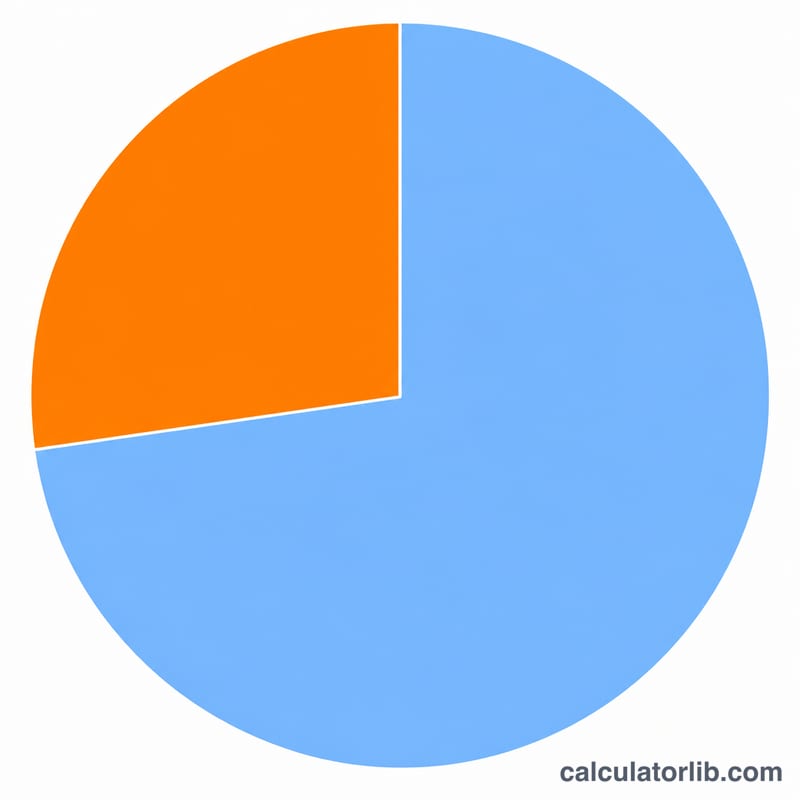
It also calculates each category's share of the year individually so the breakdown can be visualised.
Worked example
Suppose you have 25 annual leave days, 5 sick days, 3 personal days and 11 public holidays:
- Total days off = $$25 + 5 + 3 + 11 = \textbf{44 days}$$
- Working days = $$365 - 44 - 104 = \textbf{217 days}$$
- Time off percentage = $$\frac{44}{365} \times 100 \approx \textbf{12.1\%}$$
- Working time percentage \(\approx\) 87.9%
So just over an eighth of the calendar year is accounted for by your leave, with 217 weekdays left for work.
Frequently asked questions
Why does it subtract 104 days? Those are the weekend days in a typical year (52 weeks × 2). Since you don't usually work weekends, the calculator removes them so the "working days" figure reflects weekdays only.
Are the percentages based on the full year? Yes. Both the time-off percentage and each individual category percentage are calculated against all 365 days, not just working days, so they show your share of the whole calendar year.
Could the working days come out negative? If your total days off exceed 261 \((365 - 104)\), the formula will return a negative working-days figure — a sign your entered leave is unrealistically high for a single year.