
What Is VO2 Max?
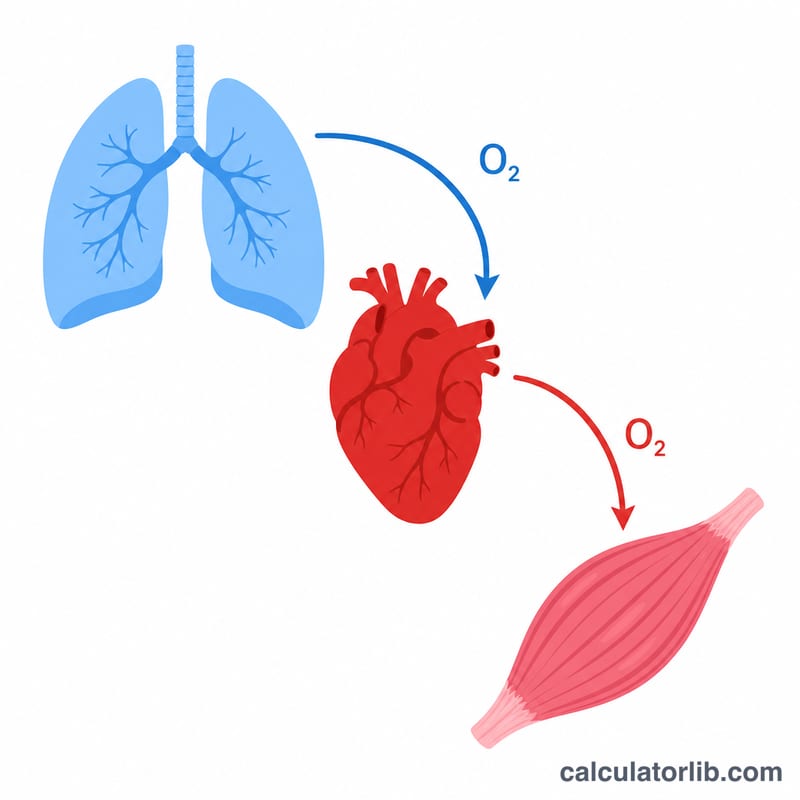
VO2 Max is the maximum amount of oxygen your body can use during intense exercise, measured in millilitres of oxygen per kilogram of body weight per minute (ml/kg/min). It is one of the most reliable indicators of aerobic fitness and cardiovascular endurance. The higher your VO2 Max, the more efficiently your heart, lungs, and muscles deliver and use oxygen — which translates into better stamina for running, cycling, swimming, and everyday activity.
While the gold-standard test happens in a lab with a breathing mask and treadmill, this calculator gives a quick, equipment-free estimate using your heart rate data.
How to Use This Calculator
Enter the following details and the calculator estimates your maximal oxygen uptake instantly:
- Age – used to estimate your maximum heart rate.
- Gender – men and women have slightly different fitness benchmarks.
- Resting heart rate (RHR) – measure your pulse first thing in the morning before getting out of bed for the most accurate reading.
- Maximum heart rate (HRmax) – enter a measured value if you have one, or use the age-based estimate (\(220 - \text{age}\)).
The Formula Explained
This calculator uses the heart-rate ratio method developed by Uth and colleagues:
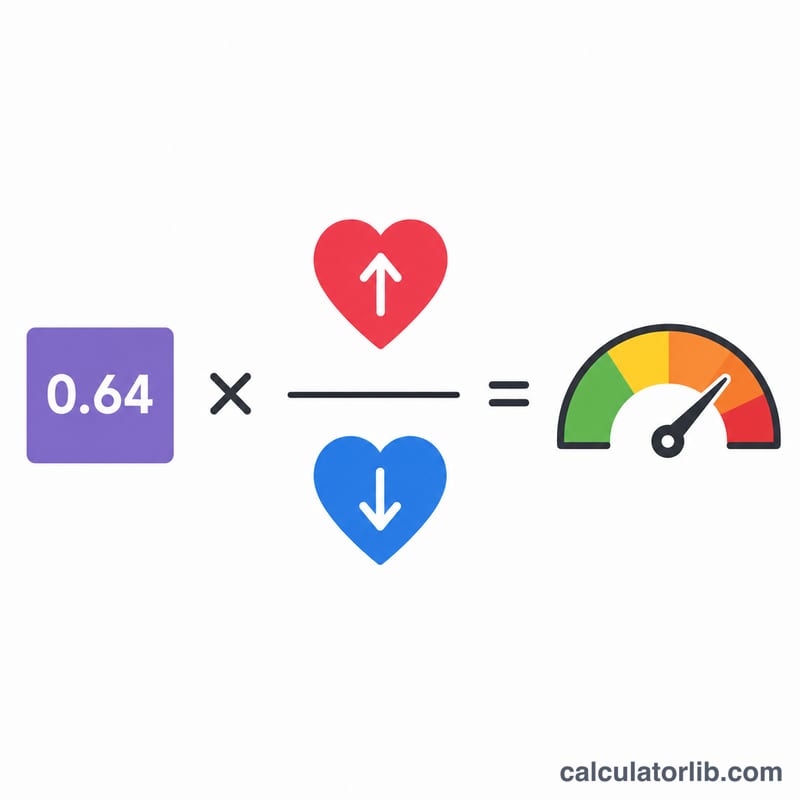
$$\text{VO}_2\text{max} = 15.3 \times \frac{\text{Max HR}}{\text{Resting HR}}$$
The principle is simple: a low resting heart rate combined with a high maximum heart rate signals a strong, efficient heart — the hallmark of good aerobic conditioning. The ratio between the two gives a practical estimate of oxygen uptake without any lab equipment.
Worked Example
Suppose a 30-year-old has a resting heart rate of 60 bpm and a maximum heart rate of 190 bpm:
- $$\text{VO}_2\text{max} = 15.3 \times \frac{190}{60}$$
- $$\text{VO}_2\text{max} = 15.3 \times 3.17$$
- $$\text{VO}_2\text{max} \approx 48.5 \ \text{ml/kg/min}$$
A result near 48 places this person in the "good to excellent" range for their age group.
Frequently Asked Questions
What is a good VO2 Max? For most adults, 35–45 ml/kg/min is average, while trained athletes often exceed 60. Values decline naturally with age, so always compare against your own age and gender bracket.
How can I improve my VO2 Max? Interval training, tempo runs, and consistent aerobic exercise are proven methods. Improvements of 10–20% are realistic over a few months of structured training.
Is this estimate accurate? It is a reasonable approximation, not a clinical measurement. For precise results, seek a laboratory test, but this calculator is excellent for tracking progress over time.