
What Is the Reverse BMI Calculator?
A standard BMI calculator tells you your Body Mass Index from your weight and height. This Reverse BMI Calculator flips that around: you choose a target BMI and enter your height, and it tells you the exact body weight that would produce that BMI. It's a practical way to translate an abstract health number into a concrete weight goal you can actually aim for. The calculation uses the metric BMI system used worldwide by the World Health Organization.
How to Use It
There are just two inputs:
- Height (cm): Your height in centimetres — for example, 175.
- BMI: The Body Mass Index you want to target — for example, 22 for a mid-range healthy weight.
The calculator returns your target weight in kilograms and also classifies the BMI you entered into a standard health category, so you immediately know what range you're aiming at.
The Formula Explained
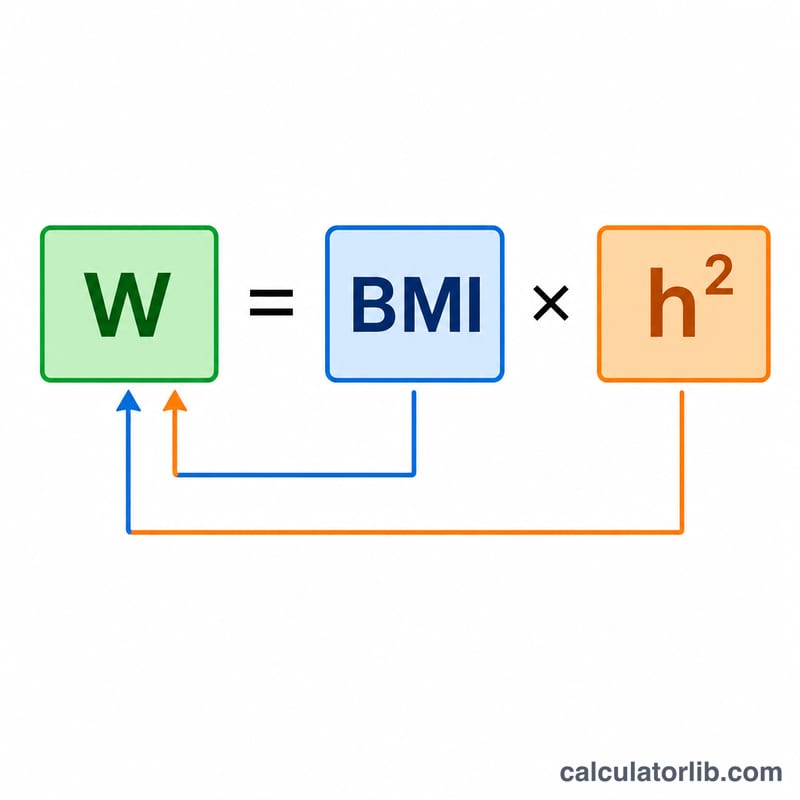
The tool rearranges the classic BMI equation. Normally BMI = weight ÷ height², with height in metres. To find weight instead, it multiplies the BMI by the square of your height:
$$\text{Weight (kg)} = \text{BMI} \times \left(\frac{\text{Height}}{100}\right)^{2}$$Internally it computes \(\frac{\text{BMI} \times \text{Height} \times \text{Height}}{10000}\) — the division by 10,000 converts your height from centimetres to metres squared, since \(100^{2} = 10000\). The result is the same as squaring metres.
Worked Example
Suppose you are 175 cm tall and want a BMI of 22:
- Height in metres: \(175 \div 100 = 1.75\)
- \(1.75^{2} = 3.0625\)
- Weight = \(22 \times 3.0625 = \mathbf{67.4 \text{ kg}}\)
A BMI of 22 falls in the "Normal weight" range, so 67.4 kg would be a healthy target weight for that height.
BMI Categories Used
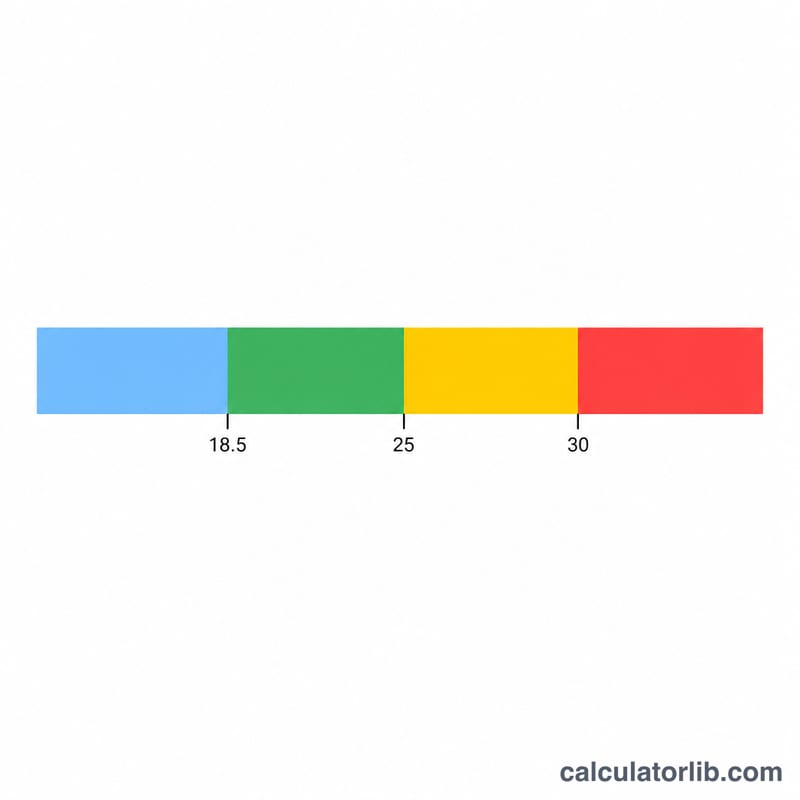
- Underweight: BMI below 18.5
- Normal weight: BMI 18.5 to under 25
- Overweight: BMI 25 to under 30
- Obese: BMI 30 and above
Frequently Asked Questions
What is the formula for calculating weight from BMI?
Rearrange the standard BMI equation. Since BMI equals weight in kilograms divided by height in metres squared, target weight equals BMI multiplied by height (in metres) squared. For example, a BMI of 22 at 1.75 m gives 22 × 1.75 × 1.75 = 67.4 kg.
Can I calculate my height from BMI and weight instead?
Yes. Rearranging the formula, height in metres equals the square root of weight divided by BMI. For instance, 70 kg at a BMI of 23 gives the square root of 70 ÷ 23, which is about 1.745 m, or roughly 175 cm.
What BMI should I target?
For most adults, a BMI between 18.5 and 24.9 is considered healthy. Many people aim for the middle of that band, around 21 to 23, to leave room for normal day-to-day weight fluctuations. The right target depends on your age, build and personal health goals.
Can I enter my height in feet and inches?
No, this calculator requires height in centimetres. Convert first: multiply total inches by 2.54, or feet by 30.48. For example, 5 feet 9 inches is 69 inches × 2.54 = 175.3 cm. Enter that figure to get your target weight.
Is BMI accurate for everyone?
BMI is a useful general guide but doesn't distinguish muscle from fat or account for bone density and fat distribution. Athletes and very muscular people may show a high BMI while being healthy, so treat the target weight as a guideline rather than a strict rule.
What are the standard BMI categories?
The widely used categories are: underweight below 18.5, healthy weight 18.5 to 24.9, overweight 25 to 29.9, and obese 30 or above. This calculator uses these standard adult ranges, so you can pick a target BMI that places you within a healthy band.