
What This Calculator Does
The Ideal Body Weight (IBW) Calculator estimates a healthy target weight based on just two inputs: your height and your gender. Rather than relying on a single formula, it runs three widely used clinical equations — Devine, Robinson and Miller — so you can compare results and see a sensible range instead of one rigid number. Results are shown in both kilograms and pounds.
The Inputs You Provide
- Height — enter the figure that matches your selected unit.
- Centimeters or Inches — pick the unit for your height. If you choose inches, the tool converts to centimeters internally by multiplying by 2.54.
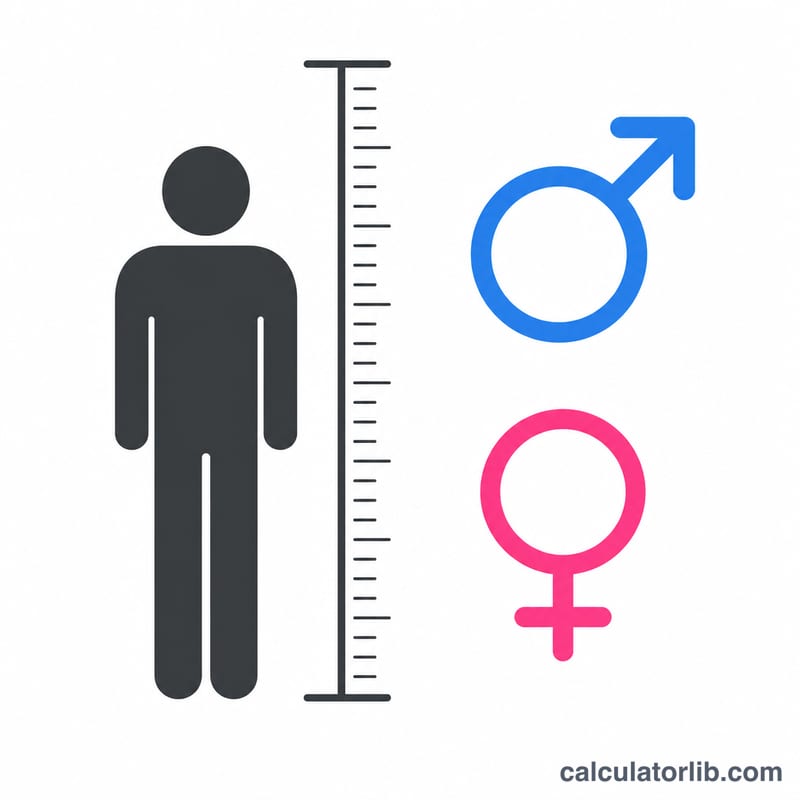
- Gender (Male or Female) — each formula uses a slightly different baseline weight for men and women.
The Formulas Explained
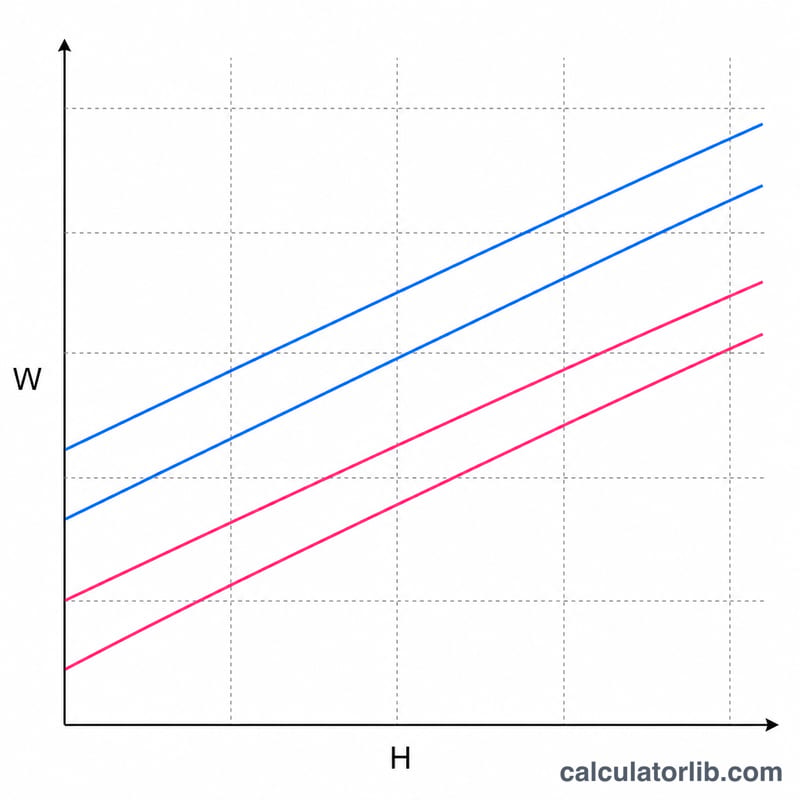
All three equations start from a base weight at 152.4 cm (5 feet) and add weight for each centimeter above that. They use centimeters directly:
- Devine: Men = 50.0 + 0.91 × (cm − 152.4); Women = 45.5 + 0.91 × (cm − 152.4)
- Robinson: Men = 52.0 + 0.75 × (cm − 152.4); Women = 49.0 + 0.67 × (cm − 152.4)
- Miller: Men = 56.2 + 0.55 × (cm − 152.4); Women = 53.1 + 0.54 × (cm − 152.4)
The result in kilograms is then multiplied by 2.20462 to give the equivalent in pounds.
Worked Example
Take a man who is 70 inches tall. First, 70 × 2.54 = 177.8 cm, which is 25.4 cm above 152.4 cm.
- Devine: 50.0 + 0.91 × 25.4 = 73.1 kg (161.2 lb)
- Robinson: 52.0 + 0.75 × 25.4 = 71.1 kg (156.6 lb)
- Miller: 56.2 + 0.55 × 25.4 = 70.2 kg (154.7 lb)
So this man's ideal body weight falls in roughly the 70–73 kg range.
Frequently Asked Questions
Why are there three different formulas? The Devine formula was originally created for medication dosing in the 1970s, while Robinson and Miller refined it using population data. Showing all three gives a more realistic range than a single value.
Does IBW account for body frame or muscle? No. These formulas use only height and gender. Athletes with high muscle mass may weigh more than their IBW yet still be healthy, so treat the result as a guideline, not a strict target.
Which result should I use? Use the range as a whole. If you need a single figure, the Devine formula is the most commonly cited in clinical settings.