What This Calculator Does
The Goal Body Fat Weight Calculator estimates the body weight you would reach at a chosen target body fat percentage, assuming you keep all of your lean body mass (muscle, bone, organs, water) and only lose fat. It also tells you how much fat you would need to lose to get there. This is a universal physics-of-composition tool — it applies to anyone regardless of country.
How to Use It
Enter your current body weight, your current body fat percentage, and the target body fat percentage you want to reach. The calculator computes your lean body mass, then divides it by the fraction of your goal weight that should be lean to find your projected goal weight. The difference between your current and goal weight is the fat you would shed.
The Formula Explained
First, lean mass is fixed: \( \text{Lean Mass} = \text{Weight} \times (1 - \text{BF\%}) \). At your target, lean mass should make up \( (1 - \text{Target\%}) \) of your total weight, so \( \text{Goal Weight} = \text{Lean Mass} \div (1 - \text{Target\%}) \). Finally, \( \text{Fat to Lose} = \text{Current Weight} - \text{Goal Weight} \). The model assumes lean mass stays constant, which is the goal of a well-managed cut.
$$\begin{gathered} W_{goal} = \frac{L}{1 - \dfrac{\text{Target BF (\%)}}{100}} \\[1.5em] \text{where}\quad L = \text{Weight (kg)} \times \left(1 - \frac{\text{Current BF (\%)}}{100}\right) \end{gathered}$$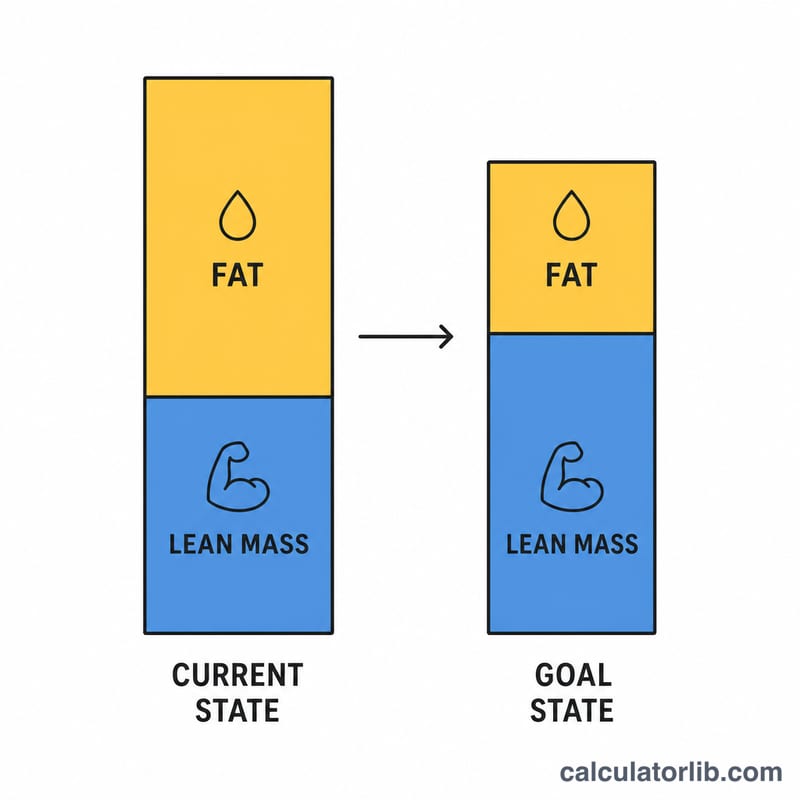
Worked Example
Suppose you weigh 80 kg at 25% body fat and want to reach 15%. Lean mass = \( 80 \times (1 - 0.25) = 60 \) kg. Goal weight = \( 60 \div (1 - 0.15) = 60 \div 0.85 \approx 70.59 \) kg. Fat to lose \( \approx 80 - 70.59 = 9.41 \) kg. Your current fat mass is \( 80 \times 0.25 = 20 \) kg.
$$L = 80 \times (1 - 0.25) = 60 \text{ kg}$$ $$W_{goal} = \frac{60}{1 - 0.15} = \frac{60}{0.85} \approx 70.59 \text{ kg}$$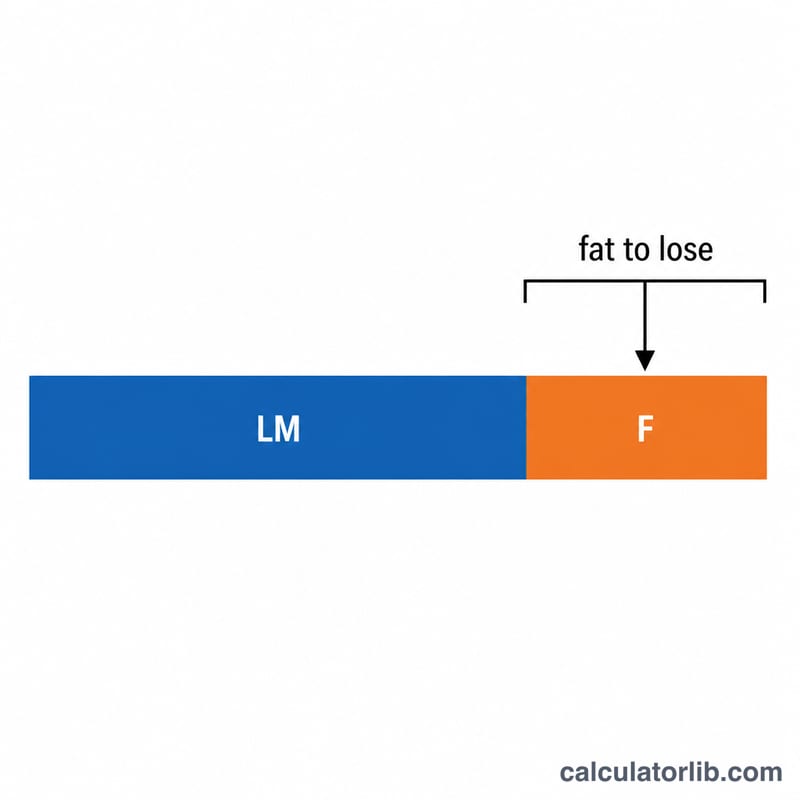
Body Fat Percentage Categories
The table below shows the body fat categories published by the American Council on Exercise (ACE). These are commonly cited general reference ranges, not diagnostic cutoffs.
| Category | Men (% body fat) | Women (% body fat) |
|---|---|---|
| Essential fat | 2–5% | 10–13% |
| Athletes | 6–13% | 14–20% |
| Fitness | 14–17% | 21–24% |
| Average | 18–24% | 25–31% |
| Obesity | 25%+ | 32%+ |
Source: American Council on Exercise (ACE). Ranges vary by source, age, and measurement method, so treat them as approximate guides. Other organizations publish different cutoffs, and age-adjusted ranges are often higher for older adults.
Goal Weight Scenarios at Different Targets
Each scenario assumes lean mass stays constant. The calculator first finds lean mass, then divides it by the lean fraction at the target body fat:
$$W_{goal} = \frac{L}{1 - \frac{T}{100}}$$
Scenario A starts at 80 kg and 25% body fat, so lean mass is \(L = 80 \times (1 - 0.25) = 60\) kg.
| Target BF% | Calculation | Goal weight (kg) | Fat to lose (kg) |
|---|---|---|---|
| 20% | 60 ÷ 0.80 | 75.00 | 5.00 |
| 15% | 60 ÷ 0.85 | 70.59 | 9.41 |
| 12% | 60 ÷ 0.88 | 68.18 | 11.82 |
| 10% | 60 ÷ 0.90 | 66.67 | 13.33 |
Scenario B starts at 100 kg and 30% body fat, so lean mass is \(L = 100 \times (1 - 0.30) = 70\) kg.
| Target BF% | Calculation | Goal weight (kg) | Fat to lose (kg) |
|---|---|---|---|
| 25% | 70 ÷ 0.75 | 93.33 | 6.67 |
| 20% | 70 ÷ 0.80 | 87.50 | 12.50 |
| 15% | 70 ÷ 0.85 | 82.35 | 17.65 |
Notice that each additional drop in target body fat requires losing progressively more fat. The fat to lose equals the starting weight minus the goal weight.
Interpreting Your Goal Weight Result
The goal weight is a model estimate, not a prediction. It answers one question: what would you weigh at the target body fat percentage if your lean mass (everything that is not fat) stayed exactly the same?
Measurement error carries through
Body fat percentage methods such as DEXA, skinfold calipers, and bioelectrical impedance (BIA) each have typical error margins of a few percentage points, and different methods can give different readings for the same person. Because lean mass is computed from your current body fat %, any error there changes the result. For example, if the 80 kg person above is really at 22% rather than 25%, lean mass is \(80 \times 0.78 = 62.4\) kg, and the goal weight at 15% becomes \(62.4 \div 0.85 = 73.41\) kg instead of 70.59 kg, a difference of about 2.82 kg. For consistency, use the same method and conditions when you track changes over time.
Lean mass rarely stays perfectly constant
In practice, lean mass often changes. Weight loss can reduce some lean tissue (including water and glycogen), while resistance training can add muscle. Hydration status also affects many body fat measurements. The goal weight is best read as a rough reference point rather than an exact number to hit on a scale.
Very low targets
Very low target percentages may fall near or below the essential fat ranges in the ACE table (about 2–5% for men and 10–13% for women). These ranges are generally not considered practical or sustainable for most people, and the model does not account for whether a target is appropriate for you. Compare any target against the category table and consider the margin of error in your starting measurement.
This tool provides general information only and is not medical advice. For personal health or body composition goals, consult a qualified healthcare professional.
FAQ
Does lean mass really stay the same? In an ideal cut, yes. Aggressive diets can cost lean mass, so use the result as a target, not a guarantee.
Which body fat number should I use? Use the most accurate measurement you have (DEXA, calipers, BIA). Garbage in, garbage out.
Can target be higher than current? The math still works but is meant for fat loss, where the target is lower than current.