
What This Calculator Does
The Body Fat Mass & Fat-Free Mass Calculator splits your total body weight into two parts: the weight that comes from body fat (fat mass) and everything else (fat-free mass, also called lean mass). Knowing both numbers is far more useful than weight alone, because the scale can't tell whether a change came from fat, muscle or water. This tool works with any weight unit you prefer — simply choose kilograms or pounds.
How to Use It
Enter your total body weight, then your body fat percentage. Your body fat percentage usually comes from a DEXA scan, bioelectrical impedance scale, skinfold calipers, or a body fat estimator. Pick your unit (kg or lb) and the calculator instantly returns your fat mass and fat-free mass in the same unit.
The Formula Explained
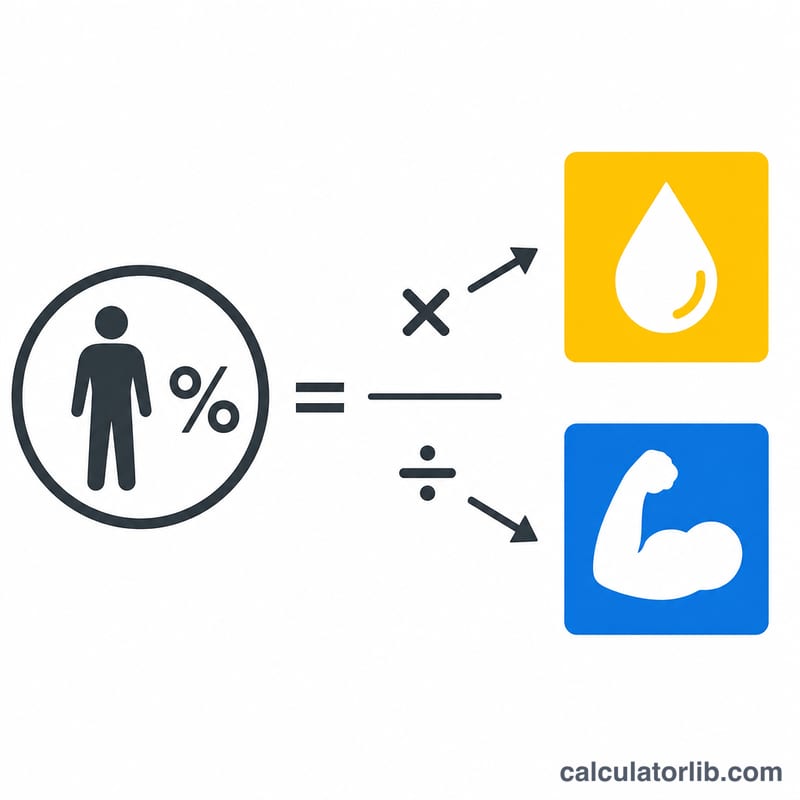
The math is straightforward. Fat mass equals your weight multiplied by your body fat percentage divided by 100. Fat-free mass is simply your weight minus that fat mass:
$$\text{Fat Mass} = \text{Weight} \times \frac{\text{BF\%}}{100}$$$$\text{Fat-Free Mass} = \text{Weight} - \text{Fat Mass}$$Because both outputs are derived directly from your two inputs, the calculation is exact — there are no population assumptions or correction factors.
Worked Example
Suppose you weigh 80 kg with 20% body fat. Fat mass = \(80 \times 20 \div 100 = \textbf{16 kg}\). Fat-free mass = \(80 - 16 = \textbf{64 kg}\). So roughly two-thirds of your body weight is lean tissue. If you later weigh 78 kg at 17% body fat, your fat mass drops to 13.26 kg while fat-free mass rises to 64.74 kg — proof you lost fat and held onto muscle.
Body Fat Percentage Categories
Body fat percentage is a more meaningful indicator of body composition than scale weight alone. The table below shows the body fat percentage categories published by the American Council on Exercise (ACE), which are widely referenced alongside ACSM guidance. Healthy ranges differ between sexes because women carry more essential fat for hormonal and reproductive function.
| Category | Women | Men |
|---|---|---|
| Essential fat | 10–13% | 2–5% |
| Athletes | 14–20% | 6–13% |
| Fitness | 21–24% | 14–17% |
| Average (acceptable) | 25–31% | 18–24% |
| Obese | 32% and higher | 25% and higher |
For example, a 70 kg woman at 25% body fat carries a fat mass of 17.5 kg and the remaining 52.5 kg is fat-free mass. These cut-offs are general references and may not perfectly fit every individual, particularly very muscular athletes or older adults.
Key Terms Explained
- Fat Mass
- The total weight of all adipose (fat) tissue in the body, calculated as weight multiplied by body fat percentage divided by 100. It includes both essential and storage fat.
- Fat-Free Mass (FFM)
- Everything in the body that is not fat — muscle, bone, organs, connective tissue and body water. It is found by subtracting fat mass from total body weight.
- Lean Mass
- Often used interchangeably with fat-free mass. Strictly speaking, lean body mass includes the small amount of essential fat within organs and the central nervous system, but in everyday use it refers to non-fat body weight.
- Body Fat Percentage (BF%)
- The proportion of your total body weight that is fat, expressed as a percentage. It is the key input for converting body weight into fat mass and fat-free mass.
- Essential Fat
- The minimum fat the body requires for normal physiological function, including hormone regulation and organ protection. It is roughly 2–5% of body weight in men and 10–13% in women.
- DEXA (DXA)
- Dual-energy X-ray absorptiometry, a clinical scan that measures bone, fat and lean tissue separately. It is considered one of the most accurate practical methods for assessing body composition.
- BIA
- Bioelectrical impedance analysis, a method used by many smart scales and handheld devices that estimates body fat by sending a small electrical current through the body. It is convenient but more sensitive to hydration and timing than DEXA.
FAQ
Is fat-free mass the same as muscle mass? No. Fat-free mass includes muscle, bone, organs, connective tissue and body water. Muscle is a large part of it but not all of it.
What is a healthy body fat percentage? General fitness ranges are roughly 10–20% for men and 18–28% for women, but ideal values vary by age, sex and goals.
Does the unit affect accuracy? No. The percentages stay the same regardless of unit, so your fat mass and fat-free mass are reported in whichever unit you entered.