
What This Calculator Does
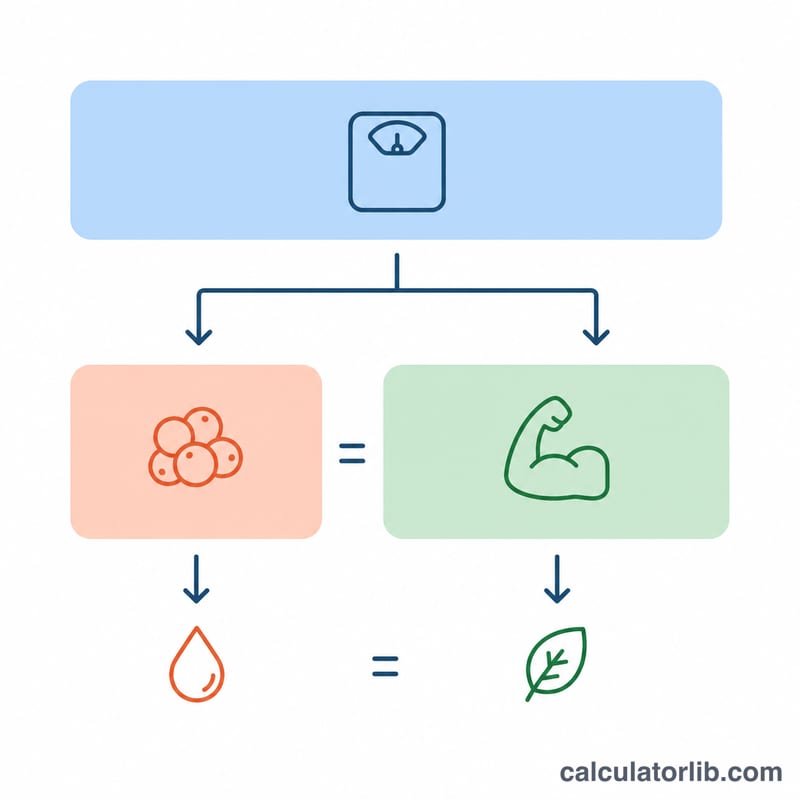
This tool splits your total body weight into two parts: fat mass and lean body mass (LBM). If you know your body fat percentage — from a smart scale, DEXA scan, calipers, or a bioimpedance device — this calculator tells you exactly how many kilograms or pounds of that weight are fat and how much is fat-free tissue such as muscle, bone, organs and water.
How to Use It
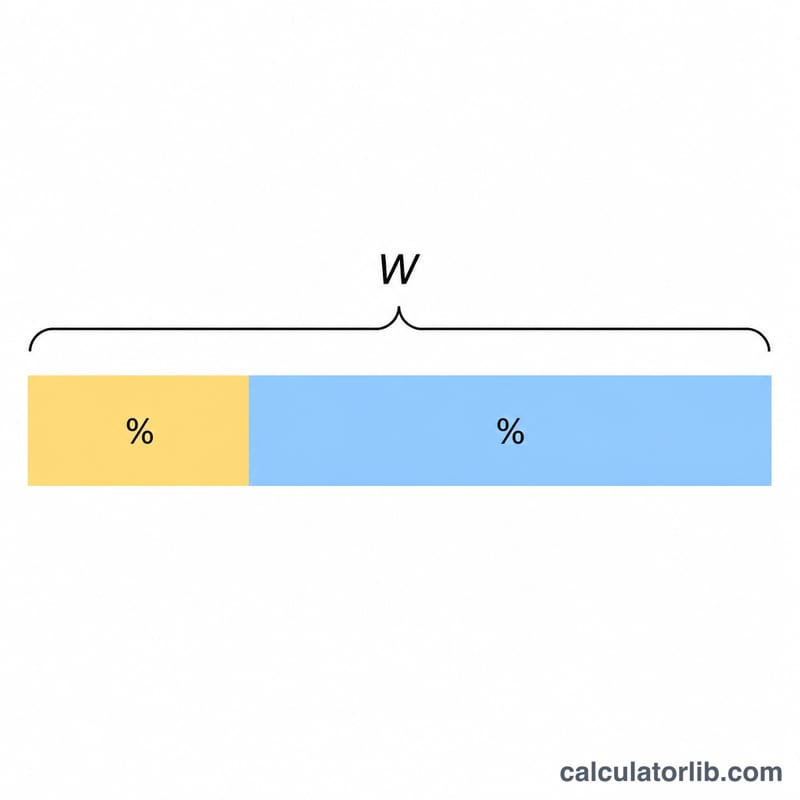
Enter your current body weight and your measured body fat percentage. The units are flexible: enter weight in kilograms and your results are in kilograms; enter pounds and your results are in pounds. Press calculate to see your lean and fat mass instantly. Tracking these numbers over time is far more useful than tracking scale weight alone, because it reveals whether you are losing fat, losing muscle, or both.
The Formula Explained
The math is direct. Fat mass is your weight multiplied by your body fat fraction:
$$\text{Fat Mass} = \text{Weight} \times \frac{\text{BF\%}}{100}$$
Lean mass is simply everything left over:
$$\text{Lean Mass} = \text{Weight} - \text{Fat Mass} = \text{Weight} \times \left(1 - \frac{\text{BF\%}}{100}\right)$$
Worked Example
Suppose you weigh 80 kg with 20% body fat. Fat mass \(= 80 \times 20 \div 100 =\) 16 kg. Lean mass \(= 80 - 16 =\) 64 kg. So 64 kg of your body is fat-free tissue, which is the figure you generally want to maintain or grow while dieting.
FAQ
What is a healthy body fat percentage? For men, roughly 10–20% is typical and healthy; for women, 18–28%. Athletes are often lower. Essential fat sits around 3% (men) and 12% (women).
Why track lean mass instead of just weight? Losing scale weight can mean losing muscle, which slows metabolism. Watching lean mass helps confirm you're losing fat, not muscle.
Is this accurate? The calculation itself is exact. Accuracy depends entirely on the precision of your body fat percentage measurement — DEXA and hydrostatic weighing are the gold standards.