
What Is the Katch-McArdle BMR Calculator?
The Katch-McArdle equation estimates your Basal Metabolic Rate (BMR) — the number of calories your body burns at complete rest to keep vital functions running. Unlike the Harris-Benedict or Mifflin-St Jeor formulas, which rely on height, weight, age and sex, the Katch-McArdle formula uses your lean body mass. Because muscle is the main driver of resting energy expenditure, this approach can be more accurate for lean, muscular, or very athletic individuals who know their body fat percentage.
How to Use It
Enter your total body weight in kilograms and your estimated body fat percentage (from a body fat scale, calipers, or a DEXA scan). The calculator first converts these into your lean body mass, then applies the Katch-McArdle equation to produce your BMR in calories per day.
The Formula Explained
First, lean body mass (LBM) is calculated as \(\text{LBM} = \text{weight} \times \left(1 - \frac{\text{bodyfat\%}}{100}\right)\). Then BMR is found with \(\text{BMR} = 370 + 21.6 \times \text{LBM}\), where LBM is in kilograms. The constant 370 represents baseline energy use independent of muscle, while 21.6 calories is the additional resting cost per kilogram of lean tissue.
$$\text{BMR} = 370 + 21.6 \times \text{Weight (kg)} \times \left(1 - \frac{\text{Body Fat (\%)}}{100}\right)$$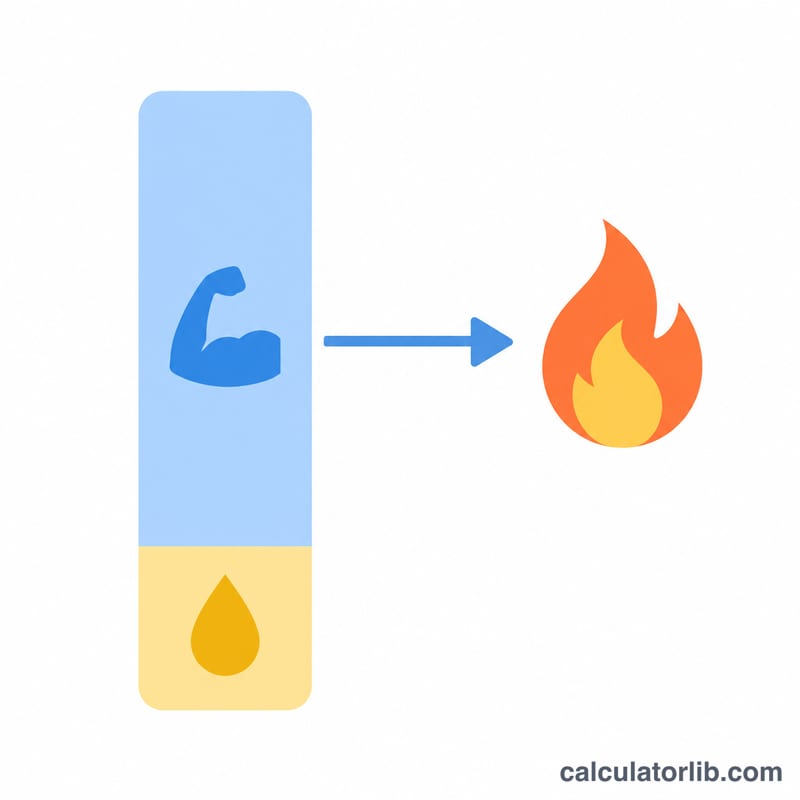
Worked Example
Suppose you weigh 80 kg with 20% body fat. Your lean body mass is \(80 \times (1 - 0.20) = 64\) kg. Your BMR is:
$$\text{BMR} = 370 + 21.6 \times 64 = 370 + 1382.4 = 1752.4 \text{ calories/day}$$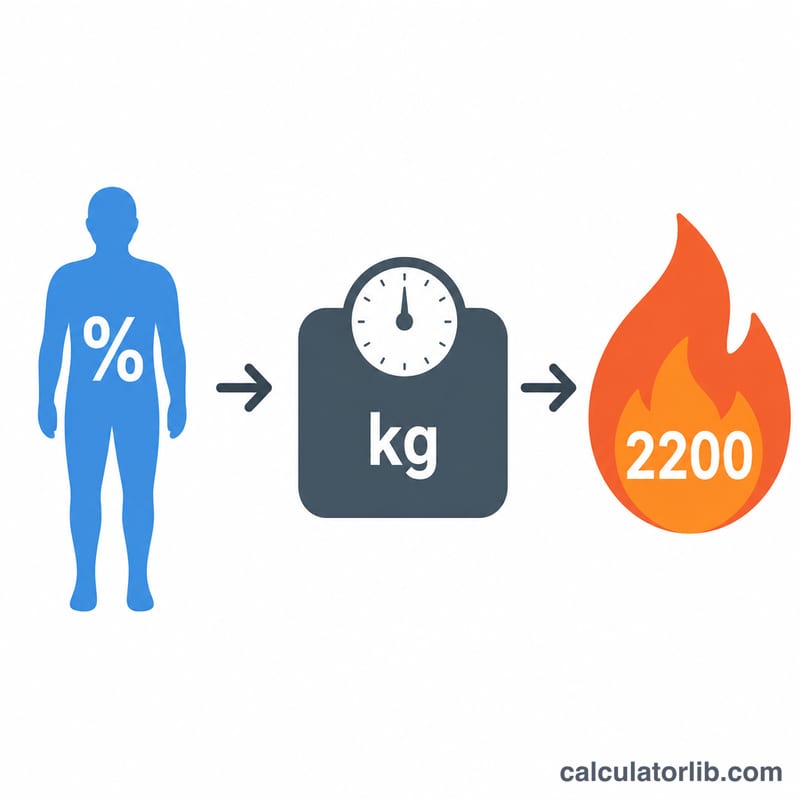
FAQ
Is Katch-McArdle better than Mifflin-St Jeor? It is often more accurate for people with low body fat or high muscle mass, but it requires a reliable body fat measurement.
How do I find my total daily calories? Multiply your BMR by an activity factor (1.2 sedentary up to ~1.9 very active) to estimate TDEE.
What if I don't know my body fat? Use a measured value if possible; estimates from generic charts will reduce accuracy. Consider the Mifflin-St Jeor formula instead.