
What This Calculator Does
This tool estimates the total amount of weight a person should expect to gain over a full single (one baby) pregnancy, based on their pre-pregnancy Body Mass Index (BMI). It uses the widely cited 2009 Institute of Medicine (IOM, now the National Academy of Medicine) guidelines. These are general recommendations — always confirm your personal target with your doctor or midwife, especially for twins, multiples, or specific health conditions.
How to Use It
Enter your weight as it was before you became pregnant, in kilograms, and your height in centimetres. The calculator first works out your pre-pregnancy BMI, classifies it into one of four categories, and then shows the recommended total weight-gain range for the entire pregnancy.
The Formula Explained
BMI is weight in kilograms divided by height in metres squared. The recommended gain depends on the resulting category: underweight (BMI under 18.5) → 12.5–18 kg; normal weight (18.5–24.9) → 11.5–16 kg; overweight (25–29.9) → 7–11.5 kg; obese (30 and above) → 5–9 kg.
$$\text{BMI} = \frac{\text{Weight (kg)}}{\left(\dfrac{\text{Height (cm)}}{100}\right)^{2}} \;\Rightarrow\; \text{Gain} = \begin{cases} 12.5 - 18.0\,\text{kg} & \text{BMI} < 18.5 \\ 11.5 - 16.0\,\text{kg} & 18.5 \le \text{BMI} < 25 \\ 7.0 - 11.5\,\text{kg} & 25 \le \text{BMI} < 30 \\ 5.0 - 9.0\,\text{kg} & \text{BMI} \ge 30 \end{cases}$$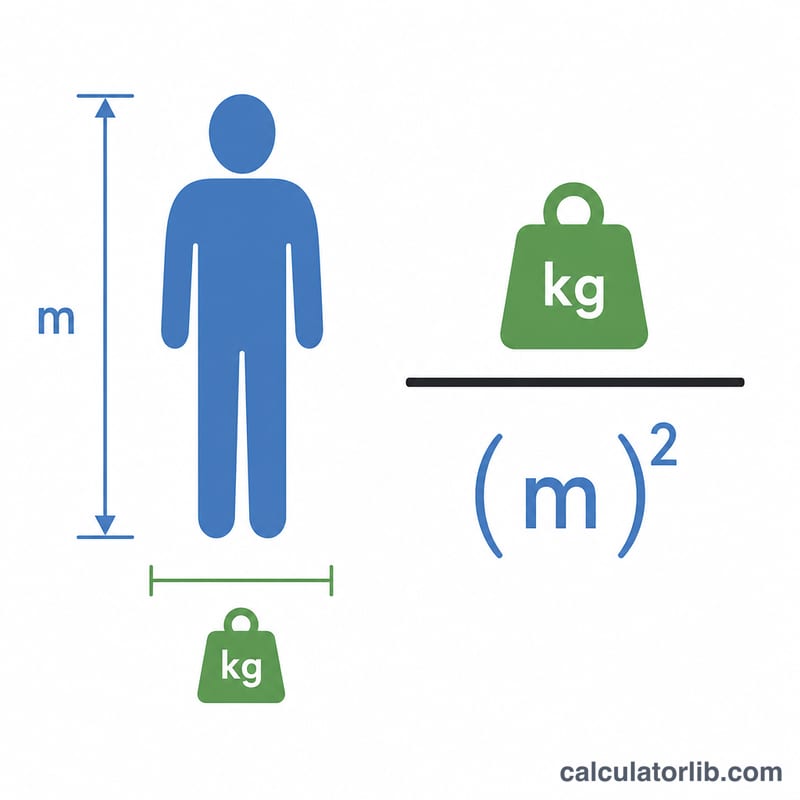
Worked Example
A person weighing 60 kg and 165 cm tall has a height of 1.65 m.
$$\text{BMI} = 60 \div (1.65 \times 1.65) = 60 \div 2.7225 \approx 22.04\ \text{kg/m}^2$$That falls in the normal-weight band, so the recommended total gain is 11.5–16 kg.
FAQ
Is this for twins? No — these ranges are for a single baby. Twin pregnancies have higher recommended ranges.
Which weight should I enter? Use your weight before pregnancy, not your current weight.
Are these strict limits? No, they are guideline ranges. Your healthcare provider may adjust them for your situation.