
What is gestational age by LMP?
Gestational age (GA) is the standard way pregnancy is dated. It measures how far along a pregnancy is, counting from the first day of the woman's last menstrual period (LMP) rather than from conception. Because ovulation and conception are difficult to pin down exactly, the LMP method gives a consistent, widely used reference. A full-term pregnancy is about 40 weeks of gestational age.
How to use this calculator
Enter the date of the first day of the last menstrual period and the date you want to measure to (the calculator defaults today's date for you). It returns the gestational age expressed as completed weeks plus extra days — for example "12w 3d" — along with the total number of days elapsed and a decimal-weeks figure used in many clinical charts.
The formula explained
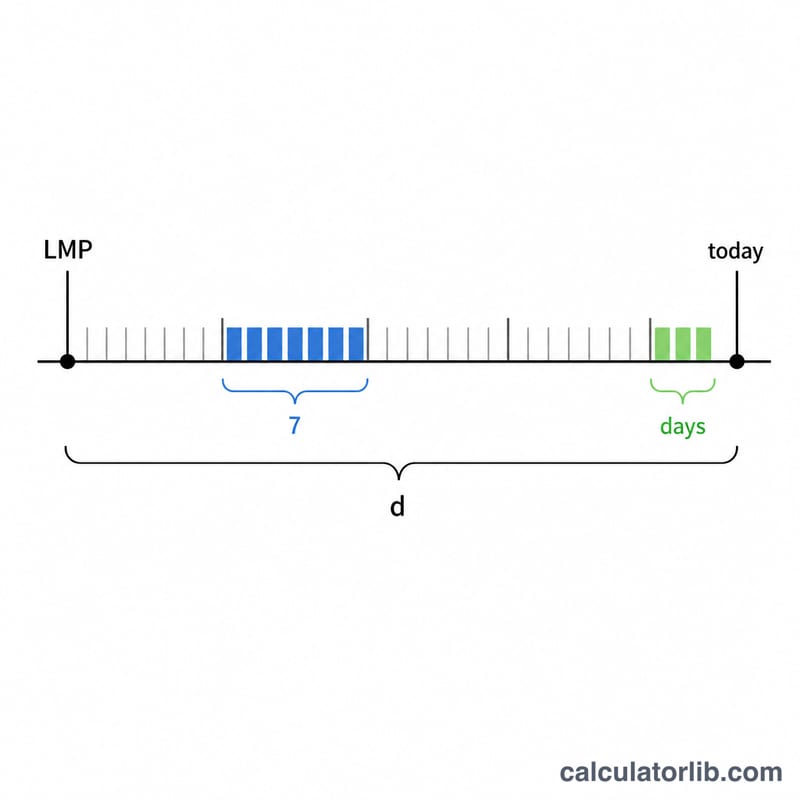
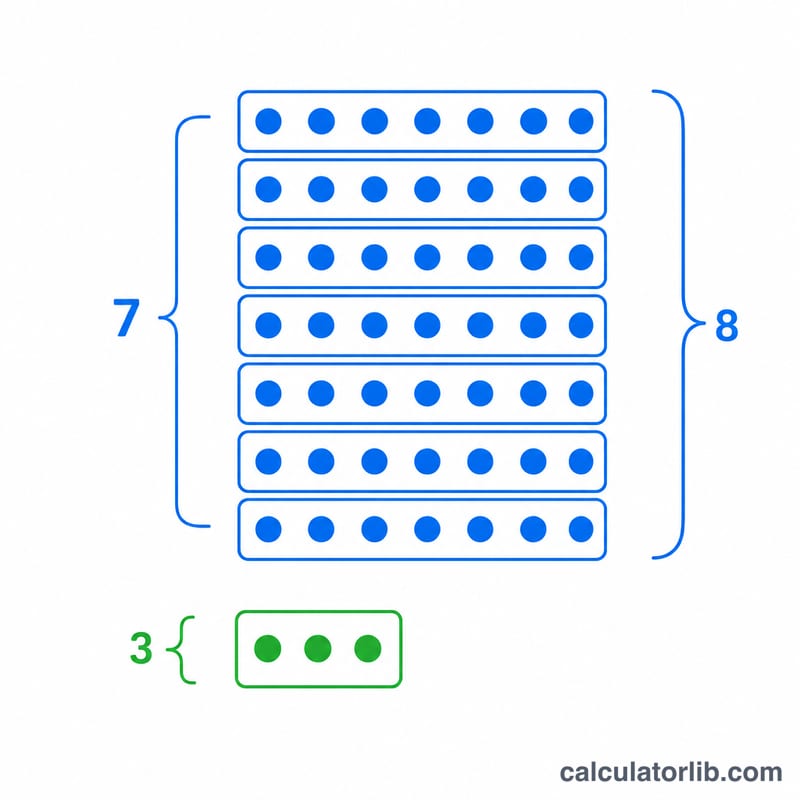
First the number of days between the two dates is computed: \(d = \text{today} - \text{LMP}\). The completed weeks are the whole-number part of \(d\) divided by 7, and the remaining days are the remainder:
$$\text{GA} = \left\lfloor \frac{d}{7} \right\rfloor \text{ weeks} + (d \bmod 7)\text{ days}$$The decimal-weeks value is simply \(d / 7\).
Worked example
Suppose the LMP was 1 January 2024 and today is 1 April 2024. That is 91 days later. \(91 \div 7 = 13\) exactly, so the gestational age is 13 weeks 0 days, or 13.0 decimal weeks.
FAQ
Is gestational age the same as fetal age? No. Fetal (conceptional) age starts at conception and is roughly two weeks less than gestational age based on LMP.
What if my cycle is irregular? The LMP method assumes a typical 28-day cycle with ovulation around day 14. If your cycle differs significantly, an ultrasound dating estimate may be more accurate.
Can I use this to find a due date? The estimated due date is reached at 40 weeks of gestational age; this tool focuses on current age, but 40 weeks from the LMP gives the classic Naegele due date.