What this calculator does
An early ultrasound is the most accurate way to date a pregnancy. This tool takes the date of the scan and the gestational age (GA) the sonographer measured at that scan — for example "8 weeks 3 days" — and works out the estimated due date (EDD) plus how many weeks and days pregnant you are today. Dating is based on the standard 280-day (40-week) full-term gestation.
How to use it
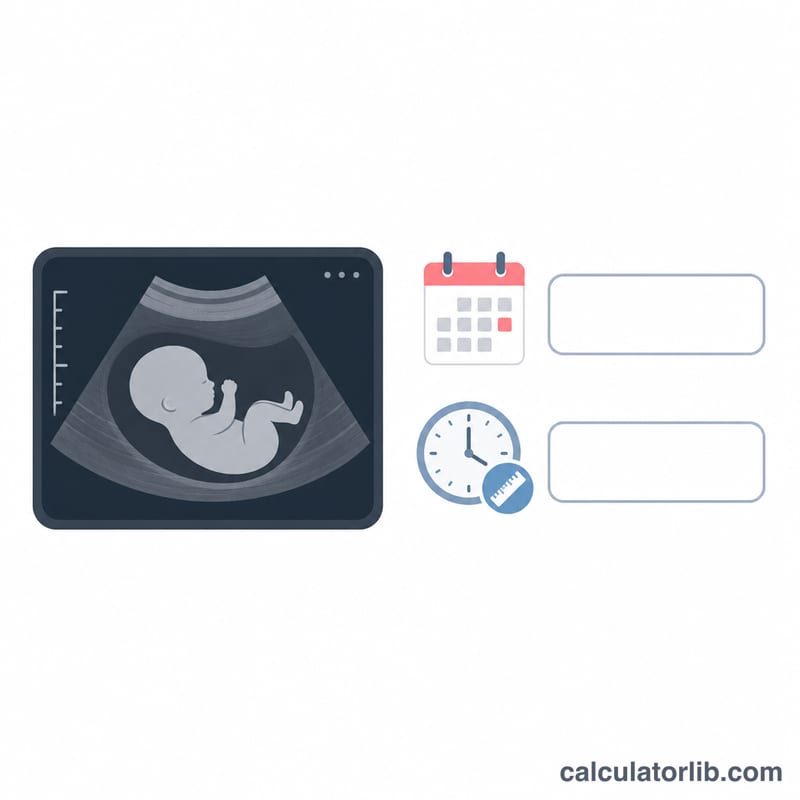
Enter the scan date, the gestational age recorded at the scan (weeks and days), and today's date. The calculator returns the EDD as a calendar date and your current gestational age in weeks + days.
The formula
First the scan GA is converted to days: \(\text{GA}_{\text{scan}} = \text{weeks} \times 7 + \text{days}\). The days still needed to reach a full 280-day term is \(280 - \text{GA}_{\text{scan}}\), and adding that to the scan date gives the EDD. Current gestational age is the scan GA plus the number of days elapsed between the scan date and today.
$$\text{EDD} = \text{Scan Date} + \left(280 - g\right)\text{ days}$$$$\text{where}\quad \left\{ \begin{aligned} g &= 7 \times \text{GA Weeks} + \text{GA Days} \\ \text{Scan Date} &= \left(\text{Y},\ \text{M},\ \text{D}\right) \end{aligned} \right.$$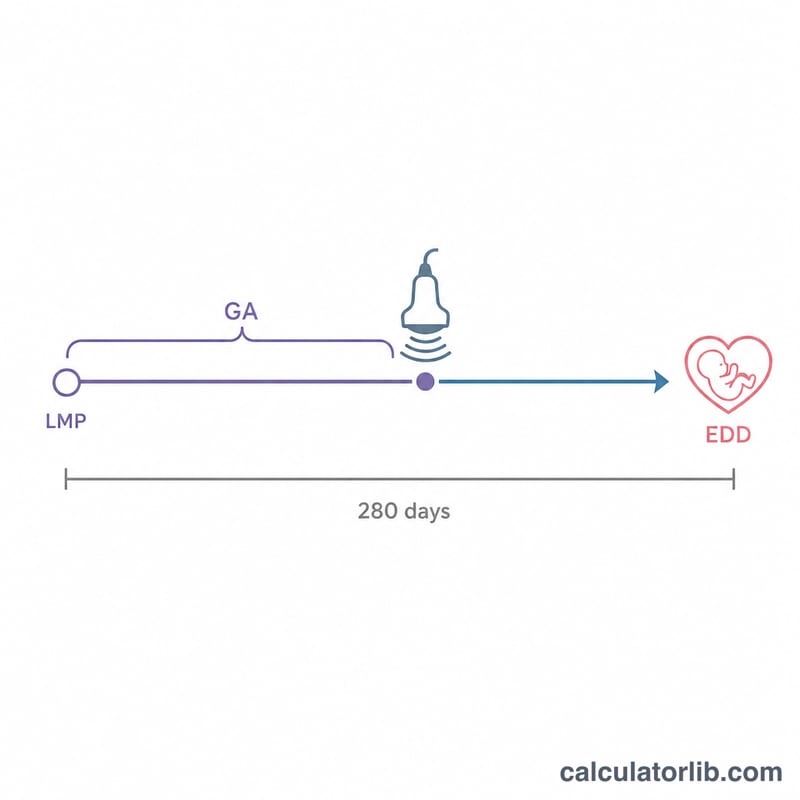
Worked example
Scan on 2024-01-15 measuring 8 weeks 3 days.
$$\text{GA}_{\text{scan}} = 8 \times 7 + 3 = 59\text{ days}$$$$\text{Days to term} = 280 - 59 = 221$$Adding 221 days to 2024-01-15 gives an EDD of 2024-08-23. If today is the scan date, current GA is still 8w 3d (59 days).
Interpreting Your Gestational Age and EDD
The calculator counts forward from your scan date: \(\text{EDD} = \text{Scan Date} + (280 - g)\) days, where \(g = 7 \times \text{weeks} + \text{days}\) is the gestational age (GA) measured at the scan. It assumes a full pregnancy of 280 days (40w0d).
The EDD is a midpoint estimate, not a deadline. Only about 4-5% of babies are born on the EDD. Normal, healthy births are spread over several weeks around it.
The American College of Obstetricians and Gynecologists (ACOG) defines these term categories:
- Early term: 37w0d to 38w6d
- Full term: 39w0d to 40w6d
- Late term: 41w0d to 41w6d
- Post-term: 42w0d and beyond
Trimester boundaries commonly used: first trimester up to 13w6d, second trimester 14w0d to 27w6d, third trimester from 28w0d onward. Some sources draw these lines slightly differently.
Ultrasound measurements taken early in pregnancy (especially in the first trimester) are generally considered more accurate for dating than the last menstrual period (LMP), because early embryos grow at very similar rates. Whether to keep an LMP-based date or change it to the ultrasound date is a decision for your clinician, who uses your scan details and guidelines. The earlier the scan, the narrower the margin of error; later scans are less precise for dating.
This is general information, not medical advice. Always confirm your dates with your healthcare provider.
Gestational Age Reference: Trimesters and Term Definitions
Day counts are total days since the start of GA (0w0d = day 0), using \(\text{days} = 7 \times \text{weeks} + \text{days}\). Term categories follow ACOG; preterm (<37 weeks) matches the WHO definition. Trimester limits vary slightly between sources.
| Milestone | Range (weeks+days) | Range (total days) |
|---|---|---|
| First trimester | 0w0d to 13w6d | 0 to 97 |
| Second trimester | 14w0d to 27w6d | 98 to 195 |
| Third trimester | 28w0d until birth | 196 onward |
| Preterm | before 37w0d | fewer than 259 |
| Early term | 37w0d to 38w6d | 259 to 272 |
| Full term | 39w0d to 40w6d | 273 to 286 |
| Late term | 41w0d to 41w6d | 287 to 293 |
| Post-term | 42w0d and beyond | 294 or more |
| EDD reference point | 40w0d | 280 |
Scenario Comparison: Different Scan Dates and Gestational Ages
Each row uses \(\text{EDD} = \text{Scan Date} + (280 - g)\) days. The last column shows the GA 30 days after the scan (\(g + 30\)). Scenarios 3 and 4 cross into 2028, a leap year (February has 29 days), which is accounted for in the day counts.
| # | Scan date | GA at scan | g (days) | Days to term (280 − g) | EDD | GA 30 days after scan |
|---|---|---|---|---|---|---|
| 1 | 2025-03-03 | 6w0d | 42 | 238 | 2025-10-27 | 10w2d (72 days) on 2025-04-02 |
| 2 | 2025-06-10 | 8w3d | 59 | 221 | 2026-01-17 | 12w5d (89 days) on 2025-07-10 |
| 3 | 2027-11-15 | 12w0d | 84 | 196 | 2028-05-29 | 16w2d (114 days) on 2027-12-15 |
| 4 | 2028-02-29 | 20w0d | 140 | 140 | 2028-07-18 | 24w2d (170 days) on 2028-03-30 |
Check of scenario 3 (leap year)
November 15, 2027 is day 319 of 2027 (304 days through October + 15). Adding 196 days gives \(319 + 196 = 515\). Subtracting the 365 days of 2027 leaves day 150 of 2028. In a leap year, January to April total 121 days, so day 150 is \(150 - 121 = 29\) May: May 29, 2028.
Check of scenario 4
February 29, 2028 is day 60 of 2028. Adding 140 days gives day 200. January to June total 182 days in a leap year, so day 200 is July \(200 - 182 = 18\): July 18, 2028.
Earlier scans generally give a more reliable EDD than later ones. These are arithmetic examples only; your clinician decides which dating to use.
FAQ
Is ultrasound dating better than LMP dating? Yes — first-trimester ultrasound is generally more accurate than dating from the last menstrual period, especially with irregular cycles.
What is the 280-day rule? A full-term pregnancy is conventionally counted as 280 days (40 weeks) of gestational age.
Will my real due date change? Clinicians may adjust dating after later scans; this calculator reflects the single scan you enter and is for information only, not medical advice.