
What is the Chronological Age Calculator?
The Chronological Age Calculator measures the exact amount of time that has elapsed between a person's date of birth and a chosen "as-of" date. Instead of a rough year count, it returns a precise breakdown in years, months and days, and also expresses the same age as total months, total weeks and total days. This is the standard way ages are reported on school enrollment forms, developmental assessments, medical records and psychological test scoring sheets.
How to use it
Enter the birthdate using the year, month and day fields. Then enter the as-of date — leave it as today's date to get the current age, or set it to a past or future date (for example a test date or an enrollment deadline). The calculator subtracts one date from the other and shows the precise age. All fields use plain numeric inputs: month 1–12 and day 1–31.
The formula explained
The age is found by subtracting each component of the birthdate from the as-of date: days minus days, months minus months, years minus years. When the day difference is negative, the calculator borrows the number of days in the previous month and reduces the month count by one. When the month difference is then negative, it borrows 12 months and reduces the year count by one. This borrowing logic is exactly how calendar age is computed by hand and matches official age-at-test conventions.
$$\begin{gathered} \text{Age} = (Y,\; M,\; D) \\[1.5em] \text{where}\quad \left\{ \begin{aligned} Y &= \text{As-Of Year} - \text{Birth Year} \\ M &= \text{As-Of Month} - \text{Birth Month} \\ D &= \text{As-Of Day} - \text{Birth Day} \end{aligned} \right. \end{gathered}$$The same duration can also be expressed as totals:
$$\begin{gathered} \text{Total Days} = \frac{\text{AsOfDate} - \text{BirthDate}}{86400000\ \text{ms/day}} \\[1em] \text{Total Weeks} = \frac{\text{Total Days}}{7} \qquad \text{Total Months} = 12\,Y + M \end{gathered}$$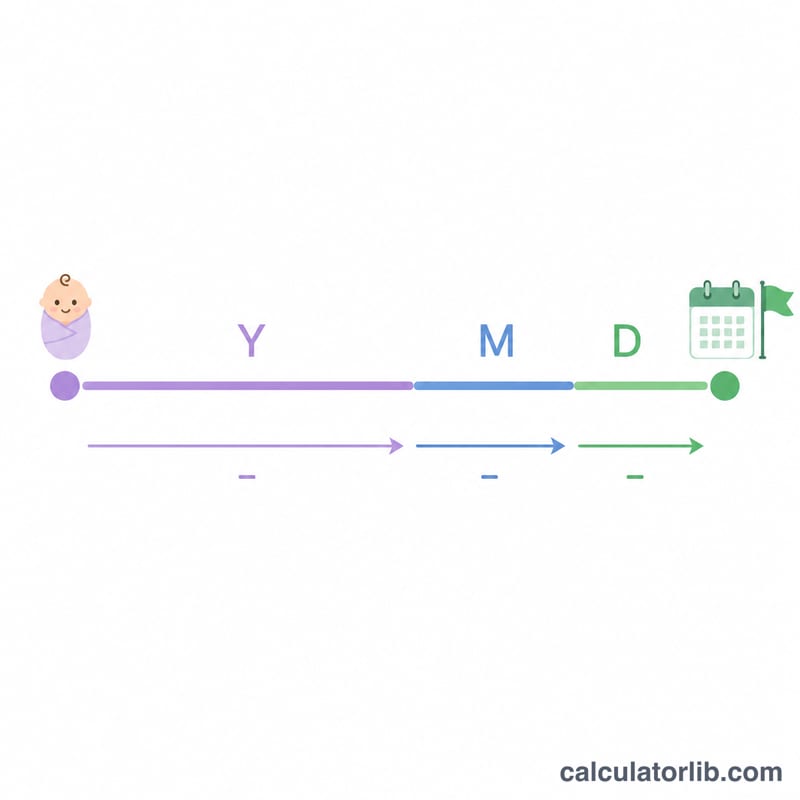
Worked example
Birthdate 15 March 2010, as-of date 10 June 2023. Days: \(10 - 15 = -5\), so borrow May's 31 days → 26 days, months become \(6 - 3 - 1 = 2\). Years: \(2023 - 2010 = 13\). Result: 13 years, 2 months, 26 days.
FAQ
Does it count the day of birth? Age increments on the birthday itself, so someone born on 1 Jan turns 1 year old on the following 1 Jan.
Does it handle leap years? Yes — the day-borrowing step uses the actual number of days in the relevant month, and the total-days figure is computed from real calendar timestamps.
Can the as-of date be in the future? Yes, you can project a future age by setting any as-of date later than the birthdate.