What is the Day of the Week Calculator?
This tool tells you which day of the week any calendar date falls on — past, present or future. Whether you want to know what day you were born, when a historical event happened, or which weekday a future deadline lands on, enter the year, month and day and get the answer instantly. The calculation uses Zeller's congruence on the proleptic Gregorian calendar.
How to use it
Choose the year, pick the month from the dropdown, and enter the day of the month. Press calculate and the result box shows the weekday name. The table also reports the raw Zeller index (\(h\)) and the ISO weekday number (1 = Monday … 7 = Sunday) for programmers and the curious.
The formula explained
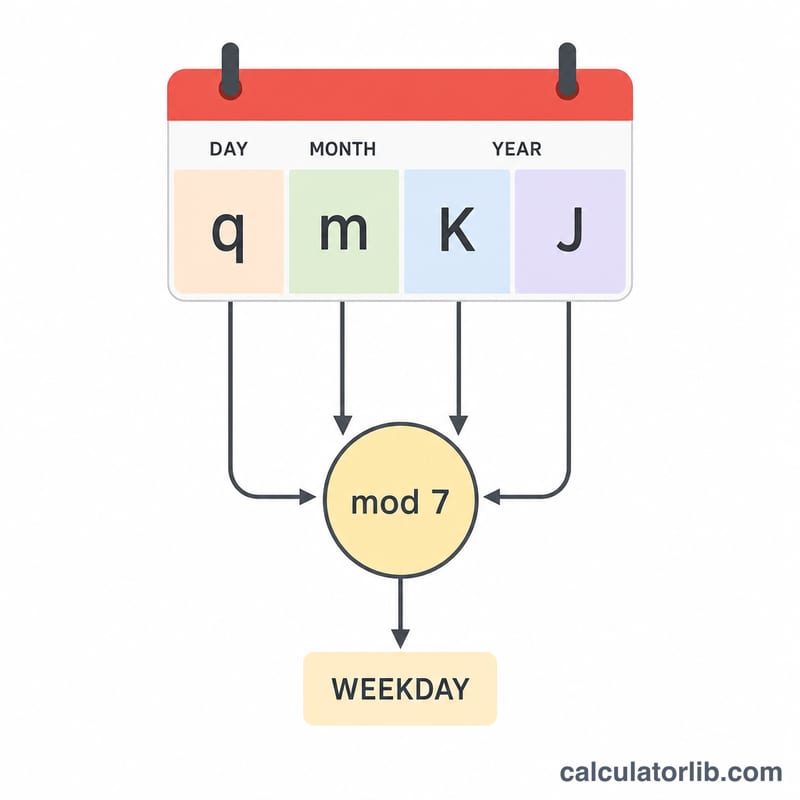
Zeller's congruence computes the weekday with pure arithmetic — no lookup tables. January and February are treated as months 13 and 14 of the previous year, which keeps leap-day handling simple. With \(q = \text{day}\), \(m = \text{adjusted month}\), \(K = Y \bmod 100\) and \(J\) = the century (year ÷ 100), the formula is:
$$h = \left( q + \left\lfloor \frac{13(m+1)}{5} \right\rfloor + K + \left\lfloor \frac{K}{4} \right\rfloor + \left\lfloor \frac{J}{4} \right\rfloor + 5J \right) \bmod 7$$Here \(h = 0\) is Saturday, \(1\) is Sunday, and so on up to \(6\) = Friday.
Worked example
For 13 March 2020: \(q = 13\), \(m = 3\), \(y = 2020\), so \(K = 20\) and \(J = 20\). Then $$h = \left( 13 + \left\lfloor \frac{52}{5} \right\rfloor + 20 + \left\lfloor \frac{20}{4} \right\rfloor + \left\lfloor \frac{20}{4} \right\rfloor + 100 \right) \bmod 7 = (13 + 10 + 20 + 5 + 5 + 100) \bmod 7 = 153 \bmod 7 = 6 = \text{Friday}.$$ And 13 March 2020 was indeed a Friday.
Zeller Index to Weekday Lookup Table
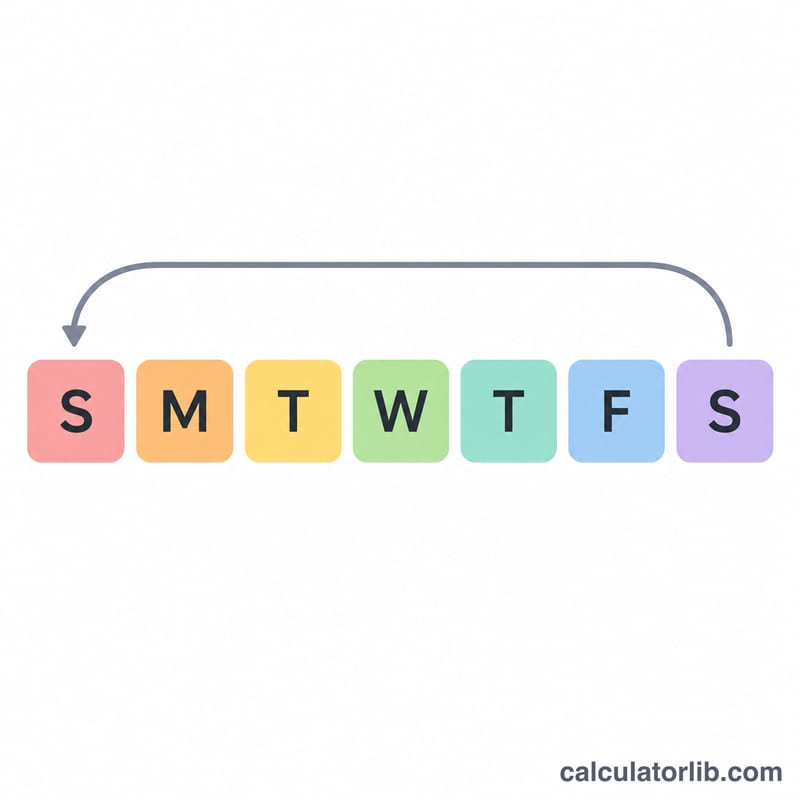
Zeller's congruence (in the Gregorian-calendar form used here) returns a value \(h\) from 0 to 6. In this convention \(h = 0\) is Saturday, not Sunday. The table also gives the matching ISO 8601 weekday number, where Monday = 1 and Sunday = 7.
| h (Zeller index) | Weekday | ISO weekday number |
|---|---|---|
| 0 | Saturday | 6 |
| 1 | Sunday | 7 |
| 2 | Monday | 1 |
| 3 | Tuesday | 2 |
| 4 | Wednesday | 3 |
| 5 | Thursday | 4 |
| 6 | Friday | 5 |
Month adjustment
Zeller's method counts January and February as months 13 and 14 of the previous year. March to December keep their normal numbers 3 to 12.
| Calendar month | Value of m | Year used |
|---|---|---|
| January | 13 | Year − 1 |
| February | 14 | Year − 1 |
| March to December | 3 to 12 | Unchanged |
How to Find the Weekday by Hand
This procedure uses the Gregorian calendar, which is the civil calendar in most countries today. It is not valid for dates before a region adopted it.
- Adjust January and February. If the month is January or February, add 12 to the month (giving 13 or 14) and subtract 1 from the year. Otherwise leave both unchanged.
- Split the year. Using the adjusted year \(Y\), compute \(K = Y \bmod 100\) and \(J = \lfloor Y/100 \rfloor\).
- Compute each term. Find \(q\) (the day of the month), \(\lfloor 13(m+1)/5 \rfloor\), \(K\), \(\lfloor K/4 \rfloor\), \(\lfloor J/4 \rfloor\) and \(5J\).
- Sum and reduce. Add the terms and take the result mod 7:
$$h = \left( q + \left\lfloor \frac{13(m+1)}{5} \right\rfloor + K + \left\lfloor \frac{K}{4} \right\rfloor + \left\lfloor \frac{J}{4} \right\rfloor + 5J \right) \bmod 7$$ - Map h to the weekday. Use the lookup table above: 0 = Saturday, 1 = Sunday, 2 = Monday, 3 = Tuesday, 4 = Wednesday, 5 = Thursday, 6 = Friday.
Example with the Jan/Feb adjustment: 15 January 2021
January becomes \(m = 13\) and the year becomes 2020. So \(q = 15\), \(K = 20\) and \(J = 20\).
$$h = (15 + \lfloor 13 \cdot 14 / 5 \rfloor + 20 + \lfloor 20/4 \rfloor + \lfloor 20/4 \rfloor + 5 \cdot 20) \bmod 7$$
$$h = (15 + 36 + 20 + 5 + 5 + 100) \bmod 7 = 181 \bmod 7 = 6$$
Since \(181 = 7 \cdot 25 + 6\), we get \(h = 6\), which is Friday.
Example without adjustment: 1 March 2024
Here \(m = 3\), \(Y = 2024\), \(K = 24\), \(J = 20\) and \(q = 1\).
$$h = (1 + \lfloor 13 \cdot 4 / 5 \rfloor + 24 + 6 + 5 + 100) \bmod 7 = (1 + 10 + 24 + 6 + 5 + 100) \bmod 7 = 146 \bmod 7 = 6$$
Again \(h = 6\), so 1 March 2024 was a Friday.
Why the adjustment matters: Treating January and February as the last months of the previous year puts the leap day at the end of the counting year. That keeps the month-length pattern in the \(\lfloor 13(m+1)/5 \rfloor\) term regular. If you skip the adjustment for a January or February date, the result will usually be wrong.
FAQ
Does it work for old dates before 1582? It uses the proleptic Gregorian calendar, so for very old dates that were originally recorded in the Julian calendar the weekday may differ from the historical record.
Why is Saturday h = 0? That is simply how the classic Zeller formula is defined. The calculator converts it to a readable weekday name for you.
Can I enter any year? Yes, any year from 1 to 9999. Just make sure the day is valid for the chosen month.