
What Is the Hours Worked Calculator?
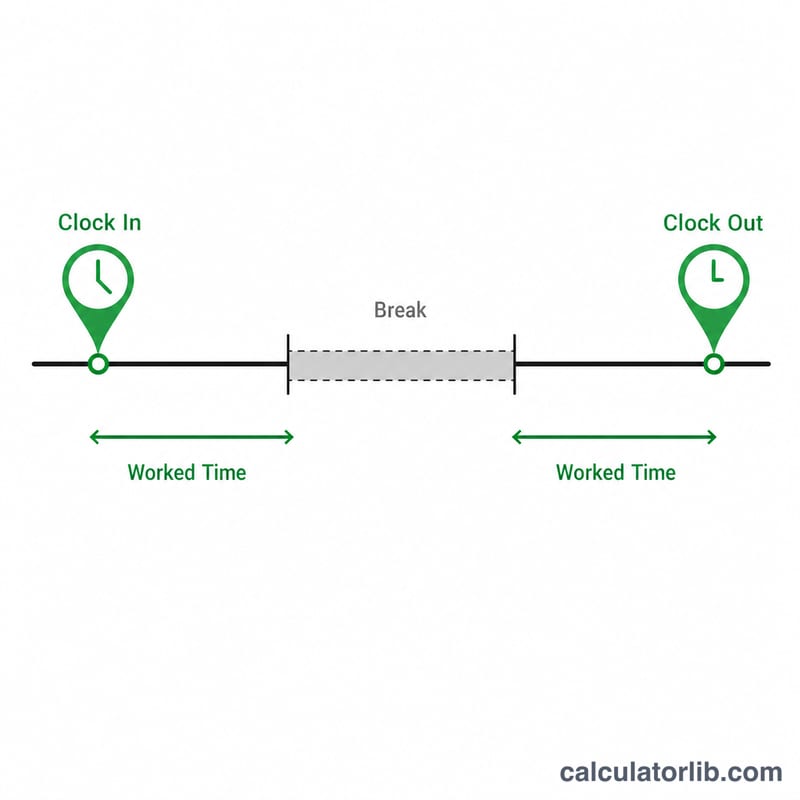
This time card calculator works out how many hours you worked in a single shift. Enter your clock in time, clock out time and any unpaid break, and it returns the total in both decimal hours (ideal for payroll) and standard hours-and-minutes format. It even handles overnight shifts that cross midnight.
How to Use It
Enter the clock in hour and minute using a 24-hour clock (for example, 1:30 PM is hour 13, minute 30). Do the same for clock out, then type the total break minutes to subtract. The result updates instantly with your net paid time.
The Formula Explained
The tool converts each time to total minutes since midnight, subtracts the start from the end, then subtracts the break: net minutes = (out − in) − break. If the clock out time is earlier than the clock in time, 24 hours (1440 minutes) is added to account for an overnight shift. Decimal hours are simply net minutes ÷ 60.
$$\begin{gathered} \text{Hours} = \frac{(E - S) - \text{Break (min)}}{60} \\[1.5em] \text{where}\quad \left\{ \begin{aligned} S &= 60\cdot\text{In Hr} + \text{In Min} \\ E &= 60\cdot\text{Out Hr} + \text{Out Min} \\ &\quad (E \mathrel{+}= 1440 \text{ if } E \le S) \end{aligned} \right. \end{gathered}$$
Worked Example
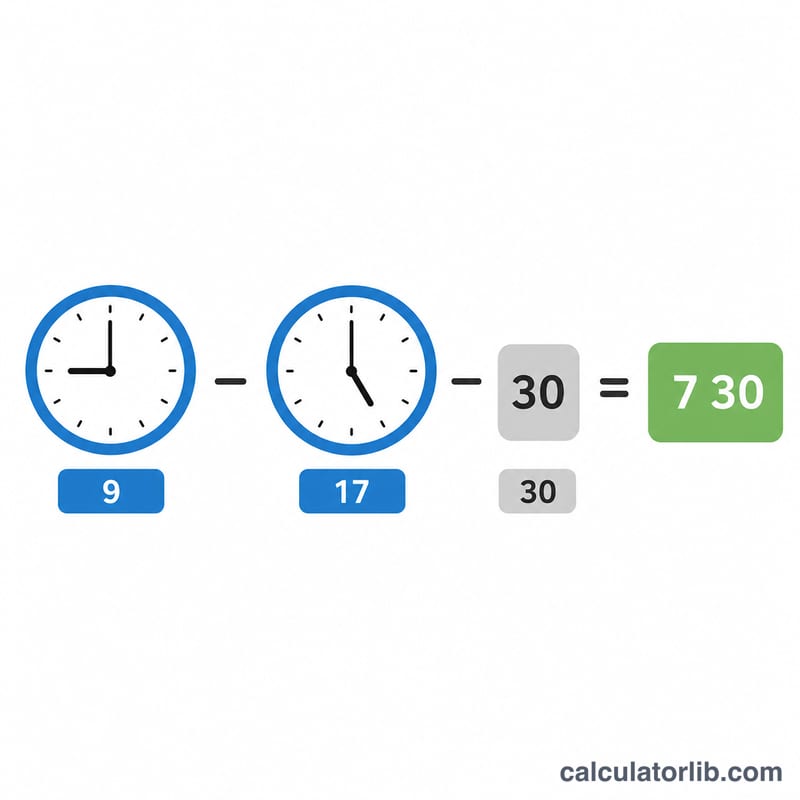
You clock in at 9:00 and clock out at 17:30 with a 30-minute break. Gross time is 17:30 − 9:00 = 8 hours 30 minutes = 510 minutes. Subtract the 30-minute break to get 480 net minutes, which is 8.00 decimal hours, or 8 h 0 min.
$$\frac{(1050 - 540) - 30}{60} = \frac{480}{60} = 8.00 \text{ h}$$
FAQ
How do I convert minutes to decimal hours? Divide the minutes by 60. For example, 15 minutes is \(15 \div 60 = 0.25\) hours.
Does it handle night shifts? Yes. If your clock out time is before your clock in time, the calculator assumes the shift crossed midnight and adds a full day.
Should I include my break? Only include unpaid break time. Enter 0 if your breaks are paid or you took none.