
What is the Age on Other Planets Calculator?
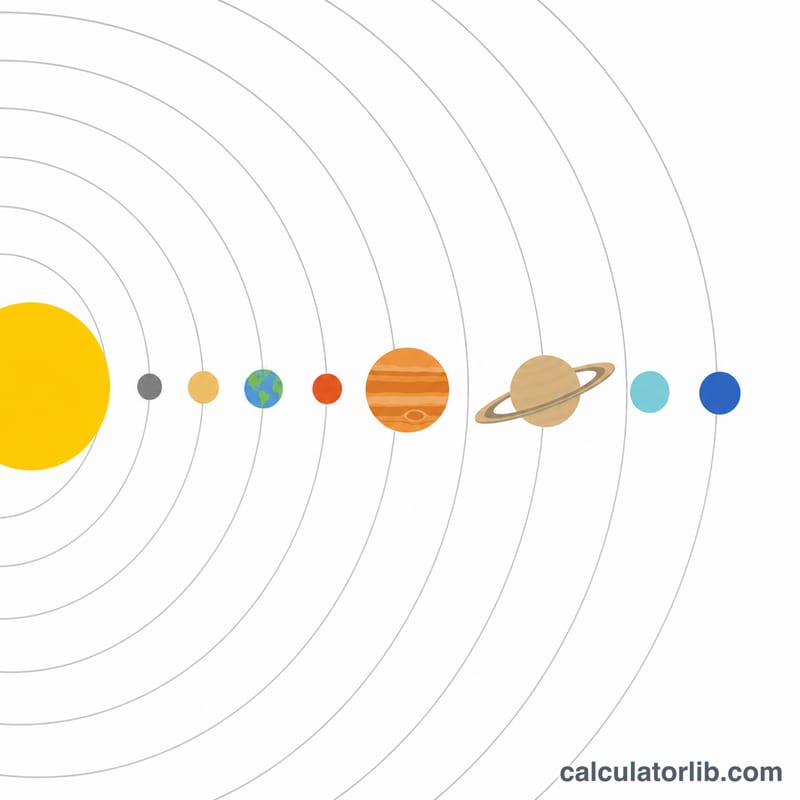
A year is simply the time a planet takes to orbit the Sun once. Because every planet travels a different path at a different speed, a "year" lasts a different amount of time on each one. This calculator converts your age in Earth years into the number of years you would have lived on Mercury, Venus, Mars, Jupiter, Saturn, Uranus and Neptune.
How to use it
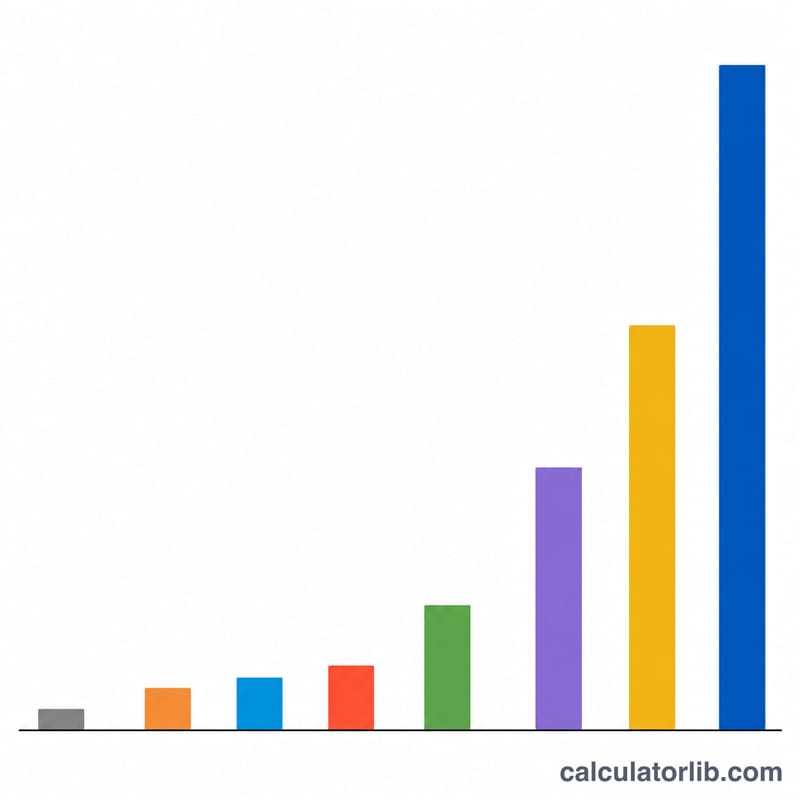
Enter your current age in Earth years and read off your age on each planet from the results table. Mercury races around the Sun in just 88 days, so your Mercury age is the largest. Distant Neptune takes almost 165 Earth years per orbit, so you would be only a fraction of a Neptune year old.
The formula explained
The math is a single division:
$$\text{Planet age} = \dfrac{\text{Earth age (years)}}{\text{orbital period (Earth years)}}$$
The orbital periods used are: Mercury \(0.2408\), Venus \(0.6152\), Mars \(1.8808\), Jupiter \(11.8626\), Saturn \(29.4475\), Uranus \(84.0168\) and Neptune \(164.7913\) Earth years.
Worked example
Suppose you are 30 Earth years old. On Mars, with an orbital period of \(1.8808\) years, your age is $$30 \div 1.8808 \approx 15.95 \text{ Mars years}.$$ On Mercury it is $$30 \div 0.2408 \approx 124.6 \text{ Mercury years},$$ while on Neptune it is only $$30 \div 164.7913 \approx 0.18 \text{ Neptune years}.$$
Orbital Periods of the Planets
The values below are the sidereal orbital periods — the time each planet takes to complete one full revolution around the Sun relative to the fixed stars. These are the constants \(T_{\text{planet}}\) used in the formula \(\text{Age}_{\text{planet}} = \frac{\text{Earth Age}}{T_{\text{planet}}}\). The Earth-days column uses 1 Earth year \(\approx 365.25\) days.
| Planet | Orbital period (Earth years) | Orbital period (Earth days, approx.) |
|---|---|---|
| Mercury | 0.2408 | 87.97 |
| Venus | 0.6152 | 224.70 |
| Earth | 1.0000 | 365.25 |
| Mars | 1.8808 | 686.98 |
| Jupiter | 11.8618 | 4332.59 |
| Saturn | 29.4571 | 10759.22 |
| Uranus | 84.0205 | 30688.5 |
| Neptune | 164.7913 | 60195 |
Note that these sidereal periods differ slightly from the "orbital year" sometimes quoted for everyday use, and they do not account for the length of a planet's day (rotation period), which is a separate quantity entirely.
FAQ
Does this account for the length of a day? No — it compares orbital periods (years), not the rotation period (a day), which differs separately.
Why is my Mercury age so high? Mercury's year is only about 88 Earth days, so you complete many more orbits in the same lifetime.
Is Pluto included? Pluto is classified as a dwarf planet, so the main eight planets are shown here.