What Is the Water Weight Calculator?
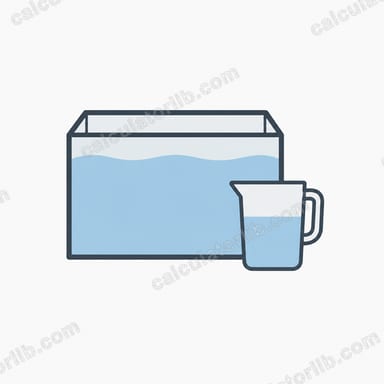
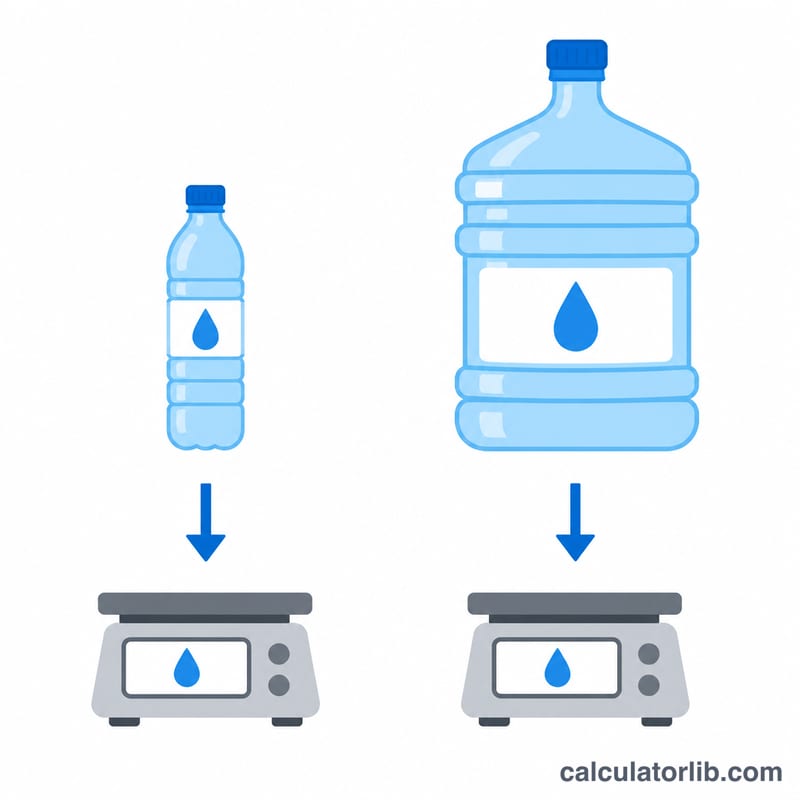
This tool tells you how much a given volume of water weighs. Because water has a well-known density — approximately 1 kilogram per liter, or about 8.345 pounds per US gallon at room temperature — you can convert any volume directly into a weight. It is handy for cooking, aquariums, fish tanks, plumbing, shipping, fitness, and science experiments.
How to Use It
Enter the volume of water and choose the unit (US gallons, liters, milliliters, or US fluid ounces). The calculator instantly returns the weight in pounds, kilograms, grams, and ounces. It first converts your volume to liters, then applies the density of water.
The Formula Explained
The core relationship is weight = volume × density. Water's density is essentially 1 kg per liter, which is why metric conversions are so clean. For imperial units, 1 US gallon equals 3.78541 liters, and 1 kg equals 2.20462 lb, giving roughly 8.345 lb per gallon.
$$\text{Weight} = \text{Volume} \times 3.785411784 \;\text{kg} \quad\left(\times\,2.20462\;\text{lb}\right)$$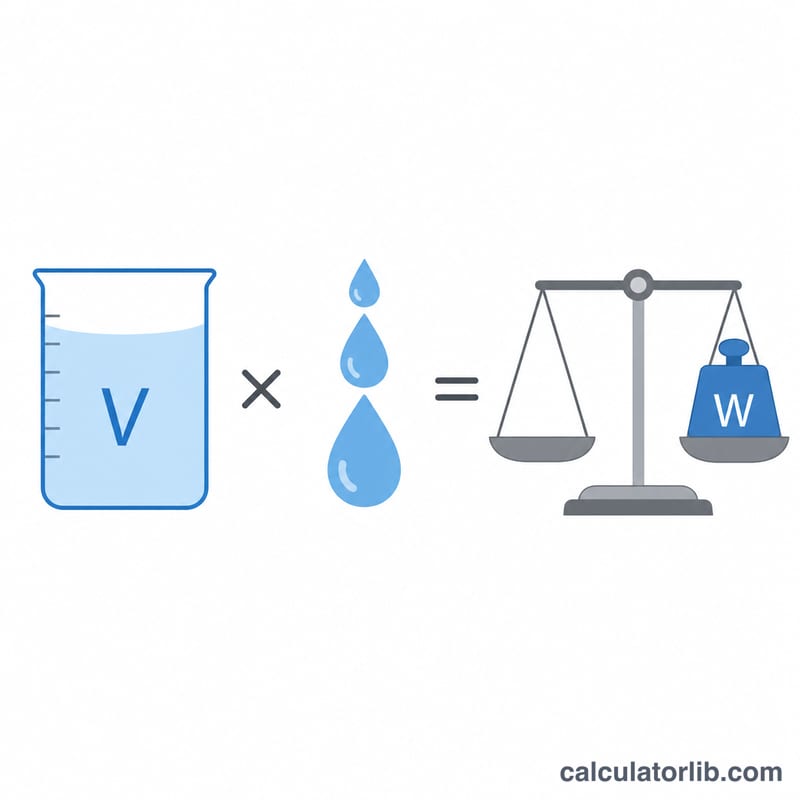
Worked Example
How much does 5 US gallons of water weigh? Convert:
$$5 \times 3.78541 = 18.927 \;\text{liters} = 18.927 \;\text{kg}$$In pounds:
$$18.927 \times 2.20462 \approx \mathbf{41.73 \;\textbf{lb}}$$That is why a full 5-gallon jug is heavy to lift.
Density of Water by Temperature
Water is densest at about 4 °C and becomes lighter both when heated and when cooled toward freezing. The values below are published densities of pure (air-free) liquid water at 1 atm, expressed in kg/L (numerically the same as g/mL and kg/dm³). The pounds-per-US-gallon column is derived from the same density using:
$$\text{lb per US gallon} = \rho\;[\text{kg/L}] \times 3.785411784 \times 2.20462262$$| Temperature (°C) | Temperature (°F) | Density (kg/L) | lb per US gallon | Note |
|---|---|---|---|---|
| 0 °C | 32 °F | 0.99984 | 8.344 | Freezing point (liquid water) |
| 4 °C | 39.2 °F | 0.99997 | 8.345 | Maximum density |
| 10 °C | 50 °F | 0.99970 | 8.343 | Cold tap water |
| 20 °C | 68 °F | 0.99821 | 8.330 | Common "room temperature" reference |
| 25 °C | 77 °F | 0.99705 | 8.321 | Standard lab temperature |
| 37 °C | 98.6 °F | 0.99336 | 8.290 | Human body temperature |
| 60 °C | 140 °F | 0.98320 | 8.205 | Typical hot-water setting |
| 100 °C | 212 °F | 0.95835 | 7.998 | Boiling point at 1 atm |
Reading the table: the whole liquid range from 0 °C to 100 °C spans only about 4 % in density, and from 0 °C to 30 °C less than 0.5 %. That is why using 1.000 kg/L (or 8.34 lb/gal) is perfectly adequate for plumbing, aquariums, shipping weights and cooking, while laboratory volumetric work, calibration and precise hydrostatic calculations do need the temperature-corrected value.
When these numbers do not apply
- Dissolved solids raise density. Seawater at typical salinity (~35 g/kg) is about 1.025 kg/L, roughly 8.55 lb/US gal — so a 55-gallon drum of seawater weighs about 11 lb more than the same drum of fresh water. Brines, sugar syrups and saline solutions are heavier still.
- Ice is lighter than liquid water. Ice at 0 °C is about 0.917 kg/L (≈7.65 lb/US gal), an expansion of roughly 9 % on freezing — which is why water pipes and sealed containers burst rather than simply getting heavier.
- Pressure matters very little. Water is nearly incompressible; at ordinary pressures the density change is negligible compared with the temperature effect.
- Above 100 °C or below 0 °C at 1 atm, water is no longer a stable liquid, so these values stop applying.
If you need a single rule of thumb: 1 litre of water ≈ 1 kg, and 1 US gallon of water ≈ 8.34 lb (1 imperial gallon ≈ 10.02 lb). For anything where a fraction of a percent matters, enter the actual temperature's density instead of the 1.000 kg/L default.
FAQ
Does temperature change the weight? Slightly. Water is densest near 4 °C. At normal room temperature the density is about 0.997 kg/L, so this calculator's use of 1.0 kg/L introduces under 0.3% difference — negligible for everyday use.
Is a US gallon the same as a UK gallon? No. This calculator uses the US gallon (3.78541 L). A UK (imperial) gallon is larger at 4.546 L and weighs about 10.02 lb.
Why does 1 liter equal 1 kilogram? The kilogram was originally defined as the mass of one liter of water, so the relationship is essentially exact for pure water.