
What this calculator does
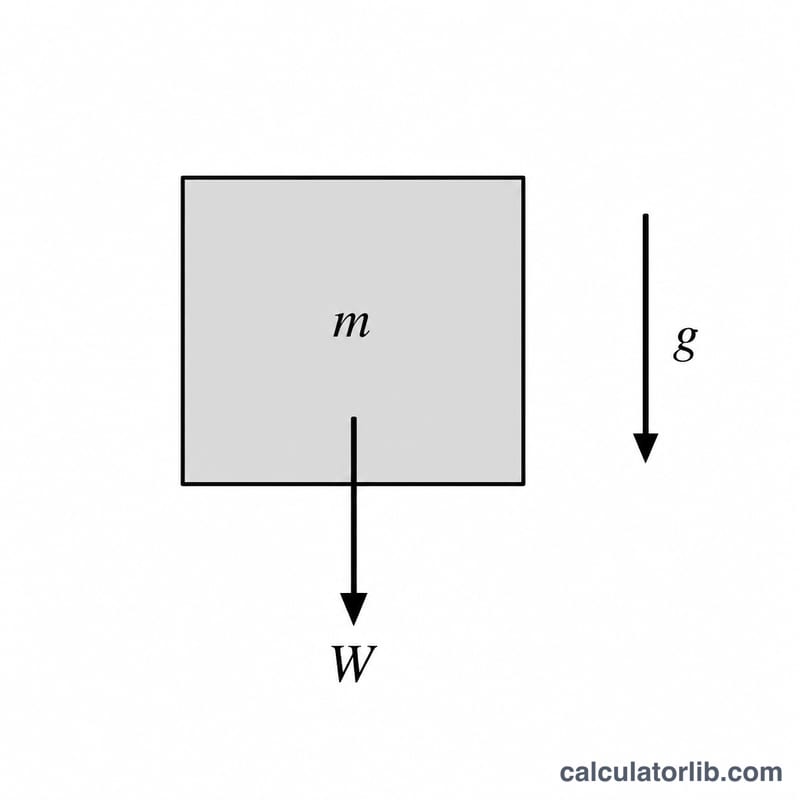
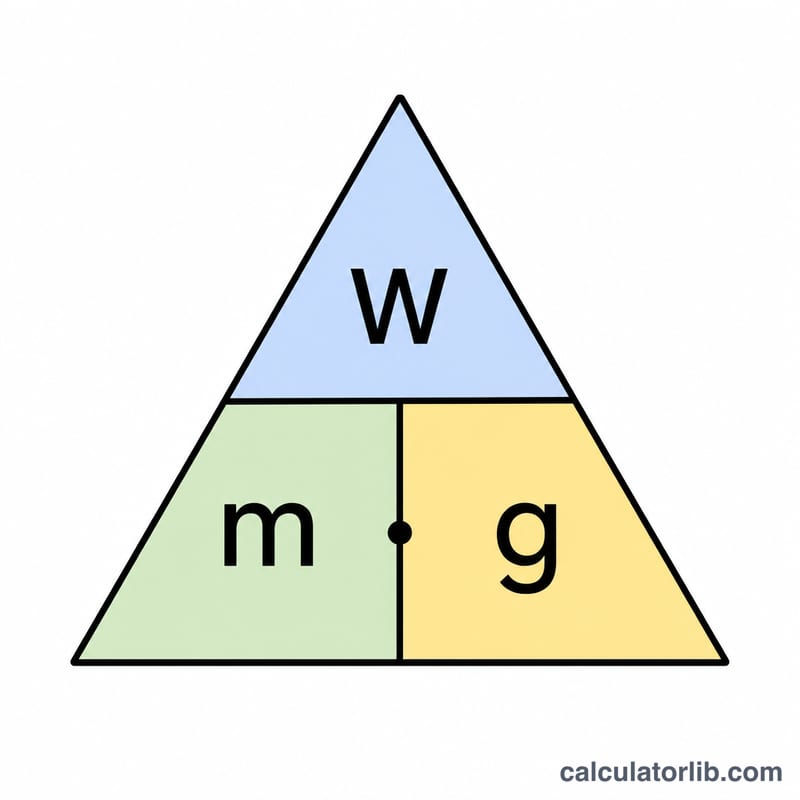
This tool solves the fundamental weight equation \(W = m \cdot g\), a direct application of Newton's second law (\(F = ma\)). Weight W is the gravitational force on an object, m is its mass, and g is the local gravitational acceleration. Given any two of these quantities, the calculator finds the third, with full unit selection and conversion. It is a pure physics and unit-conversion tool, so it applies universally with no regional rules.
How to use it
First pick what you want to solve for: weight, mass, or gravity. Then enter the two known values and choose units for each (newtons, pound-force, kilogram-force; kilograms, pounds, ounces; meters per second squared, feet per second squared, and more). The default gravity is standard gravity, 9.80665 m/s2. Choose "auto" significant figures for full precision, or pick 3 to 9 to round the displayed answer.
The formula explained
All inputs are first converted to SI base units: weight to newtons, mass to kilograms, gravity to meters per second squared. The unknown is then computed in SI: \(W = m \cdot g\), or \(m = W/g\), or \(g = W/m\). Finally the SI result is converted back into your chosen output unit. Because a newton is \(\text{kg} \cdot \text{m}/\text{s}^2\), the units stay consistent throughout.
Worked example
A 10 kg object at standard gravity: $$W = 10 \text{ kg} \times 9.80665 \text{ m/s}^2 = 98.0665 \text{ N}$$ Expressed in pound-force, \(98.0665 / 4.4482216 = 22.0463\) lbf. To go the other way, a 50 N force at \(g = 9.80665\) gives \(m = 50 / 9.80665 = 5.09858\) kg.
FAQ
Is mass the same as weight? No. Mass (kg) measures how much matter is present and never changes; weight (N) is the force gravity exerts on that mass and depends on g.
Why are kg and kgf related? At standard gravity, a 1 kg mass weighs exactly 1 kilogram-force = 9.80665 N. That is why everyday scales conveniently read mass in kg.
What is g on the Moon? About 1.62 m/s2, roughly one sixth of Earth's, so the same mass weighs about one sixth as much.