
What is the Coin Flipper?
The Coin Flipper is a free online tool that simulates tossing a fair two-sided coin as many times as you choose, from a single flip up to 100,000 flips at once. Each toss is decided by a random number generator, recorded as Heads or Tails, and tallied so you can see exactly how many of each came up and what percentage of the total they represent. It is a universal probability tool with no country-specific rules.

How to use it
Enter how many coins you want to flip in one run (1 to 100,000) and submit. The result shows the face of the final flip, the running totals of Heads and Tails, the total number of flips, and the percentage split. A results table lists the outcome of each individual flip (the first 200 are displayed for very large runs, while the counts and percentages always reflect every flip).
The formula explained
Each flip is an independent Bernoulli trial with a 50% chance of Heads. The simulator draws a uniform random value \(r\) in \([0, 1)\); if \(r\) is below 0.5 the flip is Heads, otherwise Tails. After all flips it computes
$$\%\,\text{Heads} = \frac{\text{Heads}}{\text{Number of Flips}} \times 100$$and \(\%\,\text{Tails} = \frac{\text{Tails}}{\text{Number of Flips}} \times 100\), which always add up to 100%.
Worked example
Suppose you flip 10 coins and the sequence comes out H, T, H, H, T, T, H, T, H, H. That is 6 Heads and 4 Tails.
$$\%\,\text{Heads} = \frac{6}{10} \times 100 = 60\%$$$$\%\,\text{Tails} = \frac{4}{10} \times 100 = 40\%$$
and the last flip result is Heads. Because the run is random, your own 10-flip run may differ.
FAQ
Is the coin really fair? Yes. Each flip has an exact 50% chance of Heads and 50% chance of Tails, independent of every previous flip.
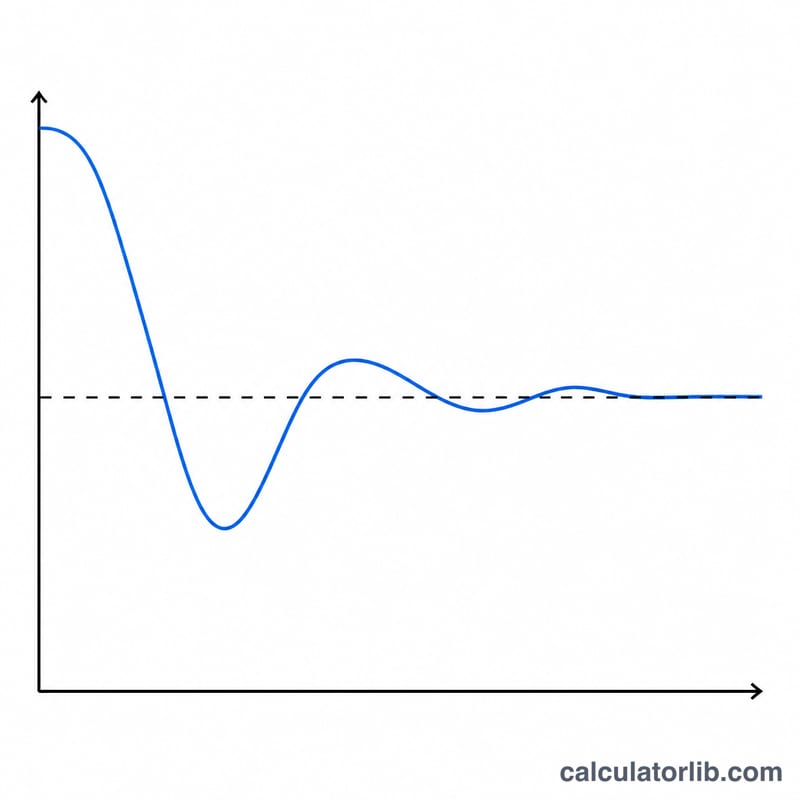
Why isn't it exactly 50/50? Small samples vary by chance. As the number of flips grows, the observed percentages converge toward 50% (the law of large numbers), with the standard deviation of the heads proportion roughly \(\sqrt{0.25 / n}\).
Does a streak of Heads make Tails more likely next? No. That is the gambler's fallacy. Past results never change the probability of the next flip.