What is the Percent Grade to Degrees Calculator?
This tool converts a slope expressed as a percent grade into the equivalent angle in degrees. Percent grade is widely used on road signs, railways, ramps, and trail maps, where it describes how many units of vertical rise occur for every 100 units of horizontal run. Engineers, surveyors, hikers, and cyclists often need that same slope expressed as an angle, which this calculator provides instantly.
How to use it
Enter the grade as a percentage. For example, a road sign reading "8%" means you type 8. The calculator returns the slope angle in degrees and also shows the angle in radians for convenience. A 100% grade equals a 45-degree angle, because the rise equals the run.
The formula explained
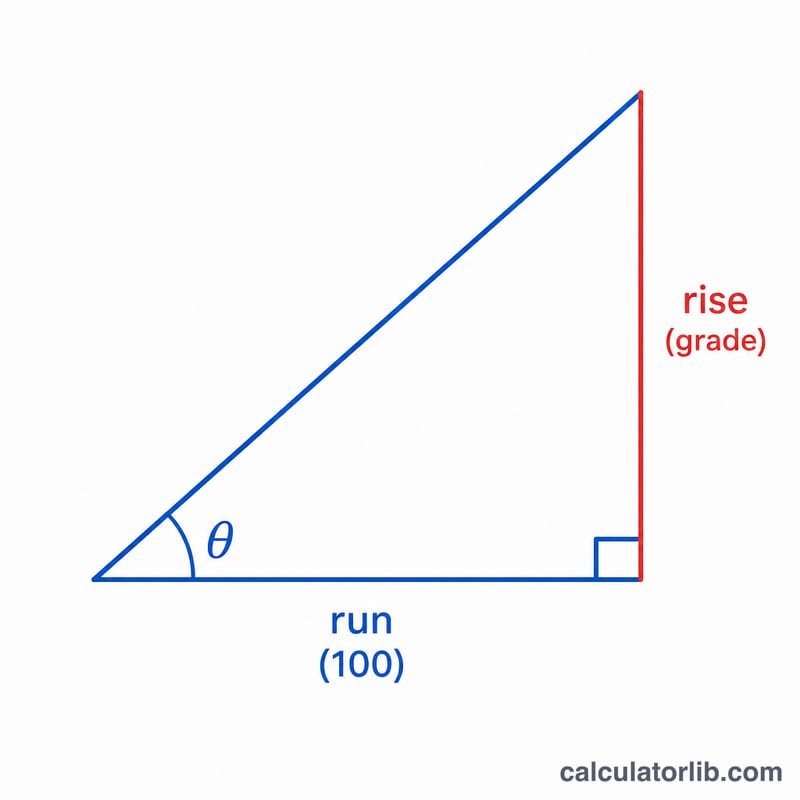
The relationship comes from basic trigonometry. The tangent of the slope angle equals rise over run, and percent grade is exactly rise over run multiplied by 100. So the angle is the arctangent of the grade divided by 100. The result is in radians, so we multiply by 180/π to convert to degrees:
$$\theta = \arctan\left(\frac{\text{Grade (\%)}}{100}\right) \times \frac{180}{\pi}$$
Worked example
Suppose a trail has a 25% grade. Divide 25 by 100 to get 0.25. The arctangent of 0.25 is about 0.2450 radians. Multiply by 180/π (about 57.2958) to get approximately 14.04 degrees. So a 25% grade corresponds to a slope of roughly 14 degrees.
$$\theta = \arctan\left(\frac{25}{100}\right) \times \frac{180}{\pi} \approx 0.2450 \times 57.2958 \approx 14.04^\circ$$
Typical Slope Grades in Practice
The table converts commonly cited grades to angles using \(\theta = \arctan(\text{grade}/100)\). The standards named are mostly United States rules (the ADA is a US law). Other countries and local building codes, highway agencies and railway operators set their own limits, so always check the code that applies to your project.
| Situation | Grade (%) | Angle (°) | Source / standard |
|---|---|---|---|
| Accessible ramp, maximum running slope (1:12) | 8.33% | ≈ 4.76° | US ADA Accessibility Standards (1:12 maximum for ramps) |
| Accessible route, maximum cross slope | 2% (1:48 is about 2.08%) | ≈ 1.15° (at exactly 2%) | US ADA Accessibility Standards (1:48 maximum, commonly rounded to 2%) |
| Steep road warning sign, lower end | 6% | ≈ 3.43° | Typical range on US-style hill warning signs (varies by jurisdiction) |
| Steep road warning sign, upper end | 10% | ≈ 5.71° | Typical range on US-style hill warning signs (varies by jurisdiction) |
| Mainline railway, gentle grade | 2% | ≈ 1.15° | General railway practice; mainline grades are usually kept below about 2–4% |
| Mainline railway, upper typical range | 4% | ≈ 2.29° | General railway practice; limits depend on country, line type and traction |
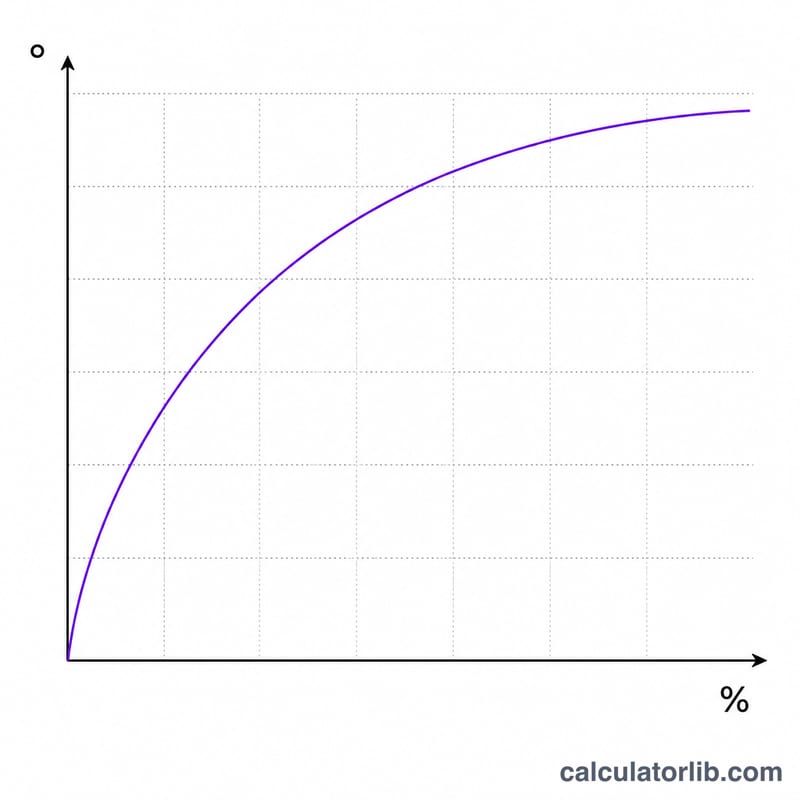
Reading the table: for small slopes, the angle in degrees is roughly 0.57 times the percent grade. At steeper grades the angle grows more slowly than the percentage. For example, a 100% grade is 45°, not 100°. Values are rounded to two decimals. Warning-sign and railway figures are typical ranges, not universal legal limits.
FAQ
Is 100% grade the same as vertical? No. A 100% grade is a 45-degree angle. A vertical cliff would be an infinite grade.
Why does a small percent give a similar number of degrees? For small slopes, grade and degrees are nearly equal because the tangent of a small angle is close to the angle itself, but they diverge as the slope steepens.
Can I enter a negative grade? Yes. A downhill slope of -10% returns about -5.71 degrees.