
What This Calculator Does
This tool factors out the greatest common factor (GCF) from a polynomial. Given a list of terms such as 12x^3, -18x^2, 6x, it finds the largest number and the highest combination of variables that divide every term, then rewrites the polynomial as that GCF multiplied by a simpler polynomial in parentheses. This is the first step in most factoring problems and works for any number of terms.
How to Use It
Enter each term of your polynomial on its own line (or separate them with commas). Use the caret symbol for exponents, for example x^2 for x squared, and include the sign of each term. Press calculate to see the GCF, the divided terms inside parentheses, and the fully factored expression.
The Formula Explained
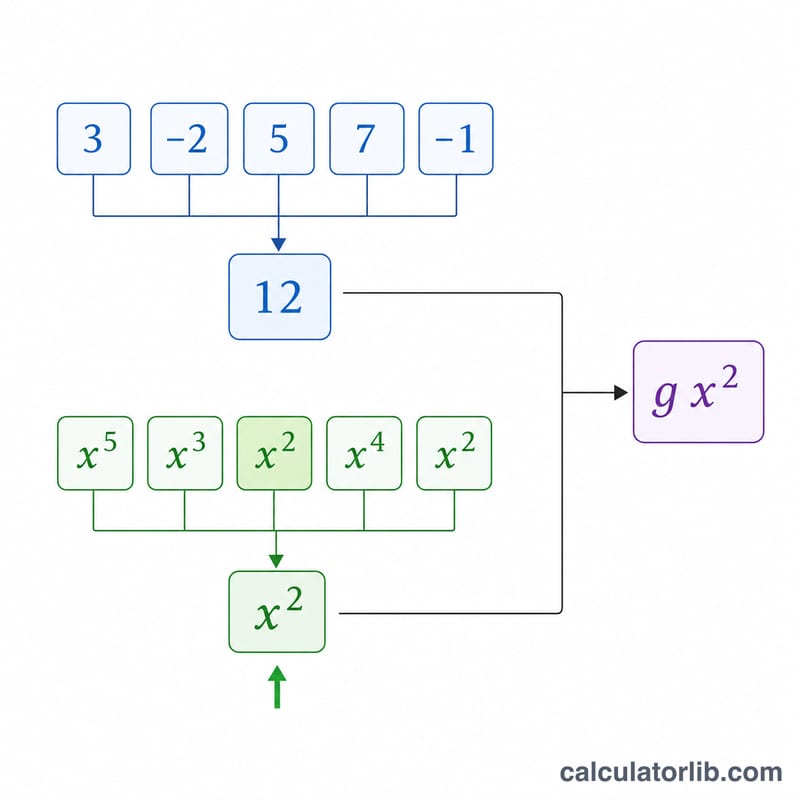
The GCF has two parts. First, take the greatest common divisor of the numeric coefficients using the Euclidean algorithm. Second, for each variable that appears in every term, take the lowest exponent it carries. The product of these is the GCF. Dividing each original term by the GCF gives the polynomial that goes inside the parentheses.
$$\text{Polynomial} = \text{GCF} \times \left( \frac{\text{Term}_1}{\text{GCF}} + \frac{\text{Term}_2}{\text{GCF}} + \cdots \right)$$where
$$\left\{ \begin{aligned} \text{GCF} &= \gcd(\text{coefficients}) \cdot \prod v^{\min(e_v)} \\ \text{Term}_i &= \text{each entry in } \text{Polynomial terms} \end{aligned} \right.$$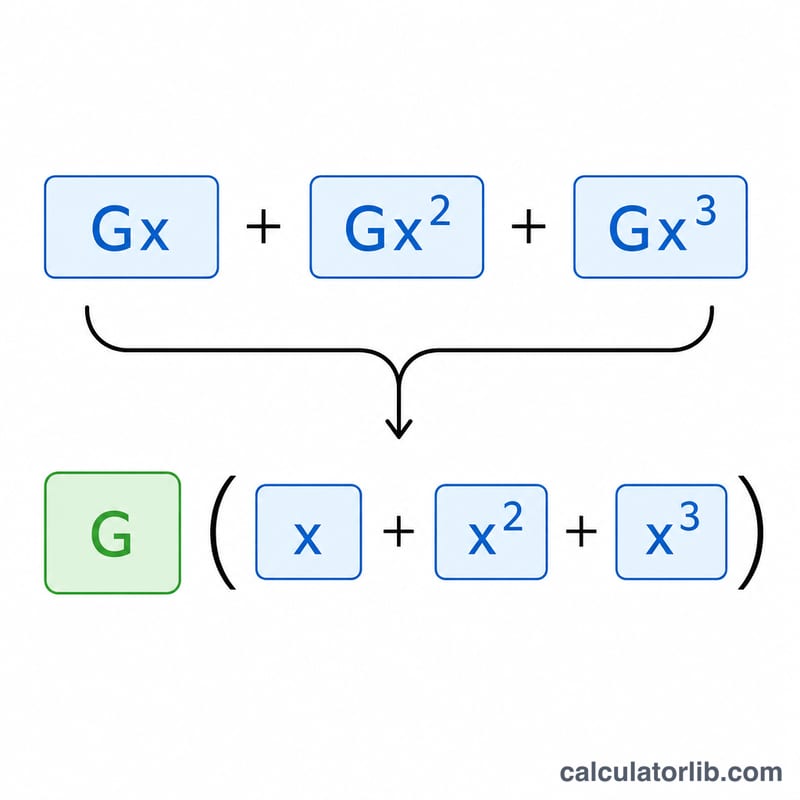
Worked Example
Factor 12x^3 - 18x^2 + 6x. The coefficients are 12, 18 and 6; their GCF is 6. Every term contains x, and the lowest power is \(x^1\), so the variable part is \(x\). The overall GCF is \(6x\). Dividing each term by \(6x\) gives \(2x^2 - 3x + 1\). The answer is $$6x(2x^2 - 3x + 1)$$
FAQ
What if there is no common factor? The GCF is 1 and the polynomial is already in simplest factored form for this step.
Can it handle negative leading terms? Yes. The GCF is taken as a positive number, and the signs are preserved in the divided terms.
Does it factor completely? It only factors out the GCF. You may still be able to factor the remaining polynomial further (for example as a trinomial or difference of squares).