
What This Calculator Does
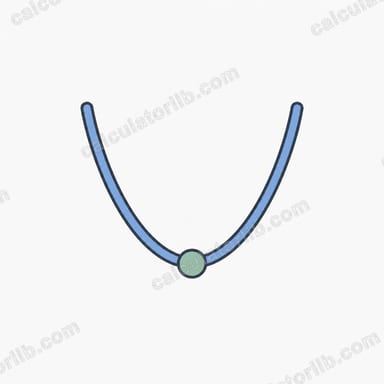
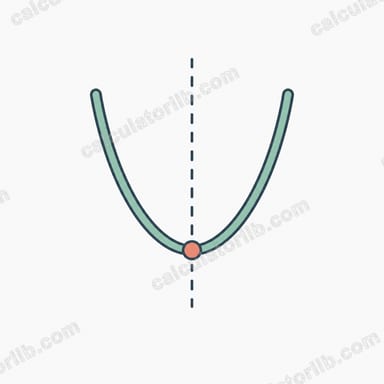
A quadratic function in standard form is written as \(f(x) = ax^2 + bx + c\). Its graph is a parabola, and the single most important point on that parabola is the vertex — the highest point if the parabola opens downward (\(a < 0\)) or the lowest point if it opens upward (\(a > 0\)). This tool converts the standard-form coefficients directly into the vertex coordinates \((h, k)\) without you having to complete the square by hand.
How to Use It
Enter the three coefficients \(a\), \(b\), and \(c\) from your quadratic. The value of \(a\) must not be zero (otherwise the equation is linear, not quadratic). Click calculate and you instantly get the x-coordinate \(h\), the y-coordinate \(k\), and the axis of symmetry \(x = h\).
The Formula Explained
The vertex x-coordinate comes from \(h = -b / (2a)\). This is the line of symmetry of the parabola. Substituting \(h\) back into the function gives the y-coordinate, which simplifies to \(k = c - b^2 / (4a)\). Together \((h, k)\) is the vertex, and the equation can be rewritten in vertex form \(f(x) = a(x - h)^2 + k\).
$$\left(h,\,k\right) = \left( -\frac{b}{2\,a},\ \ c - \frac{b^{2}}{4\,a} \right)$$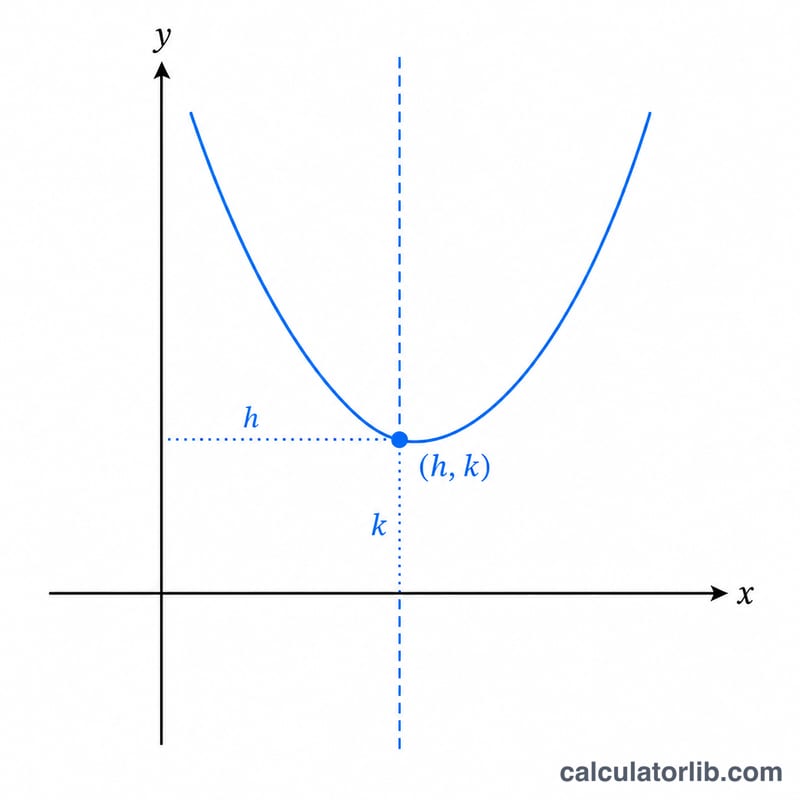
Worked Example
Take \(f(x) = x^2 - 6x + 5\), so \(a = 1\), \(b = -6\), \(c = 5\). Then $$h = \frac{-(-6)}{2 \times 1} = \frac{6}{2} = 3.$$ And $$k = 5 - \frac{(-6)^2}{4 \times 1} = 5 - \frac{36}{4} = 5 - 9 = -4.$$ The vertex is \((3, -4)\), and the axis of symmetry is \(x = 3\).
FAQ
What if a is negative? The same formulas apply; the parabola simply opens downward, so the vertex is the maximum point instead of the minimum.
What does k represent? It is the minimum (or maximum) value of the function — the extreme y-value the quadratic ever reaches.
Can a be zero? No. If \(a = 0\) the function is linear and has no vertex; the calculator requires a nonzero \(a\).