
What This Calculator Does
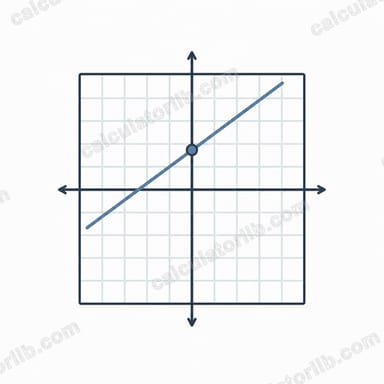
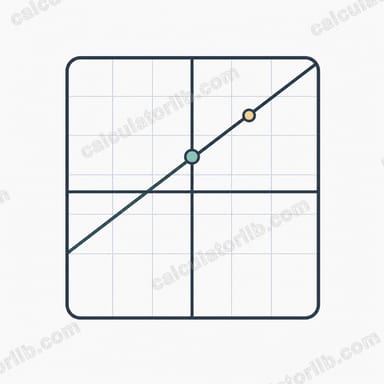
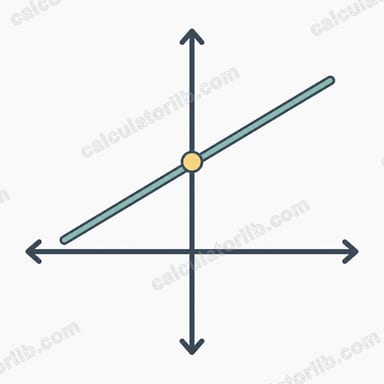
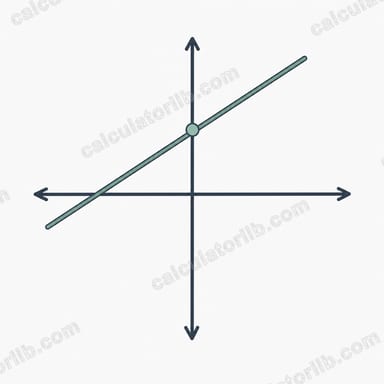
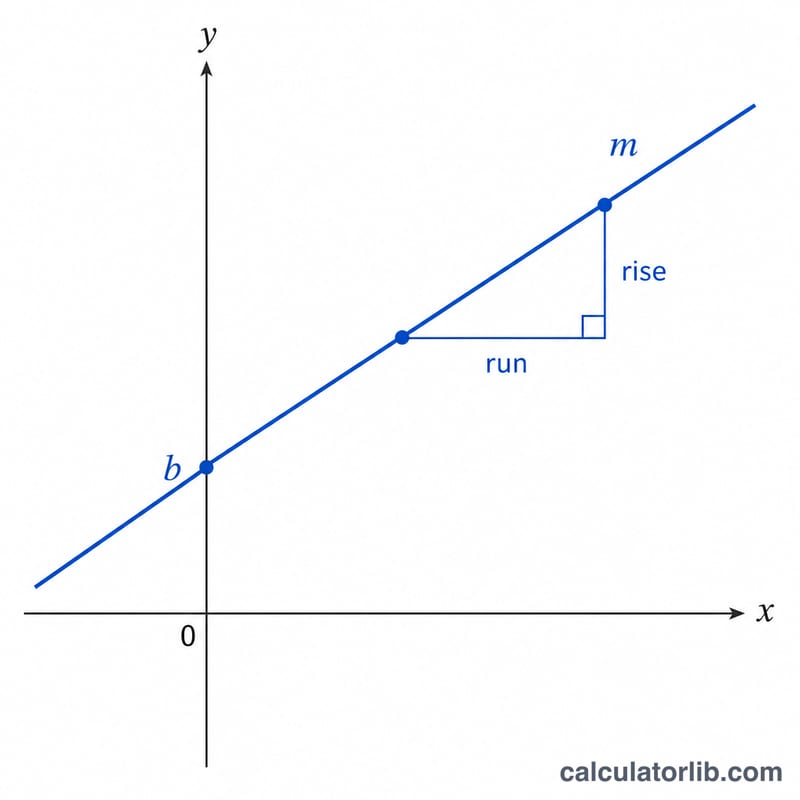
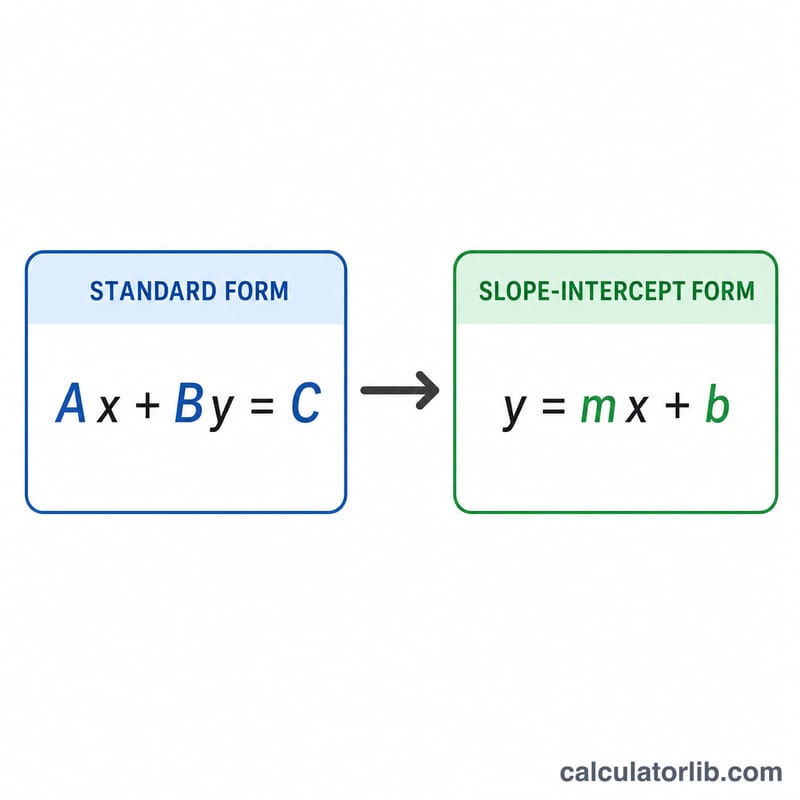
This tool converts a linear equation written in standard form, \(Ax + By = C\), into the more familiar slope-intercept form, \(y = mx + b\). Slope-intercept form makes it easy to read off the slope (how steep the line is) and the y-intercept (where the line crosses the vertical axis), which is handy for graphing and analysis.
How to Use It
Enter the three coefficients A, B, and C from your equation. For example, if your equation is \(2x + 3y = 6\), type A = 2, B = 3, and C = 6. The calculator immediately returns the slope and y-intercept and assembles the full \(y = mx + b\) equation for you.
The Formula Explained
Start with \(Ax + By = C\). To isolate y, subtract \(Ax\) from both sides to get \(By = -Ax + C\), then divide every term by B:
$$y = -\frac{\text{A}}{\text{B}}\,x + \frac{\text{C}}{\text{B}}$$
So the slope is \(m = -\frac{A}{B}\) and the y-intercept is \(b = \frac{C}{B}\). This conversion only works when \(B \neq 0\). If \(B = 0\), the equation describes a vertical line of the form \(x = \frac{C}{A}\), which has no defined slope — the calculator flags this case for you.
Worked Example
Convert \(4x + 2y = 10\). Here A = 4, B = 2, C = 10. The slope is $$m = -\frac{A}{B} = -\frac{4}{2} = -2.$$ The y-intercept is $$b = \frac{C}{B} = \frac{10}{2} = 5.$$ Therefore the slope-intercept form is \(y = -2x + 5\).
FAQ
What if B is zero? Then the line is vertical (\(x = \frac{C}{A}\)) and the slope is undefined, so it cannot be written in slope-intercept form.
What if A is zero? The line is horizontal: \(y = \frac{C}{B}\), a constant with slope 0.
Can A, B, or C be fractions or negatives? Yes. Enter any real numbers and the calculator handles the division automatically.