
What This Calculator Does
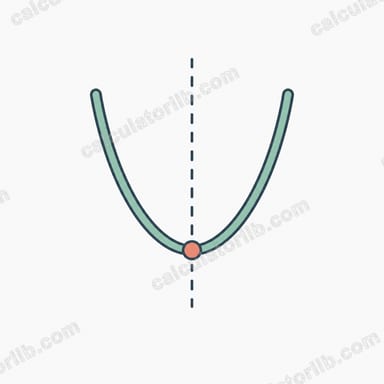
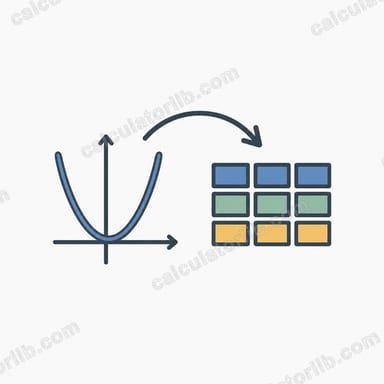
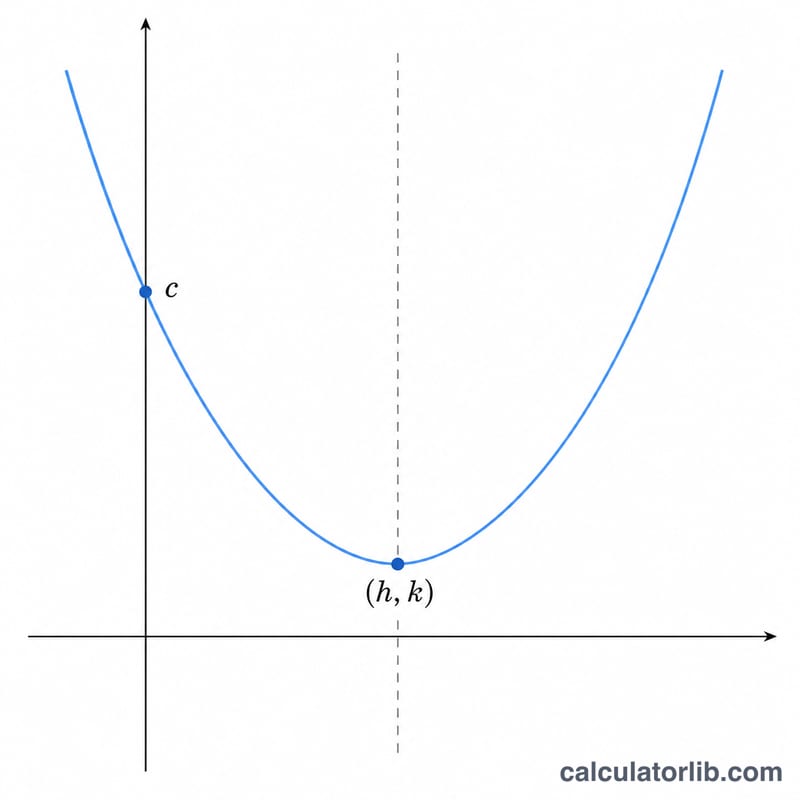
A quadratic function can be written in two equivalent ways. Vertex form, \(a(x-h)^2+k\), makes the vertex \((h, k)\) easy to read. Standard form, \(ax^2+bx+c\), is convenient for using the quadratic formula or reading the y-intercept. This tool converts vertex form into standard form by expanding the squared term and collecting like terms.
How to Use It
Enter the three vertex-form parameters: a (the leading coefficient that controls the parabola's width and direction), h (the x-coordinate of the vertex), and k (the y-coordinate of the vertex). The calculator returns the standard-form coefficients a, b, and c so you can write \(y = ax^2 + bx + c\).
The Formula Explained
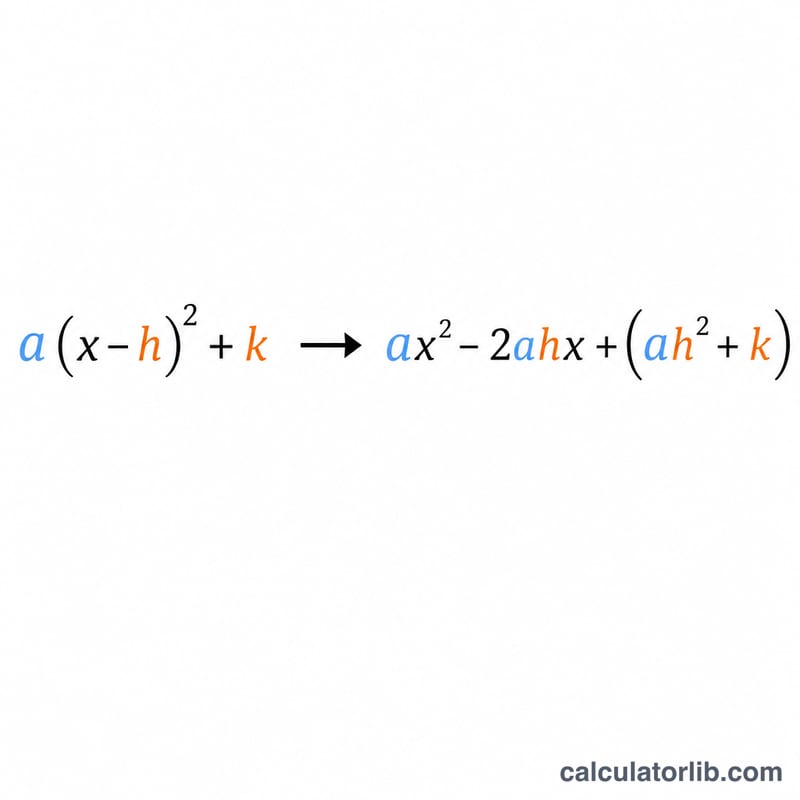
Start with \(a(x-h)^2 + k\). Expand the square: \((x-h)^2 = x^2 - 2hx + h^2\). Multiply by a: \(ax^2 - 2ah\,x + ah^2\). Add k to get the constant term. Collecting terms gives:
a stays the same, \(b = -2ah\), \(c = a\cdot h^2 + k\).
Worked Example
Convert \(y = 2(x - 3)^2 + 5\). Here \(a = 2\), \(h = 3\), \(k = 5\). Then $$b = -2(2)(3) = -12,$$ and $$c = 2(3^2) + 5 = 18 + 5 = 23.$$ So the standard form is $$y = 2x^2 - 12x + 23.$$
FAQ
What if \(a = 0\)? Then it is not a quadratic — it reduces to a constant \(y = k\), and the standard form has no \(x^2\) or \(x\) terms.
Does the vertex change after conversion? No. The two forms describe the exact same parabola; only the way it is written changes.
Why is b negative for a positive h? Because \(b = -2ah\), a positive vertex x-coordinate with a positive a produces a negative middle coefficient.