
What Is the Ellipse Standard Form Calculator?
This calculator builds the standard form equation of an ellipse from its center coordinates and its two semi-axes. The standard form makes it easy to read off the center, orientation, and size of the ellipse, and it is the starting point for finding the foci, area, perimeter, and eccentricity. The tool works for any axis-aligned ellipse and is fully universal (pure math, no jurisdiction).
How to Use It
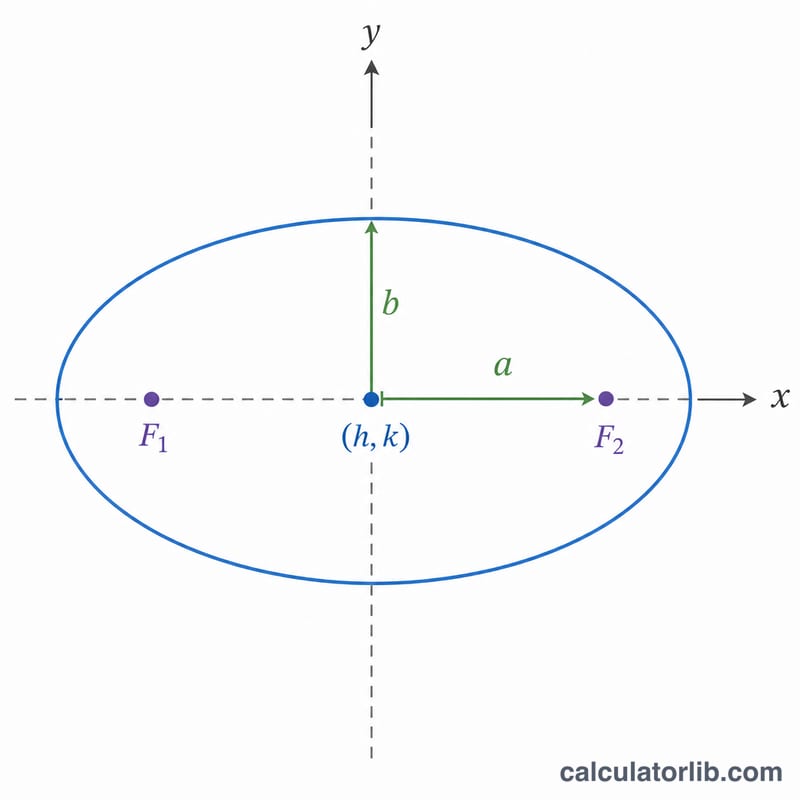
Enter the center coordinates h (x) and k (y), then enter the two semi-axes: a measured along the x-direction and b measured along the y-direction. The calculator assembles the equation and reports the semi-major axis A, semi-minor axis B, focal distance c, eccentricity e, area, and an approximate perimeter.
The Formula Explained
The standard form is:
$$\frac{\left(x - \text{h}\right)^2}{\text{a}^{\,2}} + \frac{\left(y - \text{k}\right)^2}{\text{b}^{\,2}} = 1$$
The larger of a and b is the semi-major axis A; the smaller is the semi-minor axis B. The distance from the center to each focus is \(c = \sqrt{A^2 - B^2}\), the eccentricity is \(e = c / A\) (between 0 for a circle and 1 for a very flat ellipse), the area is \(\pi\cdot\text{a}\cdot\text{b}\), and the perimeter uses Ramanujan's accurate approximation \(P \approx \pi(A + B)\left(1 + \frac{3\xi}{10 + \sqrt{4 - 3\xi}}\right)\) with \(\xi = (A - B)^2/(A + B)^2\).
Worked Example
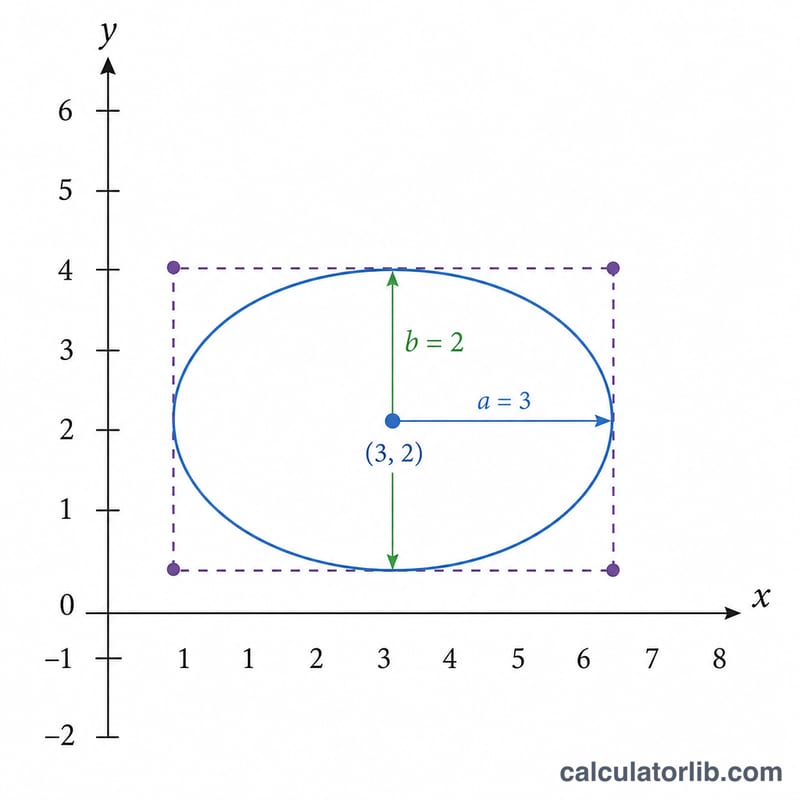
For center (2, −1) with a = 5 and b = 3, the equation is
$$\frac{(x - 2)^2}{5^2} + \frac{(y + 1)^2}{3^2} = 1$$
Here A = 5, B = 3, so \(c = \sqrt{25 - 9} = 4\), eccentricity \(e = 4/5 = 0.8\), area \(= \pi\cdot 5\cdot 3 \approx 47.12\), and perimeter \(\approx 25.53\).
FAQ
Which axis is "major"? Whichever semi-axis is larger. If a > b the major axis is horizontal; if b > a it is vertical.
What if a = b? The ellipse becomes a circle, eccentricity is 0, and the two foci coincide at the center.
Is the perimeter exact? No closed-form exists; the value uses Ramanujan's approximation, accurate to far better than 0.01% for typical ellipses.