
What This Calculator Does
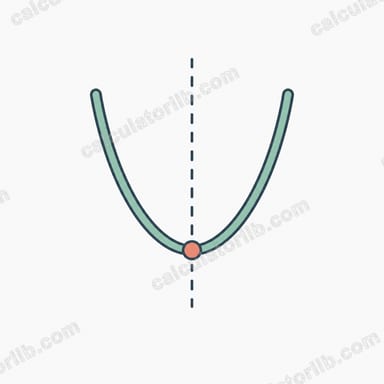
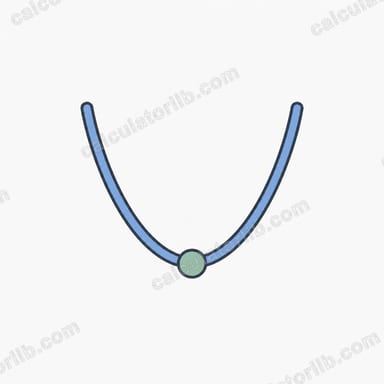
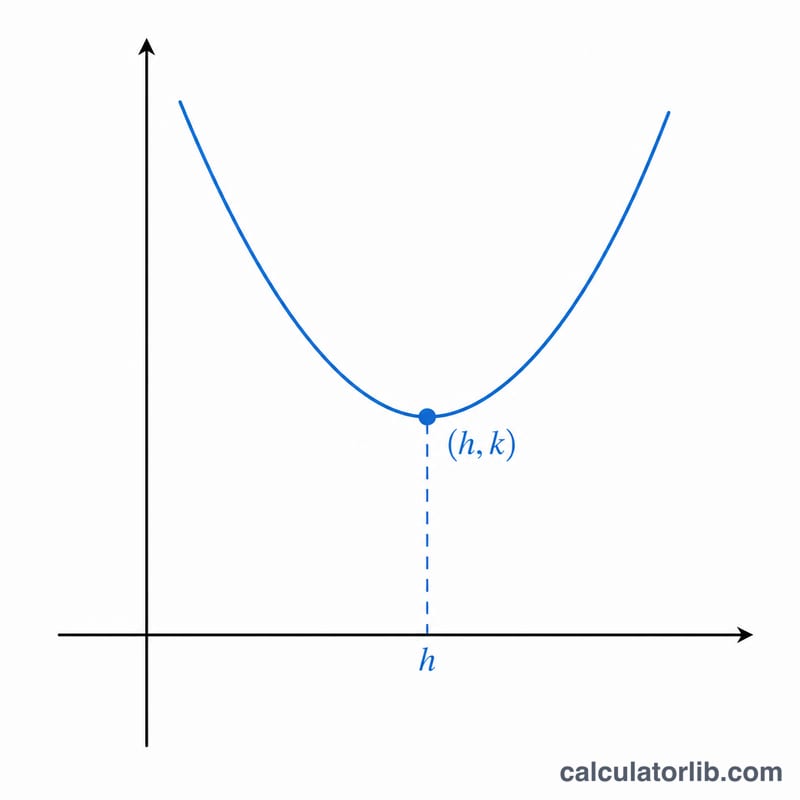
This tool converts a quadratic written in standard form \(ax^{2}+bx+c\) into vertex form \(a(x-h)^{2}+k\) by completing the square. Vertex form is convenient because it reveals the vertex \((h, k)\) directly — the turning point of the parabola — and makes graphing transformations easy to see.
How to Use It
Enter the three coefficients a, b, and c from your quadratic. The calculator computes h and k and rewrites the equation in vertex form. The coefficient a stays the same in both forms; only the way the rest is grouped changes.
The Formula Explained
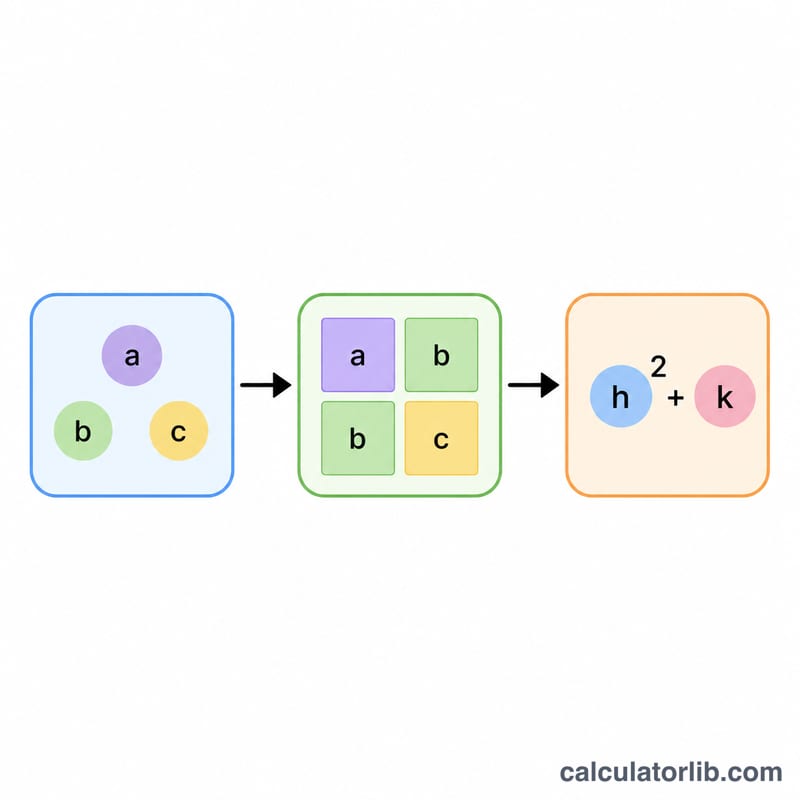
Completing the square factors a out of the first two terms and adds the term needed to form a perfect square. The result is the compact formulas \(h = -b / (2a)\) and \(k = c - b^{2} / (4a)\). Because a is unchanged, the full vertex form is $$y = \text{a}\,(x-h)^{2}+k$$ The vertex \((h, k)\) is a minimum when \(a > 0\) and a maximum when \(a < 0\).
Worked Example
Take \(y = x^{2} - 6x + 5\), so \(a = 1\), \(b = -6\), \(c = 5\). Then $$h = \frac{-(-6)}{2\cdot 1} = 3 \qquad k = 5 - \frac{(-6)^{2}}{4\cdot 1} = 5 - \frac{36}{4} = 5 - 9 = -4$$ So the vertex form is \(y = (x - 3)^{2} - 4\) with vertex \((3, -4)\).
FAQ
What if a = 0? Then it is not a quadratic — it is linear — and there is no parabola or vertex.
Is k always the minimum? k is the minimum y-value when a is positive and the maximum when a is negative.
Does a change between forms? No. The leading coefficient a is identical in standard and vertex form.