
What is exponential notation?
Exponential notation, also called scientific notation, expresses a number as a mantissa multiplied by a power of ten: \(x = m \times 10^{n}\), where the mantissa m satisfies \(1 \le |m| < 10\) and the exponent n is an integer. It is the standard way to write very large or very small numbers compactly — for example, 312,000 becomes \(3.12 \times 10^{5}\), and 0.00042 becomes \(4.2 \times 10^{-4}\).
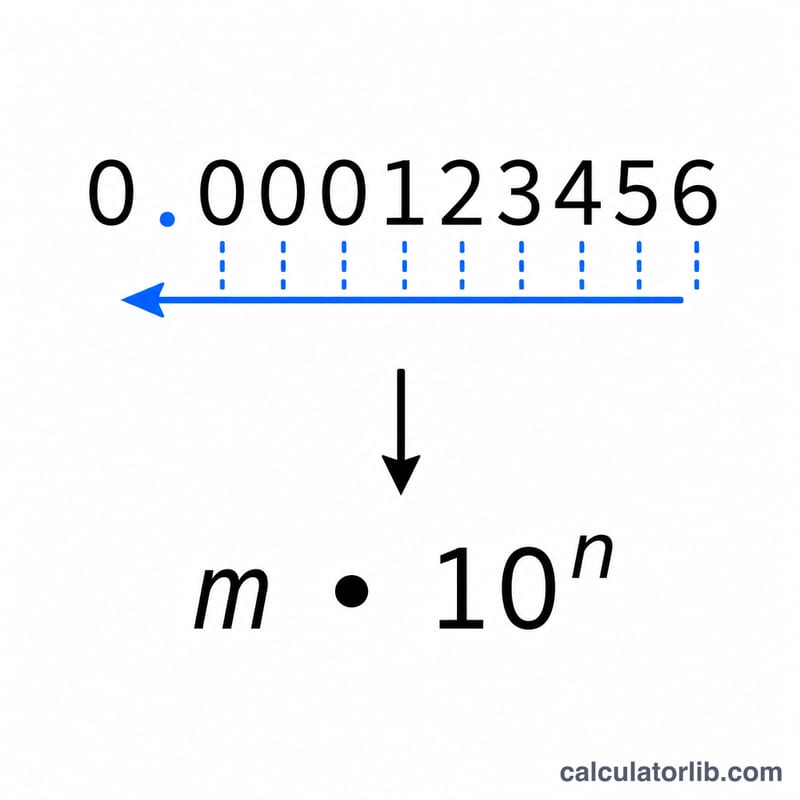
How to use this calculator
Type any number — positive, negative, large, or small — into the input box and the calculator instantly returns its exponential form. It reports the mantissa (m), the exponent (n), and the assembled notation \(m \times 10^{n}\). Decimals and thousands separators are accepted.
The formula explained
To convert a number x, first find the exponent with \(n = \left\lfloor \log_{10}|x| \right\rfloor\), the floor of its base-10 logarithm. Then divide by that power of ten to get the mantissa: \(m = \dfrac{x}{10^{n}}\). This guarantees the mantissa lands in the range \(1 \le |m| < 10\), the canonical form of scientific notation.
$$\text{Number} = m \times 10^{\,e}, \quad e = \left\lfloor \log_{10}\left|\text{Number}\right| \right\rfloor, \quad m = \frac{\text{Number}}{10^{\,e}}$$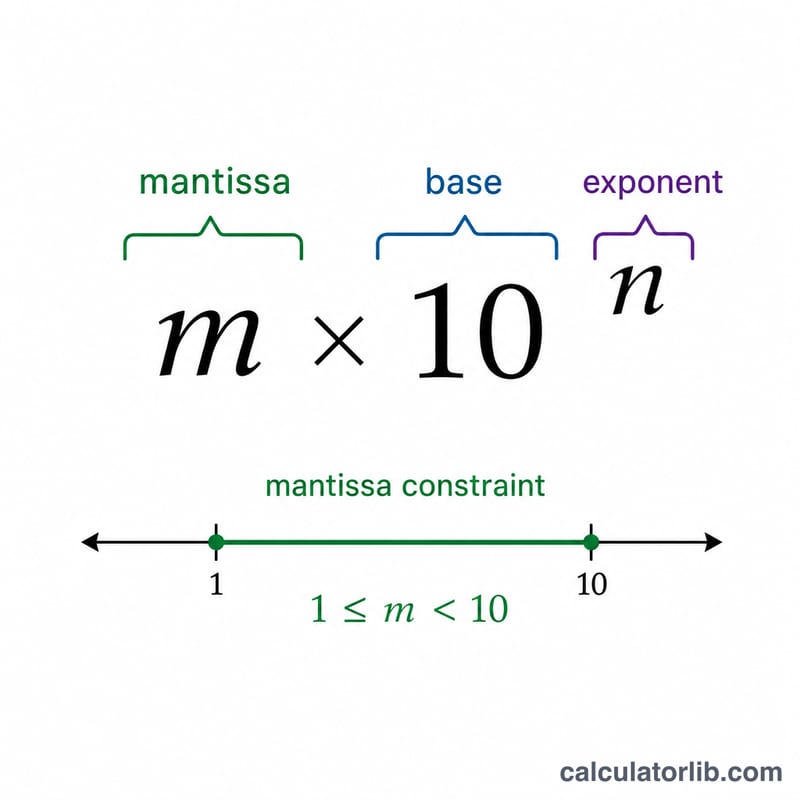
Worked example
Convert 312,000. The absolute value is 312,000, and \(\log_{10}(312{,}000) \approx 5.494\), so \(n = \lfloor 5.494 \rfloor = 5\). Then
$$m = \frac{312{,}000}{10^{5}} = \frac{312{,}000}{100{,}000} = 3.12$$The result is \(3.12 \times 10^{5}\).
FAQ
What does the calculator return for zero? Zero has no defined exponent, so the calculator reports a mantissa and exponent of 0 (\(0 \times 10^{0}\)).
Can it handle negative numbers? Yes. The sign stays with the mantissa, e.g. −0.0056 becomes \(-5.6 \times 10^{-3}\).
What is the difference between scientific and engineering notation? Scientific notation keeps \(1 \le |m| < 10\). Engineering notation restricts the exponent to multiples of 3, so the mantissa can be up to 1000. This tool produces standard scientific notation.