
What is the Fourth Root Calculator?
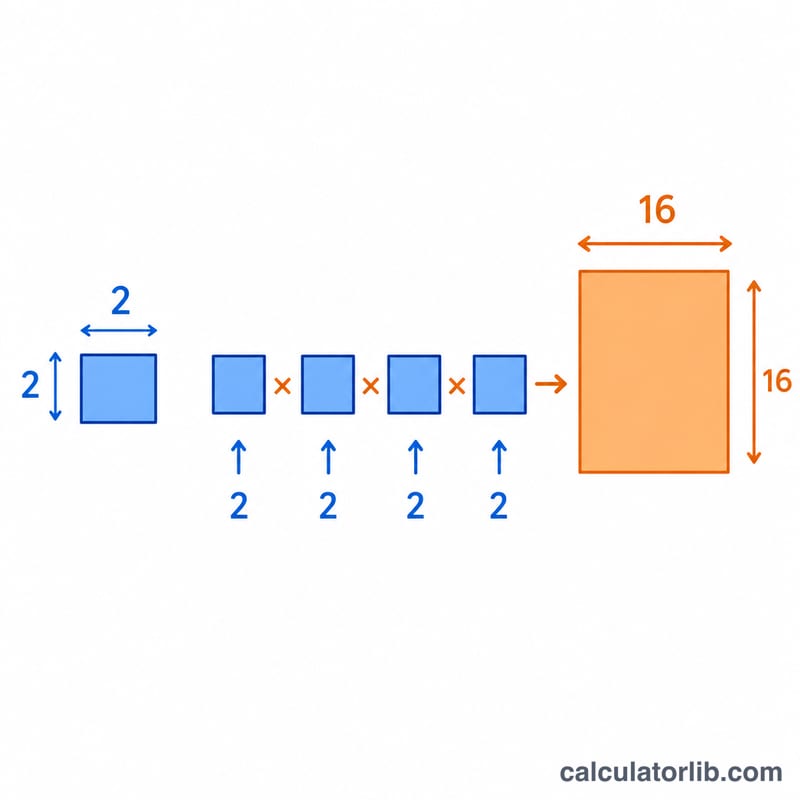
The fourth root of a number x is the value y that, when multiplied by itself four times, gives x — that is, \(y \times y \times y \times y = x\). Mathematically it is written as \(\sqrt[4]{x}\) or as the exponent \(x^{\frac{1}{4}}\). This calculator computes that value instantly for any non-negative number, including decimals and fractions.
How to use it
Enter the number whose fourth root you want in the input box and submit. The result shows the fourth root y, the original number for reference, and a verification value (y raised back to the 4th power) so you can confirm the answer. Because the fourth root of a negative number is not a real value, this tool accepts zero and positive numbers.
The formula explained
The fourth root is the inverse of raising a number to the fourth power. Using exponent rules, taking a root is the same as raising to a fractional power:
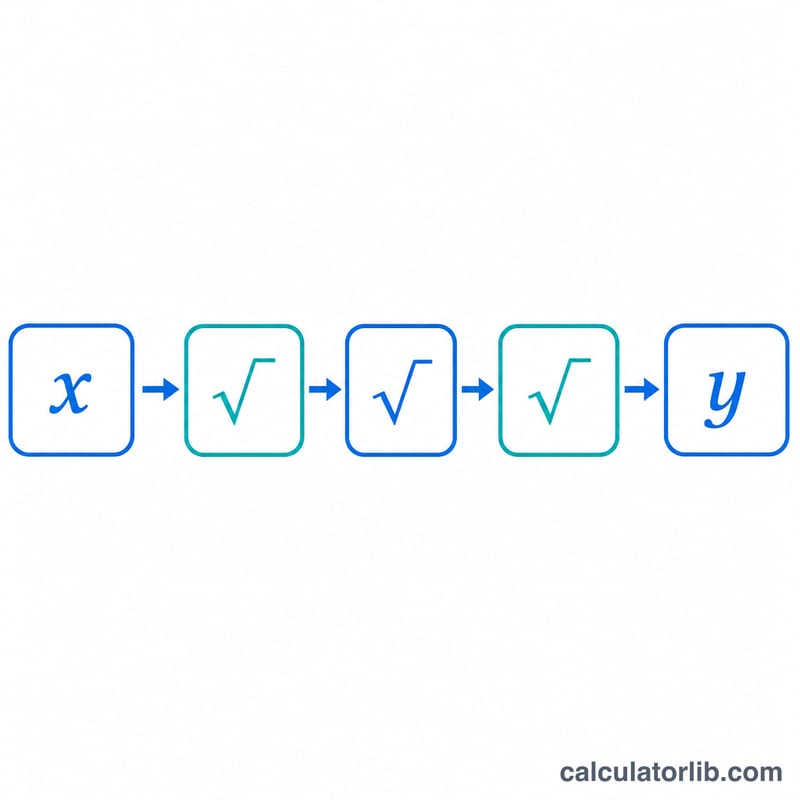
$$\sqrt[4]{x} = x^{\frac{1}{4}}$$Equivalently, the fourth root is the square root of the square root: \(\sqrt[4]{x} = \sqrt{\sqrt{x}}\). Both approaches give the same answer.
Worked example
Find the fourth root of 16. Ask: what number to the 4th power equals 16? Since \(2 \times 2 \times 2 \times 2 = 16\), the answer is 2. The calculator returns 2, and the verification \(2^4 = 16\) confirms it. For a non-perfect example, \(\sqrt[4]{50} \approx 2.659\), and \(2.659^4 \approx 50\).
Common Fourth Roots (Perfect Fourth Powers)
A fourth root undoes raising a number to the 4th power: if \(n^4 = x\), then \(\sqrt[4]{x} = n\). The table lists perfect fourth powers for n = 0 to 10.
| n | n⁴ (x) | Fourth root of x |
|---|---|---|
| 0 | 0 | 0 |
| 1 | 1 | 1 |
| 2 | 16 | 2 |
| 3 | 81 | 3 |
| 4 | 256 | 4 |
| 5 | 625 | 5 |
| 6 | 1296 | 6 |
| 7 | 2401 | 7 |
| 8 | 4096 | 8 |
| 9 | 6561 | 9 |
| 10 | 10000 | 10 |
Most numbers are not perfect fourth powers, so their fourth roots are irrational decimals. Some common approximate values:
| x | Fourth root (approx.) |
|---|---|
| 2 | 1.1892 |
| 10 | 1.7783 |
| 100 | 3.1623 (equal to \(\sqrt{10}\)) |
Over the real numbers, the fourth root is defined for non-negative x only, because no real number raised to the 4th power is negative.
How to Estimate a Fourth Root by Hand
Since \(x^{1/4} = (x^{1/2})^{1/2}\), a fourth root is just a square root taken twice: \(\sqrt[4]{x} = \sqrt{\sqrt{x}}\).
- Take the square root of x. For x = 50, \(\sqrt{50} \approx 7.0711\).
- Take the square root of that result. \(\sqrt{7.0711} \approx 2.6591\), so \(\sqrt[4]{50} \approx\) 2.6591.
- Check by raising to the 4th power. Square the answer twice: \(2.6591^2 \approx 7.0708\), and \(7.0708^2 \approx 50.0\) (up to rounding). If the result matches x, the root is correct.
Bracketing between perfect fourth powers
With no calculator, bracket x between the nearest perfect fourth powers from the table above. For example, 50 lies between 16 (= 2⁴) and 81 (= 3⁴), so its fourth root is between 2 and 3. Since 50 is closer to 81 than to 16 in relative terms, try about 2.7: \(2.7^2 = 7.29\) and \(7.29^2 \approx 53.1\), which is too high. Try 2.65: \(2.65^2 = 7.0225\) and \(7.0225^2 \approx 49.3\), which is slightly low. The root lies between 2.65 and 2.7. Repeating this narrowing converges on 2.659.
FAQ
Can I take the fourth root of a negative number? Not within the real numbers — there is no real value that, raised to an even power, gives a negative result. The calculator therefore expects zero or positive inputs.
Is the fourth root the same as the square root twice? Yes. Taking the square root of a number and then the square root again equals its fourth root: \(\sqrt{\sqrt{x}} = x^{\frac{1}{4}}\).
What is the fourth root of 1? It is 1, because \(1^4 = 1\). The fourth root of 0 is 0.