
What is the general form of a circle?
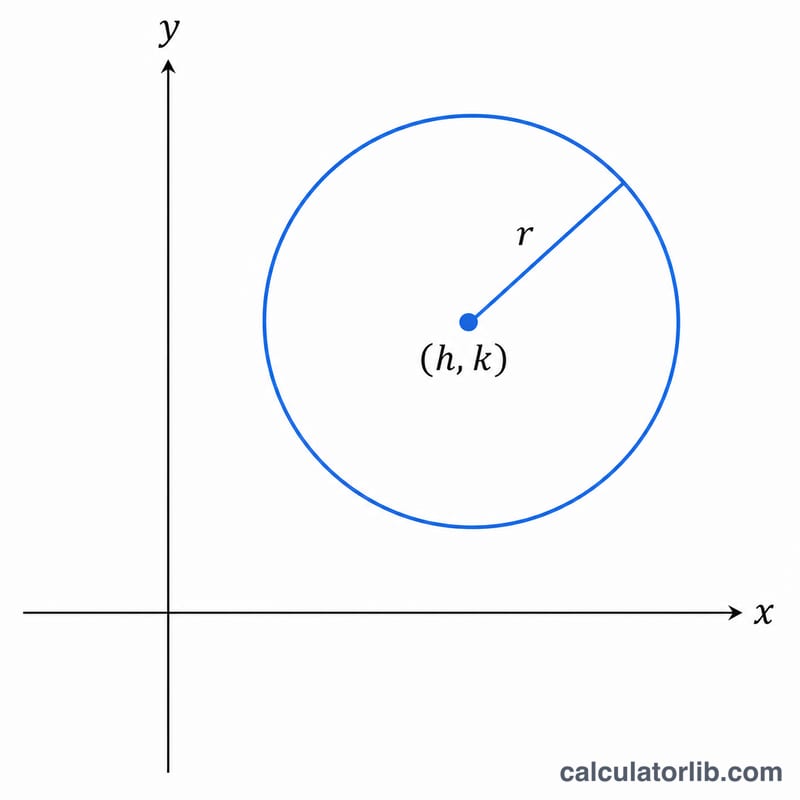
A circle is most intuitively described in standard form, \((x - h)^2 + (y - k)^2 = r^2\), where \((h, k)\) is the center and \(r\) is the radius. Expanding that expression and collecting terms gives the general form: \(x^2 + y^2 + Dx + Ey + F = 0\). This calculator does that conversion for you, returning the three coefficients \(D\), \(E\) and \(F\).
How to use this calculator
Enter the x-coordinate of the center (h), the y-coordinate of the center (k) and the radius (r). The tool instantly computes the general-form coefficients and shows the full equation. Negative centers and decimal radii are fully supported.
The formula explained
Starting from \((x - h)^2 + (y - k)^2 = r^2\), expand: \(x^2 - 2hx + h^2 + y^2 - 2ky + k^2 = r^2\). Move everything to one side: \(x^2 + y^2 - 2hx - 2ky + (h^2 + k^2 - r^2) = 0\). Matching this against \(x^2 + y^2 + Dx + Ey + F = 0\) gives:
$$D = -2h, \quad E = -2k, \quad F = h^2 + k^2 - r^2$$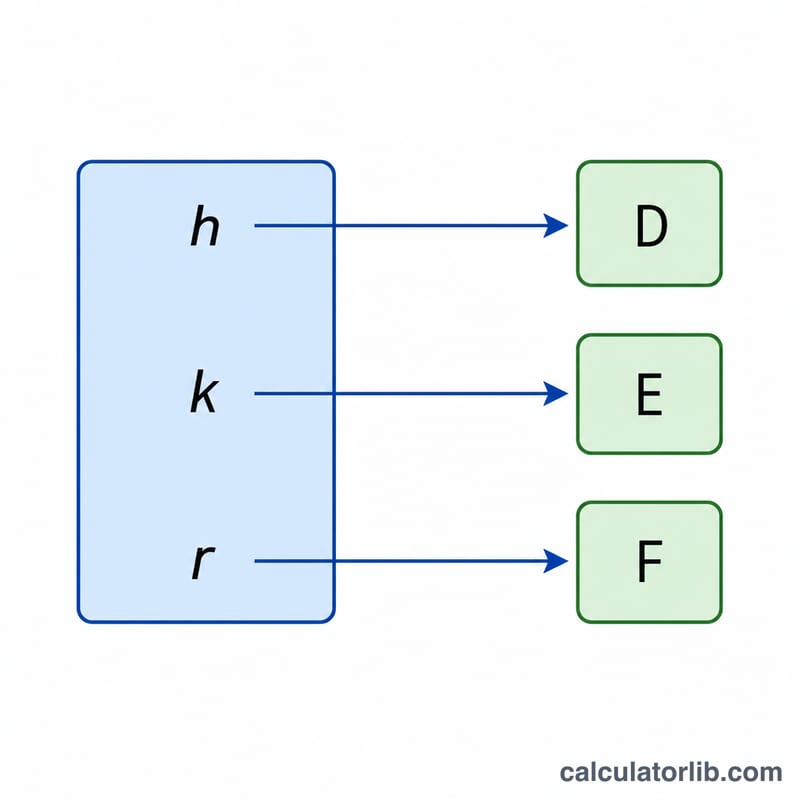
Worked example
Take a circle with center \((3, -2)\) and radius \(4\). Then
$$D = -2(3) = -6, \quad E = -2(-2) = 4, \quad F = 3^2 + (-2)^2 - 4^2 = 9 + 4 - 16 = -3.$$The general form is therefore \(x^2 + y^2 - 6x + 4y - 3 = 0\).
FAQ
Can I go back to center and radius? Yes — given \(D\), \(E\), \(F\) you recover \(h = -D/2\), \(k = -E/2\), and \(r = \sqrt{h^2 + k^2 - F}\).
What if F makes the radius imaginary? If \(h^2 + k^2 - F\) is negative there is no real circle (an "imaginary circle"); a valid radius requires \(r^2 = h^2 + k^2 - F \geq 0\).
Does the order of D and E matter? \(D\) always multiplies \(x\) and \(E\) always multiplies \(y\), so keep them paired with their variables.