
What This Calculator Does
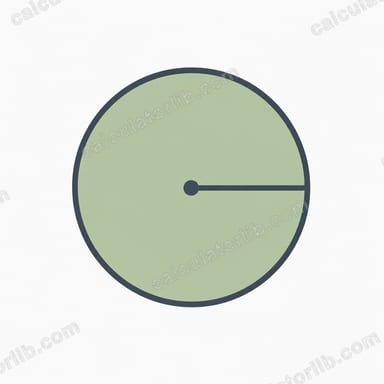
This tool converts the equation of a circle from its general form — \(x^2 + y^2 + \text{D}x + \text{E}y + \text{F} = 0\) — into the more useful standard form \((x - h)^2 + (y - k)^2 = r^2\). From the standard form you can immediately read off the circle's center \((h, k)\) and its radius \(r\), which makes graphing and geometry problems far easier.
How to Use It
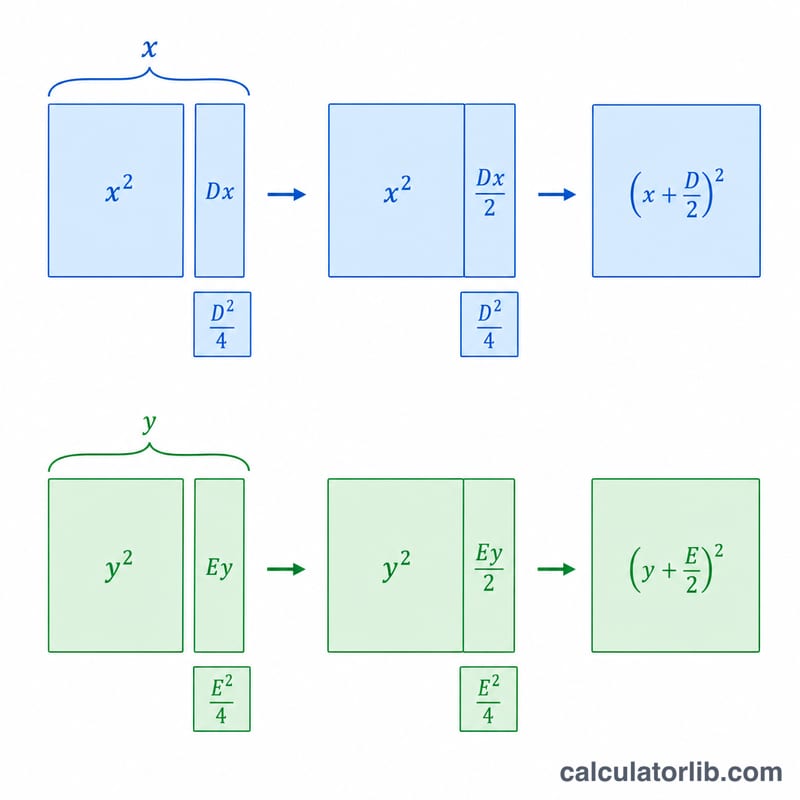
Enter the three coefficients exactly as they appear in the general equation: D (the coefficient of x), E (the coefficient of y), and F (the constant term). The calculator completes the square for you and returns the center, the radius, and the fully assembled standard-form equation.
The Formula Explained
Completing the square on the x and y terms gives \(h = -\frac{\text{D}}{2}\) and \(k = -\frac{\text{E}}{2}\). Substituting back, the right-hand side becomes \(r^2 = h^2 + k^2 - \text{F}\), so the radius is \(r = \sqrt{h^2 + k^2 - \text{F}}\). If that quantity is zero the "circle" is a single point, and if it is negative no real circle exists.
$$(x-h)^2 + (y-k)^2 = r^2 \\[1.5em] \text{where}\quad \left\{ \begin{aligned} h &= -\dfrac{\text{D}}{2} \\ k &= -\dfrac{\text{E}}{2} \\ r &= \sqrt{h^2 + k^2 - \text{F}} \end{aligned} \right.$$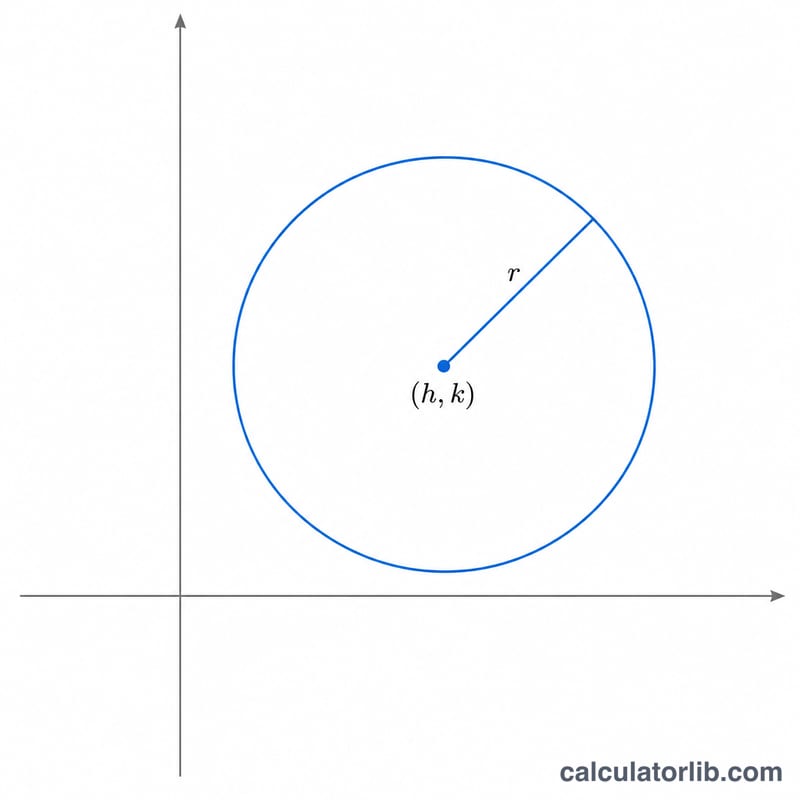
Worked Example
Take \(x^2 + y^2 - 6x + 8y + 9 = 0\), so \(\text{D} = -6\), \(\text{E} = 8\), \(\text{F} = 9\). Then \(h = -\frac{-6}{2} = 3\) and \(k = -\frac{8}{2} = -4\). The radius² is $$r^2 = 3^2 + (-4)^2 - 9 = 9 + 16 - 9 = 16,$$ so \(r = 4\). The standard form is $$(x - 3)^2 + (y + 4)^2 = 16.$$
FAQ
What if my equation has \(\text{A}x^2 + \text{A}y^2\) terms? Divide the whole equation by \(\text{A}\) first so the \(x^2\) and \(y^2\) coefficients are 1, then use the resulting D, E, F.
Why is the center \((-\frac{\text{D}}{2}, -\frac{\text{E}}{2})\) and not \((\frac{\text{D}}{2}, \frac{\text{E}}{2})\)? Completing the square introduces a sign flip, so the center coordinates are the negatives of half the linear coefficients.
What does a negative \(r^2\) mean? It means the equation has no real solutions — there is no actual circle, only an imaginary one.