
What Is a Heptagon?
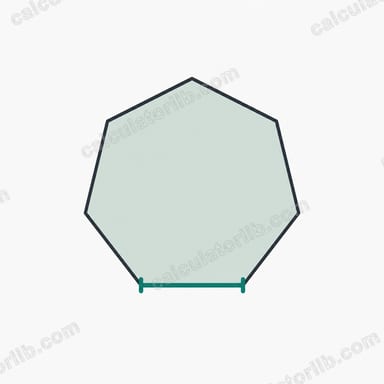
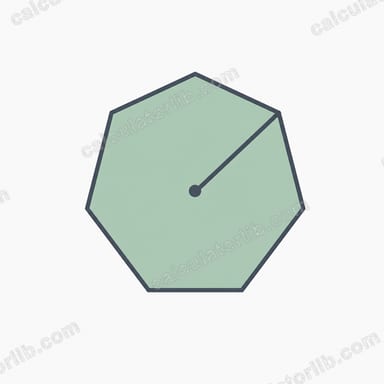
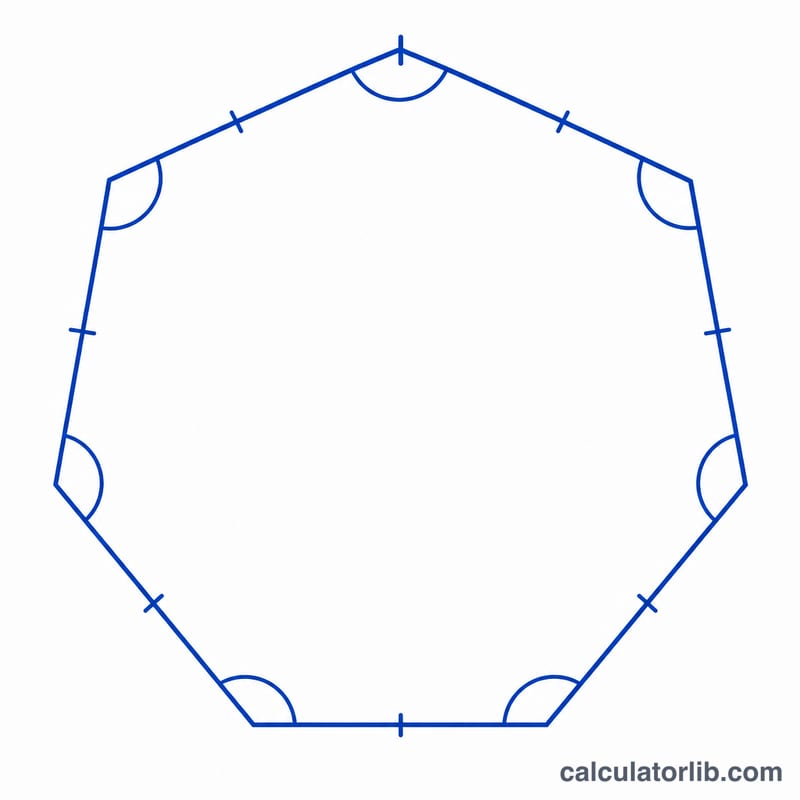
A heptagon (also called a septagon) is a polygon with seven sides and seven angles. A regular heptagon has all sides equal and all interior angles equal — each interior angle measures about 128.57°. This calculator works with regular heptagons, computing the area, perimeter, apothem (inradius) and circumradius directly from a single input: the side length.
How to Use This Calculator
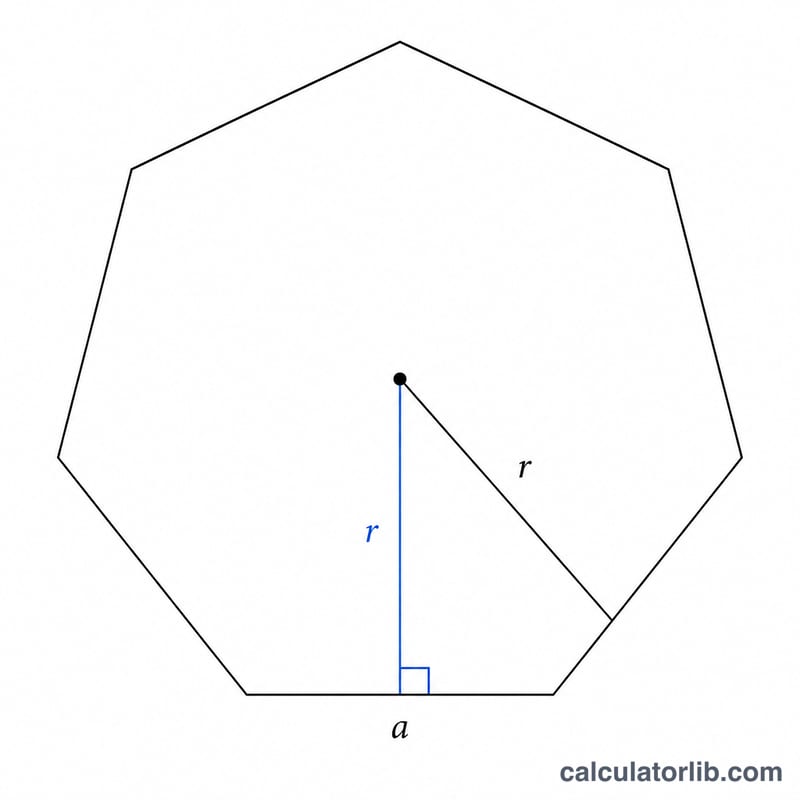
Enter the length of one side (a) in any unit you like — centimeters, inches, meters. The results come back in those same units (area is in square units). The tool instantly returns the enclosed area, the total perimeter, the apothem (the distance from the center to the midpoint of a side) and the circumradius (the distance from the center to a vertex).
The Formula Explained
The area of a regular heptagon is given by:
$$A = \frac{7}{4}\,\text{Side }(a)^{2}\cot\!\left(\frac{\pi}{7}\right)$$
Here a is the side length and \(\cot\!\left(\frac{\pi}{7}\right)\) is the cotangent of \(180°/7 \approx 25.714°\), which equals about \(2.07652\). The perimeter is simply \(P = 7a\). The apothem is \(\frac{a}{2\tan\!\left(\frac{\pi}{7}\right)}\) and the circumradius is \(\frac{a}{2\sin\!\left(\frac{\pi}{7}\right)}\).
Worked Example
Suppose a heptagon has a side length of 10. Then:
$$\text{Area} = \frac{7}{4} \times 10^{2} \times 2.07652 \approx 1.75 \times 100 \times 2.07652 \approx 363.39 \text{ square units}$$
$$\text{Perimeter} = 7 \times 10 = 70 \text{ units}$$
$$\text{Apothem} = \frac{10}{2 \times 0.48157} \approx 10.383 \text{ units}$$
$$\text{Circumradius} = \frac{10}{2 \times 0.43388} \approx 11.524 \text{ units}$$
FAQ
Is a heptagon the same as a septagon? Yes — both names refer to a seven-sided polygon. "Hepta" comes from Greek and "septa" from Latin.
What is the sum of interior angles? For any heptagon it is \((7-2) \times 180° = 900°\), so each angle in a regular heptagon is \(900°/7 \approx 128.57°\).
Does this work for irregular heptagons? No. These formulas assume a regular heptagon with all equal sides and angles. Irregular heptagons require coordinate or triangulation methods.