
What this calculator does
This tool estimates your LDL ("bad") cholesterol, your non-HDL cholesterol, and your LDL/HDL ratio (L/H ratio) from a standard lipid panel. It uses the Friedewald equation, published by Friedewald, Levy and Fredrickson in 1972, which remains the most widely used way to estimate LDL without a separate direct measurement. The formula itself is universal medicine and not specific to any country, but this calculator expects values in mg/dL — the conventional unit used on US-style and Japan-style lipid panels.
How to use it
Enter the three numbers from your blood test in mg/dL: Total Cholesterol (TC), HDL cholesterol, and Triglycerides (TG). The calculator returns your estimated LDL, your non-HDL cholesterol, and the LDL/HDL ratio. If your lab reports in mmol/L, convert first: cholesterol mmol/L \(\times 38.67\) = mg/dL, and triglycerides mmol/L \(\times 88.57\) = mg/dL.
The formula explained
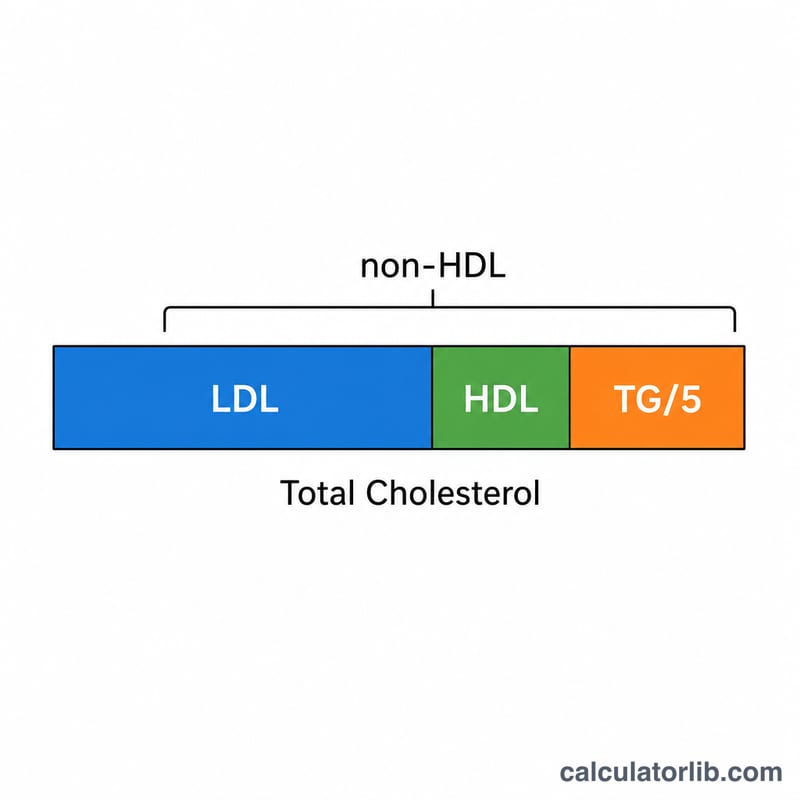
$$\text{LDL} = \text{TC} - \text{HDL} - \frac{\text{TG}}{5}$$ The TG/5 term estimates VLDL cholesterol, and the divisor of 5 is valid only in mg/dL. Non-HDL cholesterol is simply $$\text{Non-HDL} = \text{TC} - \text{HDL}$$ and the L/H ratio is LDL divided by HDL.
Worked example
With TC = 180, HDL = 50, TG = 60 (mg/dL): $$\text{LDL} = 180 - 50 - \frac{60}{5} = 118 \text{ mg/dL}$$ $$\text{Non-HDL} = 180 - 50 = 130 \text{ mg/dL}$$ $$\text{L/H ratio} = \frac{118}{50} = 2.36$$
FAQ
Why won't it compute LDL when triglycerides are high? The Friedewald formula becomes inaccurate when TG is 400 mg/dL or higher, so the tool refuses to estimate LDL in that case — your LDL should be measured directly by the lab. Non-HDL is still shown.
What if my HDL is 0? The L/H ratio cannot be calculated (division by zero) and is shown as undefined, but LDL and non-HDL are still computed.
Is this a diagnosis? No. This is an estimate for self-management and education only. Always discuss your results with a qualified healthcare professional.