
What Is Non-HDL Cholesterol?
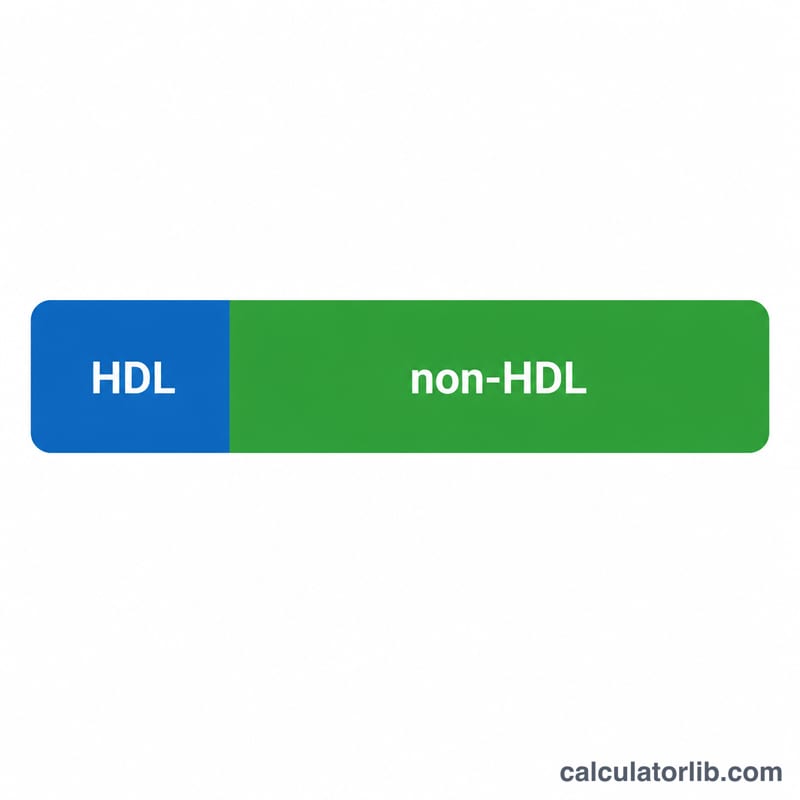
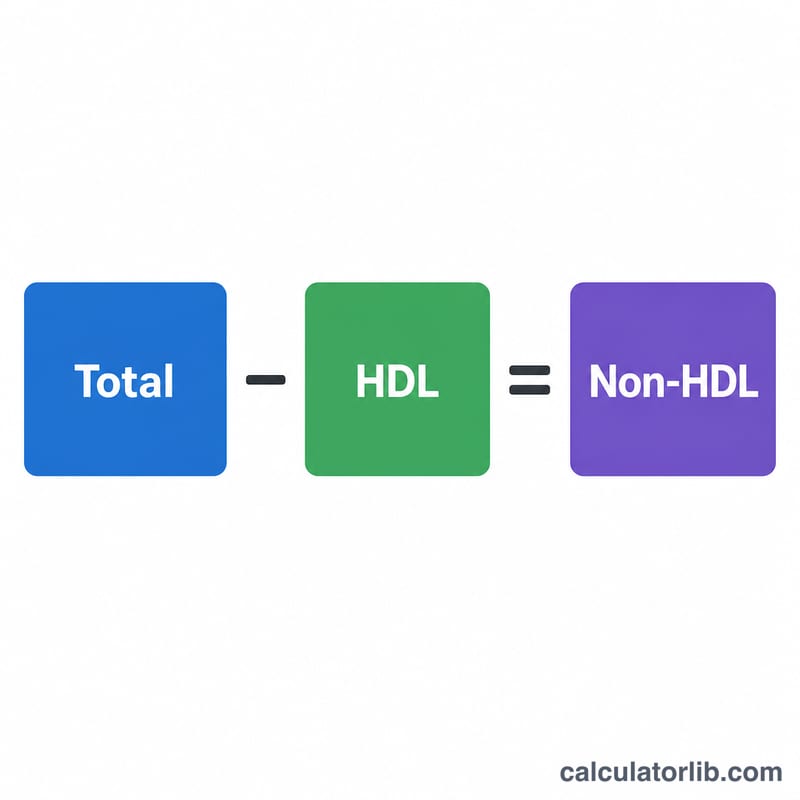
Non-HDL cholesterol represents all the "bad" cholesterol-carrying particles in your blood — including LDL, VLDL, and other atherogenic lipoproteins. It is calculated simply by subtracting your HDL ("good") cholesterol from your total cholesterol. Because it captures more than just LDL, many clinicians consider non-HDL a stronger predictor of cardiovascular risk, especially in people with high triglycerides or diabetes. This tool is for general education and is not medical advice; cholesterol targets vary by country and individual risk profile.
How to Use This Calculator
Enter your total cholesterol and HDL cholesterol values, both in milligrams per deciliter (mg/dL), as shown on your lipid panel. The calculator subtracts HDL from total cholesterol and displays your non-HDL value along with a general category. If your lab reports in mmol/L, multiply by 38.67 to convert to mg/dL first.
The Formula Explained
The equation is straightforward: $$\text{Non-HDL} = \text{Total Cholesterol} - \text{HDL}$$. No measurement of LDL or triglycerides is required, which is one reason non-HDL is reliable even on non-fasting samples. The result reflects the cholesterol carried by every particle except HDL.
Worked Example
Suppose your total cholesterol is 220 mg/dL and your HDL is 55 mg/dL. Then $$\text{Non-HDL} = 220 - 55 = 165 \text{ mg/dL}$$ which falls in the "Borderline high" range under common guidelines.
FAQ
What is a healthy non-HDL level? Many guidelines consider below 130 mg/dL optimal, though your personal target depends on overall risk.
Do I need to fast before the test? Non-HDL can be calculated accurately even from non-fasting blood, unlike directly calculated LDL.
Is non-HDL the same as LDL? No. Non-HDL includes LDL plus VLDL and other particles, so it is usually a bit higher than LDL.