

What Is APY?
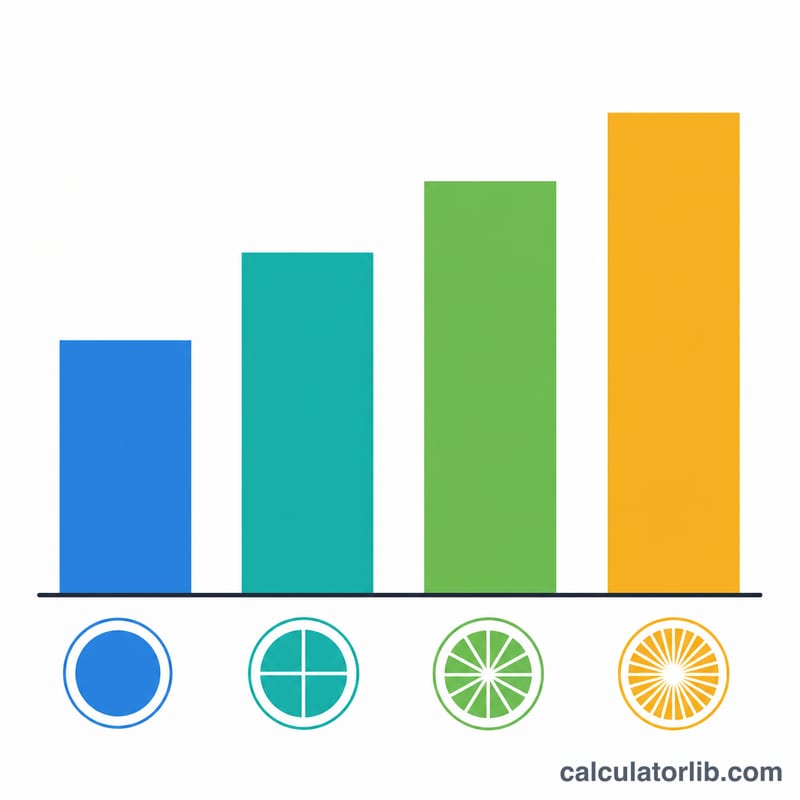
Annual Percentage Yield (APY) is the real rate of return you earn on a deposit or investment in one year once compounding is taken into account. Unlike the nominal (stated) interest rate, APY reflects the effect of interest earning interest. Two accounts with the same nominal rate can deliver different APYs if they compound at different frequencies — more frequent compounding means a higher APY.
How to Use This Calculator
Enter the nominal interest rate as a percentage and choose how often the interest compounds per year (monthly, daily, quarterly, etc.). The calculator returns the effective APY, along with the difference between APY and the nominal rate so you can see exactly how much compounding adds.
The Formula Explained
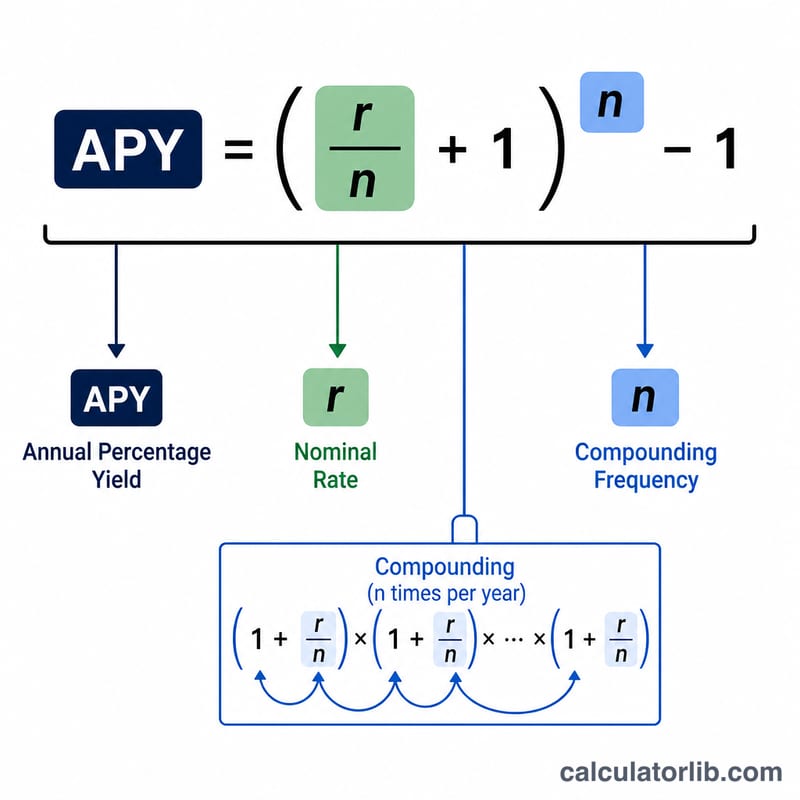
The APY formula is $$\text{APY} = \left(1 + \frac{r}{n}\right)^{n} - 1$$ where r is the nominal annual rate expressed as a decimal (e.g. 5% = 0.05) and n is the number of compounding periods per year. Dividing r by n gives the periodic rate; raising the result to the power of n compounds it across the whole year; subtracting 1 isolates the growth portion. Multiply by 100 to express APY as a percentage.
Worked Example
Suppose a savings account pays a 5% nominal rate compounded monthly (\(n = 12\)). Then $$\text{APY} = \left(1 + \frac{0.05}{12}\right)^{12} - 1 = (1.0041667)^{12} - 1 \approx 0.051162$$ or about 5.1162%. So a 5% nominal rate is actually worth roughly 5.12% per year thanks to monthly compounding.
FAQ
What is the difference between APR and APY? APR (Annual Percentage Rate) is the simple nominal rate and ignores compounding within the year, while APY includes compounding, making it the truer measure of return.
Does more frequent compounding always increase APY? Yes — for a fixed nominal rate, the more often interest compounds, the higher the APY, approaching a maximum at continuous compounding.
Is APY the same as the interest I'll actually receive? APY is the effective one-year rate. Your actual dollar earnings also depend on your balance and any deposits, withdrawals, or fees.