
What is the Annual Percentage Growth (CAGR) Calculator?
This calculator finds the compound annual growth rate (CAGR) — the smooth, constant percentage by which a value would have to increase each year to grow from a starting amount to an ending amount over a given number of years. It is the standard way to express the average yearly growth of investments, revenue, population, or any quantity that compounds over time.
How to use it
Enter the beginning value (the amount at the start of the period), the ending value (the amount at the end), and the number of years between them. The calculator returns the average percentage increase per year plus the total growth over the full period.
The formula explained
The CAGR formula is:
$$\text{CAGR} = \left( \left( \frac{\text{End}}{\text{Begin}} \right)^{\frac{1}{n}} - 1 \right) \times 100$$
Dividing the ending value by the beginning value gives the total growth multiple. Raising that to the power of 1 divided by the number of years (\(n\)) finds the equivalent single-year multiplier. Subtracting 1 and multiplying by 100 converts it into a percentage. Unlike a simple average, CAGR accounts for compounding, so it reflects real year-over-year growth.
Worked example
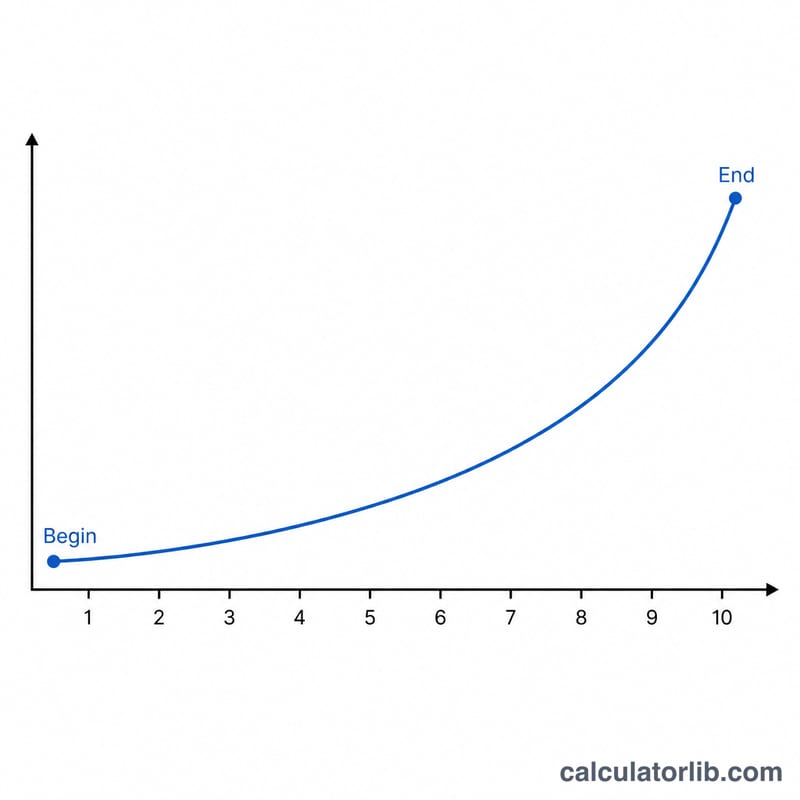
Suppose an investment grows from $1,000 to $2,000 over 5 years. Then \(\text{End} \div \text{Begin} = 2\). Raising 2 to the power \(1/5\) gives about \(1.1487\). Subtracting 1 leaves \(0.1487\), and multiplying by 100 gives a CAGR of about 14.87% per year. The total growth over the period is 100%.
FAQ
How is CAGR different from total growth? Total growth is the overall percentage change across the entire period. CAGR breaks that down into a single, constant yearly rate that accounts for compounding.
Can I use months instead of years? Yes — just enter the time span in the same unit you want the rate expressed in (e.g. 60 for months), though the result would then be a per-month rate.
What if the value decreased? If the ending value is smaller than the beginning value, CAGR will be negative, indicating an average annual decline.