
What Is Purchasing Power Loss?
Inflation steadily reduces what your money can buy. A dollar today buys more than the same dollar will buy in ten years. This calculator measures that erosion: it tells you the percentage of purchasing power your money loses over a chosen period at a given annual inflation rate, and optionally converts a starting amount into its real, inflation-adjusted value.
How to Use It
Enter the expected average annual inflation rate as a percentage, the number of years you want to look ahead, and (optionally) a starting amount of money. The calculator returns the percentage of purchasing power lost, the percentage that remains, and the real value of your starting amount.
The Formula Explained
The percentage of purchasing power lost is:
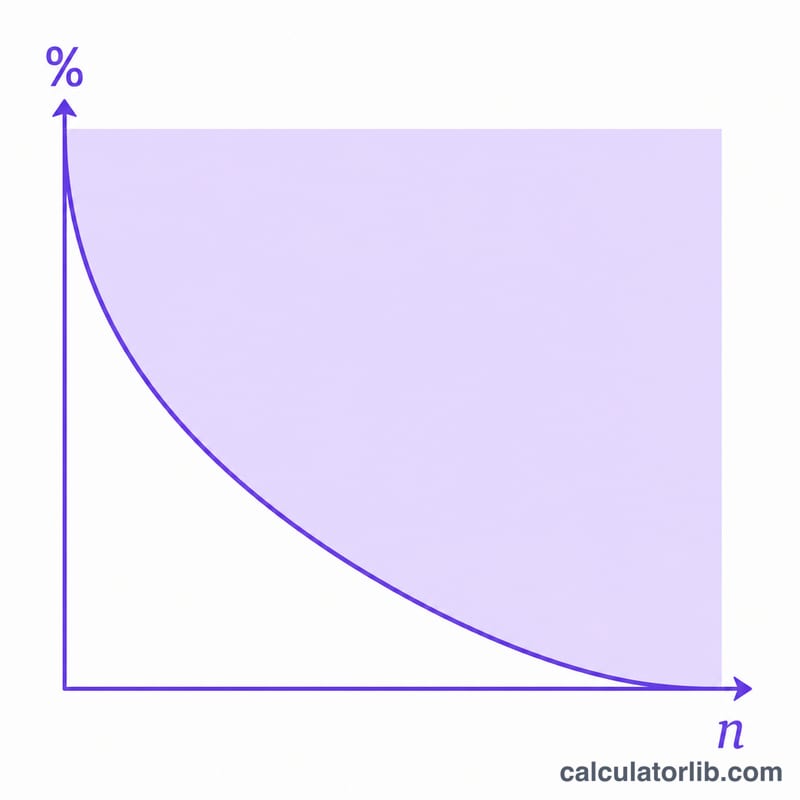
$$\text{Power Lost (\%)} = \left(1 - \frac{1}{(1 + i)^{n}}\right) \times 100$$
Here \(i\) is the inflation rate expressed as a decimal (3% = 0.03) and \(n\) is the number of years. The term \(1 / (1 + i)^{n}\) is the present-value discount factor — the fraction of real value that survives. Subtracting it from 1 gives the fraction lost.
Worked Example
Suppose inflation averages 3% per year for 10 years. The growth factor is \((1.03)^{10} \approx 1.3439\). The remaining purchasing power is \(1 / 1.3439 \approx 0.7441\), or 74.41%. So the power lost is \(1 - 0.7441 = 0.2559\), about 25.59%. A $1,000 sum would have the real buying power of roughly $744.09 — meaning about $255.91 of value is eroded.
FAQ
Does this predict future inflation? No. It uses the rate you supply. Real inflation varies year to year, so treat the result as a scenario, not a forecast.
Why isn't 3% over 10 years just 30%? Because inflation compounds. Each year's prices rise on top of the previous year's, so the cumulative effect is non-linear.
Is this the same as a discount rate? Mathematically yes — the remaining value uses the standard present-value discount factor \(1/(1+i)^{n}\).