
What Is Body Surface Area?
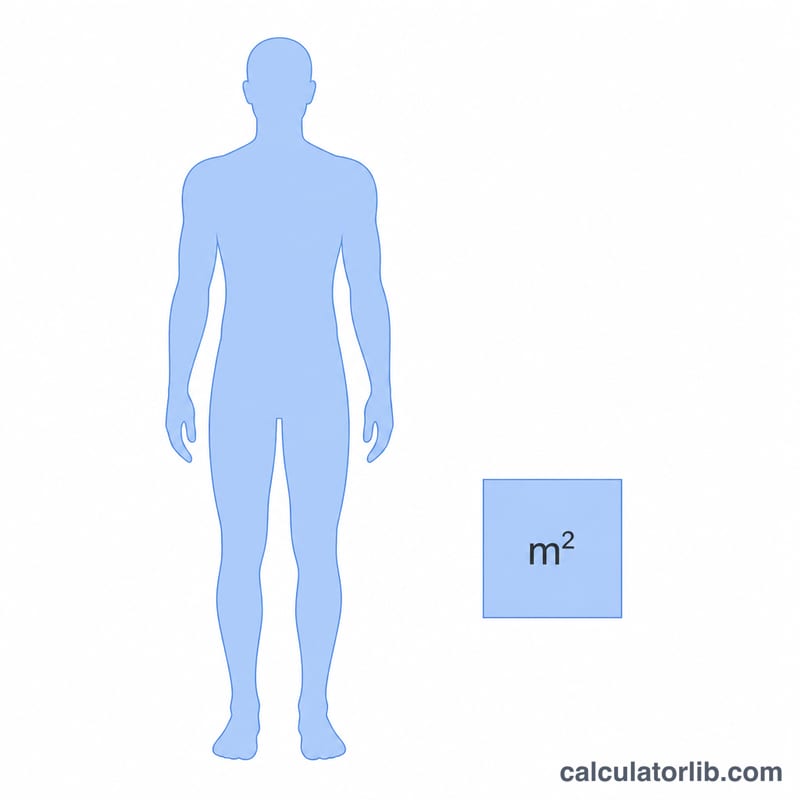
Body Surface Area (BSA) is a measurement of the total external area of the human body, expressed in square meters (m²). It is widely used in medicine — especially for dosing chemotherapy drugs, calculating cardiac index, and estimating metabolic and fluid requirements — because it correlates better with physiological function than body weight alone. The Mosteller formula is one of the most popular methods because it is simple, easy to remember, and accurate across a wide range of body sizes.
How to Use This Calculator
Enter your height in centimeters and your weight in kilograms, then submit. The calculator instantly returns your estimated BSA in square meters. For reference, the average adult BSA is roughly 1.7 m², though it varies with body size.
The Mosteller Formula Explained
The Mosteller equation is: BSA = √(height × weight / 3600), where height is in centimeters and weight is in kilograms. The constant 3600 simplifies the relationship so the square root yields a value in square meters. Its elegance lies in needing only a single square root operation, which is why clinicians can compute it quickly at the bedside.
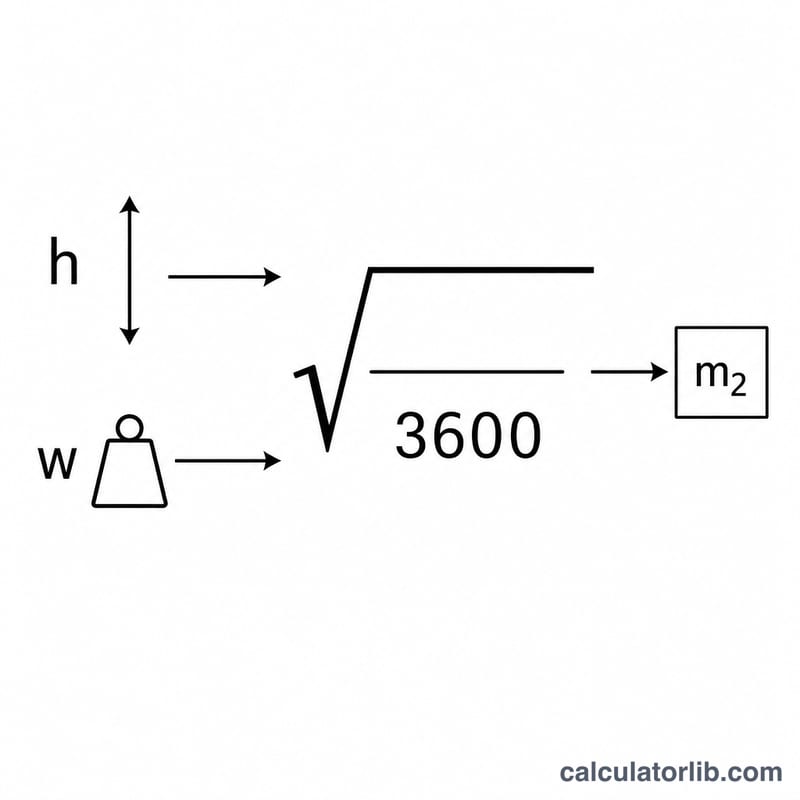
Worked Example
Suppose a person is 180 cm tall and weighs 80 kg. First multiply: 180 × 80 = 14,400. Divide by 3600: 14,400 / 3600 = 4. Take the square root: √4 = 2. So the BSA is exactly 2.00 m².
Typical BSA Values by Age and Body Size
Body surface area (BSA) increases with body size, growing rapidly through childhood before levelling off in adulthood. The values below are widely cited average figures used as general reference points. The 1.7 m² figure is the classic adult reference value historically used to normalize physiological measurements such as cardiac output and glomerular filtration rate.
| Group | Approximate BSA (m²) |
|---|---|
| Neonate (newborn) | ~0.25 |
| 2-year-old child | ~0.5 |
| 9-year-old child | ~1.07 |
| Adult reference (standard) | ~1.7 |
| Average adult woman | ~1.6 |
| Average adult man | ~1.9 |
Individual values vary considerably with height and weight; these averages are intended for orientation rather than precise clinical use.
BSA Across Different Body Sizes
The Mosteller formula is \(\text{BSA} = \sqrt{\dfrac{\text{Height (cm)} \times \text{Weight (kg)}}{3600}}\). The table below applies it to several realistic height and weight combinations. For example, a person measuring 180 cm and 80 kg has \(\text{BSA}=\sqrt{\dfrac{180\times80}{3600}}=\sqrt{4}=2.00\;\text{m}^2\).
| Height (cm) | Weight (kg) | Mosteller BSA (m²) |
|---|---|---|
| 150 | 50 | 1.44 |
| 165 | 65 | 1.73 |
| 180 | 80 | 2.00 |
| 190 | 100 | 2.30 |
Notice that the 165 cm / 65 kg case lands almost exactly on the 1.7 m² adult reference value.
Interpreting Your BSA Result
Your BSA result is expressed in square meters (m²) and represents the estimated total external surface area of the body. A larger value reflects a larger overall body size — it rises with both height and weight, so it captures body dimensions in a single number better than weight alone.
An adult value near 1.7 m² is the long-standing clinical reference because it approximates the surface area of an average adult; most healthy adults fall roughly between 1.5 and 2.0 m². This is why BSA is widely used in medicine to normalize and individualize measurements, including:
- Drug dosing — many chemotherapy agents and other medications are dosed per m² of BSA to scale the dose to body size.
- Cardiac index — cardiac output divided by BSA, allowing comparison across people of different sizes.
- Other physiological indices such as indexed glomerular filtration rate.
Keep in mind that the Mosteller formula gives an estimate derived only from height and weight; it does not account for body composition, fluid status, or individual variation, and different BSA formulas (e.g. Du Bois) can yield slightly different values. This page provides general information, not professional medical advice — always consult a qualified clinician for dosing, diagnosis, or any medical decision.
FAQ
Which units should I use? This calculator uses metric units — centimeters for height and kilograms for weight.
How does Mosteller compare to Du Bois? The Mosteller and Du Bois formulas give very similar results for most people, but Mosteller is simpler and slightly easier to compute by hand.
Is BSA the same for children and adults? The formula applies to both, but typical values are lower for children because of their smaller size. Always consult a healthcare professional for clinical dosing decisions.