
What is Body Surface Area?
Body Surface Area (BSA) is the total external surface area of the human body, expressed in square metres (m²). It is widely used in medicine because it correlates better with metabolic mass than body weight alone. Clinicians use BSA to calculate chemotherapy doses, cardiac index, glomerular filtration rate, and other physiological parameters that scale with body size.
How to use this calculator
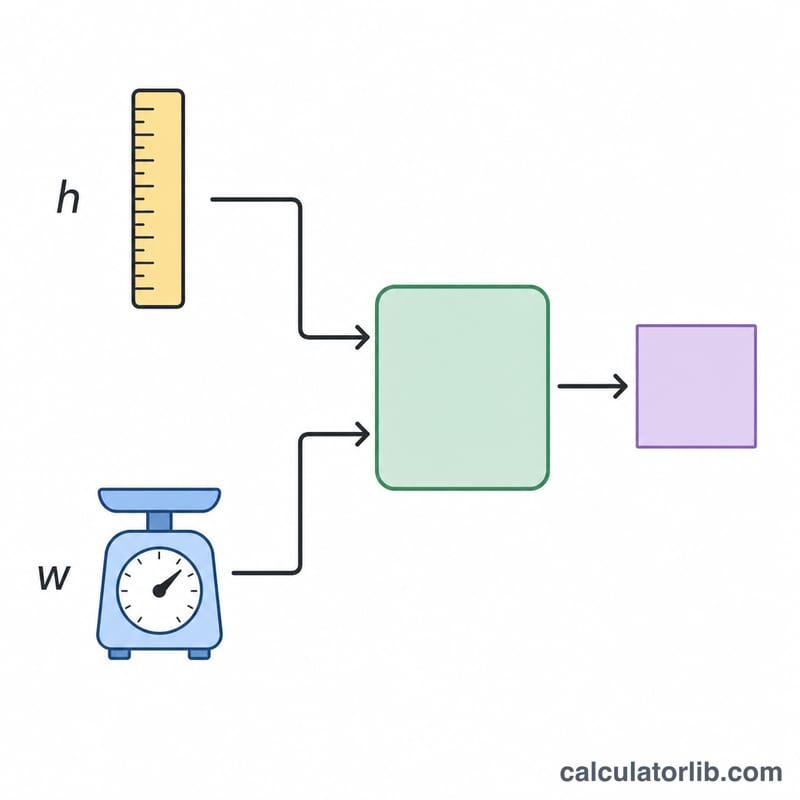
Enter your height in centimetres and your weight in kilograms, then submit. The calculator returns BSA from two of the most widely cited equations: the Mosteller formula (simple and fast) and the Du Bois & Du Bois formula (the historical standard). Both results are shown in m² so you can compare them.
The formulas explained
The Mosteller formula is $$\text{BSA} = \sqrt{\dfrac{\text{height} \times \text{weight}}{3600}}$$ where height is in cm and weight in kg. It is popular because it is easy to compute by hand. The Du Bois formula is $$\text{BSA} = 0.007184 \times \text{height}^{0.725} \times \text{weight}^{0.425}$$ derived in 1916 from measurements of nine subjects. The two formulas usually agree to within a few percent for typical adults.
Worked example
For a person 180 cm tall weighing 80 kg: $$\text{Mosteller} = \sqrt{\dfrac{180 \times 80}{3600}} = \sqrt{\dfrac{14400}{3600}} = \sqrt{4} = 2.00 \text{ m}^2$$ $$\text{Du Bois} = 0.007184 \times 180^{0.725} \times 80^{0.425} \approx 1.9979 \text{ m}^2$$ Both give roughly 2.0 m².
Interpreting Your BSA Result
Your BSA result is expressed in square meters (m²) and represents an estimate of the total external surface area of your body. Most adults fall between roughly 1.5 and 2.0 m², with the often-quoted average around 1.7 m².
- Compared to the ~1.7 m² average: A higher value reflects a larger body (taller and/or heavier), while a lower value reflects a smaller frame. Children and small adults sit well below this average.
- Compared to the 1.73 m² GFR standard: Laboratory eGFR is reported per 1.73 m² of body surface. If your actual BSA differs substantially from 1.73 m², the absolute (non-indexed) filtration rate scales proportionally — relevant when precise drug clearance or kidney function in very large or very small patients is being assessed.
Why BSA scales with metabolic mass: Many physiological quantities — resting metabolic rate, cardiac output, and the volume in which a drug distributes — track more closely with surface area than with body weight alone. This is why chemotherapy doses, cardiac index, and burn-fluid calculations are frequently expressed per m² rather than per kg.
Why two formulas may differ slightly: The Mosteller formula is a simple square-root approximation, while the Du Bois & Du Bois formula uses a power equation fitted to a small early dataset. For most adult heights and weights the two agree within roughly 1–3%; differences widen at the extremes of body size. Neither is "more correct" in an absolute sense — they are estimating equations, and the choice is often institutional convention.
This is general educational information, not medical advice. Any dosing, GFR indexing, or clinical decision based on BSA must be reviewed and confirmed by a qualified clinician.
BSA Across Different Body Sizes
The table compares the Mosteller and Du Bois & Du Bois estimates across a range of body sizes. Mosteller uses \(\sqrt{(\text{height}\times\text{weight})/3600}\); Du Bois uses \(0.007184 \times \text{height}^{0.725} \times \text{weight}^{0.425}\) (height in cm, weight in kg). The final column shows the percentage difference relative to the Mosteller value.
| Height (cm) | Weight (kg) | Mosteller BSA (m²) | Du Bois BSA (m²) | Difference |
|---|---|---|---|---|
| 150 | 50 | 1.44 | 1.43 | ~0.7% |
| 165 | 65 | 1.73 | 1.72 | ~0.6% |
| 175 | 75 | 1.91 | 1.91 | ~0.0% |
| 185 | 95 | 2.21 | 2.20 | ~0.5% |
Notice that the 165 cm / 65 kg case lands almost exactly on the 1.73 m² GFR-normalization standard. Across these typical adult sizes the two formulas agree to within about 1%, confirming that either is acceptable for routine estimation while small differences emerge at the size extremes.
FAQ
Which formula should I use? Mosteller is preferred in many clinical settings for its simplicity, but Du Bois remains a recognised standard. For most adults the difference is small.
What is an average BSA? The average adult BSA is roughly 1.7 m² (about 1.6 m² for women and 1.9 m² for men).
Does this work for children? Yes, both formulas accept any valid height and weight, though pediatric dosing should always be confirmed by a clinician.