
What is Body Surface Area (BSA)?
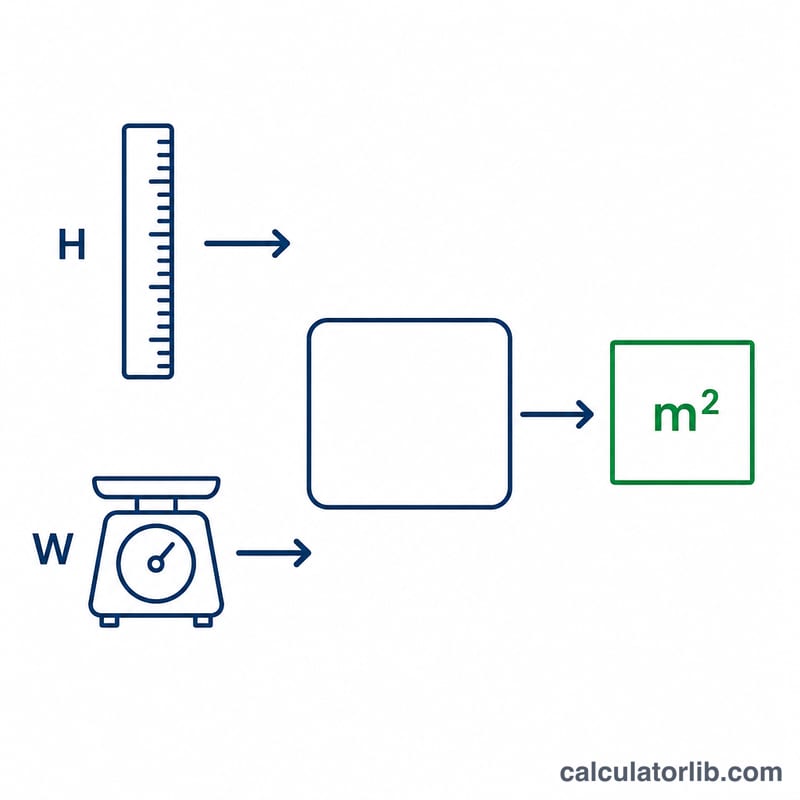
Body surface area (BSA) is the total external surface of the human body, expressed in square meters (m²). Because BSA correlates with metabolic mass better than body weight alone, clinicians use it to dose chemotherapy and other medications, calculate cardiac index, estimate fluid needs, and assess burn extent. This tool estimates BSA from your height and weight using three well-known regression formulas. The Shintani and Fujimoto formulas were derived from Japanese populations, but the arithmetic is universal and works for anyone.
How to use this calculator
Enter your height and choose its unit (cm, m, or inch) and your weight with its unit (kg or lb). The calculator converts everything to centimeters and kilograms internally, then applies all three formulas. Results are shown in square meters, rounded to three decimals. Both height and weight must be positive numbers.
The formulas explained
With H in centimeters and W in kilograms: Du Bois uses $$\text{BSA} = H^{0.725} \times W^{0.425} \times 0.007184.$$ Shintani uses the same exponents with a slightly larger constant 0.007358. Fujimoto uses different exponents and constant: $$\text{BSA} = H^{0.663} \times W^{0.444} \times 0.008883.$$ The power terms are evaluated on the raw numeric values of height (cm) and weight (kg).
Worked example
For a person 170 cm tall weighing 65 kg: \(170^{0.725} = 41.414\) and \(65^{0.425} = 5.895\), so the common product is 244.14. $$\text{Du Bois} = 244.14 \times 0.007184 = 1.754 \ \text{m}^2;$$ $$\text{Shintani} = 244.14 \times 0.007358 = 1.796 \ \text{m}^2.$$ $$\text{Fujimoto} = 170^{0.663} \times 65^{0.444} \times 0.008883 = 30.117 \times 6.382 \times 0.008883 = 1.708 \ \text{m}^2.$$
Formula Constants and Exponents
Each equation has the general form \(\text{BSA} = k \times H^{a} \times W^{b}\), where \(H\) is height in centimetres, \(W\) is weight in kilograms, \(k\) is the multiplier constant, and \(a\) and \(b\) are the height and weight exponents. The table lists the published parameters for each formula.
| Formula | Constant \(k\) | Height exponent \(a\) | Weight exponent \(b\) | Units |
|---|---|---|---|---|
| Du Bois | 0.007184 | 0.725 | 0.425 | H in cm, W in kg |
| Shintani | 0.007358 | 0.725 | 0.425 | H in cm, W in kg |
| Fujimoto | 0.008883 | 0.663 | 0.444 | H in cm, W in kg |
Note that Du Bois and Shintani share the same exponents (0.725 and 0.425) and differ only in the leading constant, which is why Shintani returns values a fixed proportion higher than Du Bois (about 2.4% larger). The Fujimoto equation uses distinct exponents, giving it a slightly different dependence on height and weight.
Worked example (Du Bois, 170 cm, 70 kg):
$$\text{BSA} = 0.007184 \times 170^{0.725} \times 70^{0.425} = 1.81\ \text{m}^2$$The same height and weight in the Fujimoto equation gives:
$$\text{BSA} = 0.008883 \times 170^{0.663} \times 70^{0.444} = 1.79\ \text{m}^2$$FAQ
Which formula should I use? Du Bois & Du Bois (1916) is the historical clinical standard worldwide. Shintani and Fujimoto may fit some Asian body types more closely. The differences are usually small.
Can I trust this for medication dosing? No. These are population estimates for informational and educational use only and are not a substitute for clinical judgement or a measurement made by a qualified professional.
Why do I need both height and weight? BSA regressions combine stature and mass; supplying only one cannot produce a meaningful surface-area estimate.