What this calculator does
This tool converts between an earthquake's moment magnitude (Mw) and the seismic energy it releases, measured in joules (J), and expresses that energy as an equivalent mass of TNT explosive in metric tons. It is based on the Gutenberg-Richter energy-magnitude relation, a universal physics relationship that applies anywhere on Earth - it is not specific to any country, although it is often illustrated with notable Japanese earthquakes.
How to use it
Pick a conversion direction with the "Convert from" selector. Choose Magnitude to enter a value of M and get the energy in joules plus the TNT equivalent. Choose Energy (J) to enter an energy value with a unit (J through EJ) and get the matching magnitude and TNT mass. The energy unit simply scales your input to SI joules before the formula is applied.
The formula explained
The core relation is $$\log_{10}(J) = 4.8 + 1.5 \times M$$ where J is energy in joules and M is moment magnitude. Solving the other way gives \(M = (\log_{10}(J) - 4.8) / 1.5\). The factor 1.5 means each whole step up in magnitude multiplies the energy by \(10^{1.5} \approx 31.6\) times, and a 2-step jump multiplies it by 1000. For TNT, one metric ton of TNT releases \(4.184 \times 10^9\) J (4.184 GJ), so the equivalent mass is simply J divided by \(4.184\mathrm{e}9\).
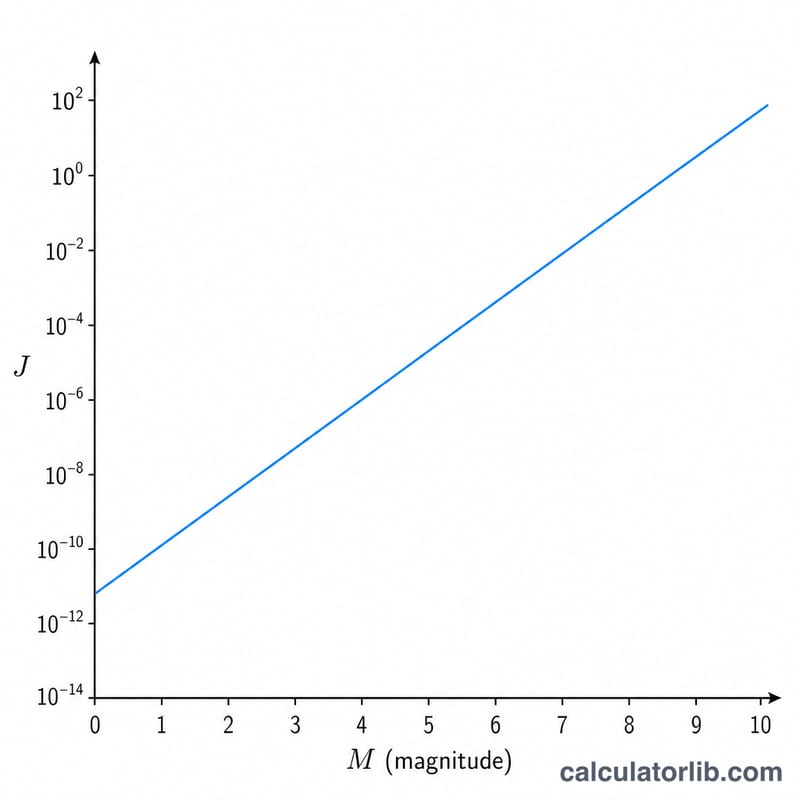
Worked example
For a magnitude M = 9.0 earthquake: $$\log_{10}(J) = 4.8 + 1.5 \times 9.0 = 18.3$$ so \(J = 10^{18.3} \approx 1.995 \times 10^{18}\) J (about 2 EJ). The TNT equivalent is $$\frac{1.995\mathrm{e}18}{4.184\mathrm{e}9} \approx 4.77 \times 10^8 \text{ tons}$$ - roughly 477 megatons of TNT.
Energy by Magnitude: Comparison Table
Values use \(\log_{10} E = 4.8 + 1.5M\) (E in joules) and \(\text{TNT (tons)} = E / 4.184\times10^{9}\). Figures are rounded to about three significant figures.
| Magnitude (M) | log10 E | Energy (J) | TNT equivalent | Multiple vs. previous row |
|---|---|---|---|---|
| 3 | 9.3 | 2.00 × 10⁹ J (2.0 GJ) | 0.477 t (about 477 kg) | – |
| 4 | 10.8 | 6.31 × 10¹⁰ J | 15.1 t | ×31.6 |
| 5 | 12.3 | 2.00 × 10¹² J (2.0 TJ) | 477 t (0.477 kt) | ×31.6 |
| 6 | 13.8 | 6.31 × 10¹³ J | 15.1 kt | ×31.6 |
| 7 | 15.3 | 2.00 × 10¹⁵ J (2.0 PJ) | 477 kt (0.477 Mt) | ×31.6 |
| 8 | 16.8 | 6.31 × 10¹⁶ J | 15.1 Mt | ×31.6 |
| 9 | 18.3 | 2.00 × 10¹⁸ J (2.0 EJ) | 477 Mt | ×31.6 |
| 10 | 19.8 | 6.31 × 10¹⁹ J | 15.1 Gt (15,100 Mt) | ×31.6 |
Each whole magnitude step multiplies energy by \(10^{1.5} \approx 31.6\). Two steps multiply it by 1,000 exactly, since \(10^{3} = 1000\).
Worked check for M = 6: \(\log_{10} E = 4.8 + 1.5 \times 6 = 13.8\), so \(E = 10^{13.8} \approx 6.31\times10^{13}\) J. Then \(6.31\times10^{13} / 4.184\times10^{9} \approx 15{,}080\) t, or about 15.1 kt TNT.
Interpreting the Energy and TNT Results
Benchmarks
- Hiroshima bomb: about 15 kt TNT, or roughly 63 TJ (6.3 × 10¹³ J). This is about the energy radiated by an M 6.0 earthquake by this relation.
- Tsar Bomba (largest nuclear device tested, 1961): about 50 Mt TNT, or roughly 2.1 × 10¹⁷ J. Inverting the relation, \(M = (\log_{10}(2.1\times10^{17}) - 4.8)/1.5 = (17.32 - 4.8)/1.5 \approx 8.3\).
- Annual world electricity generation: on the order of 1020 J (roughly 100 EJ, or about 27,000–30,000 TWh in recent years). An M 10 event at 6.3 × 10¹⁹ J would be the same order of magnitude, although no earthquake that large is known.
What the number means
The result is the radiated seismic energy, the part carried away as seismic waves. It is not the total energy released. Most of the energy of a rupture goes into breaking rock and into heat, and the seismic share is only a fraction of the total. The value also does not measure shaking damage. A TNT equivalent is only a way to scale energy. An earthquake releases its energy over a huge volume of rock and over seconds to minutes, unlike an explosion.
Damage depends on other factors
Damage depends on focal depth, distance from the rupture, fault mechanism, local soil and ground conditions (soft sediments amplify shaking), and building quality. A shallow M 6 beneath a city can be far more destructive than a deep M 7 far from people.
Uncertainty
The Gutenberg–Richter energy relation is an empirical approximation. Real radiated energy for a given magnitude can differ by a factor of a few, and sometimes more, between events. Treat the results as order-of-magnitude estimates.
Constants Used
| Constant | Value | Meaning |
|---|---|---|
| Intercept | 4.8 | Constant term in \(\log_{10} E = 4.8 + 1.5M\), with E in joules |
| Slope | 1.5 | Increase in \(\log_{10} E\) per unit of magnitude |
| \(10^{1.5}\) | ≈ 31.6 | Energy multiple for each +1 magnitude |
| 1 ton TNT | 4.184 × 10⁹ J | Thermochemical definition (1 kt = 4.184 × 10¹² J; 1 Mt = 4.184 × 10¹⁵ J) |
| 1 EJ (exajoule) | 1018 J | Convenient unit for the largest earthquakes |
Inverse relation (energy to magnitude): \(M = \dfrac{ \log_{10} E - 4.8}{1.5}\), with E in joules.
FAQ
Which magnitude scale is this? It uses moment magnitude (Mw), the modern standard for measuring large earthquakes.
Why does a small magnitude change matter so much? Because energy grows as \(10^{1.5M}\), an increase of just one magnitude unit releases about 31.6 times more energy.
Can I enter negative or very large magnitudes? Yes. The formula is defined for any real M. The energy direction only requires a positive energy value, since the logarithm of zero or a negative number is undefined.