What this calculator does
This tool estimates the energy you expend (in kilocalories, kcal) during a daily-life activity or a workout. It uses the activity's intensity expressed in METs (Metabolic Equivalent of Task), your body weight, and how long you do the activity. One MET equals the energy cost of sitting quietly at rest, so an activity rated at 4 METs burns roughly four times as much energy per minute as resting.
The METs values offered here are typical values from the international Compendium of Physical Activities, whose current edition is the 2024 Adult Compendium of Physical Activities. The calorie formula and METs concept are universal and used worldwide, so the tool works for anyone, anywhere.
How to use it
Choose an activity type, pick an activity from the dropdown (or type a custom METs value to override it), enter the duration in minutes, and enter your body weight in kilograms. The result shows the selected METs intensity and the estimated calories burned.
The formula explained
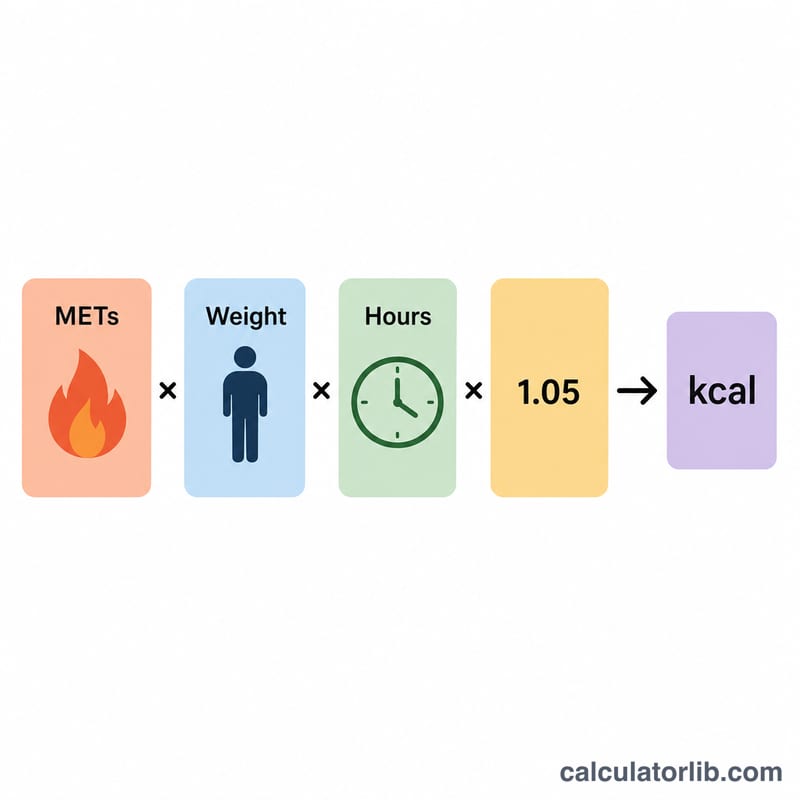
The calculation is: $$\text{kcal} = \text{METs} \times \text{weight(kg)} \times \text{hours} \times 1.05$$. Duration is entered in minutes, so it is converted to hours by dividing by 60. The 1.05 factor represents roughly 1.05 kcal burned per kilogram of body weight per MET-hour. This is mathematically equivalent to the common international form, \(\text{METs} \times 3.5 \times \text{weight} \times \text{minutes} \div 200\).
Worked example
Suppose you take a normal-paced walk (3 METs) for 60 minutes and weigh 60 kg. Hours = \(60 / 60 = 1\). Calories = $$3 \times 60 \times 1 \times 1.05 = 189 \text{ kcal}$$ 189 kcal.
Typical METs Values for Common Activities
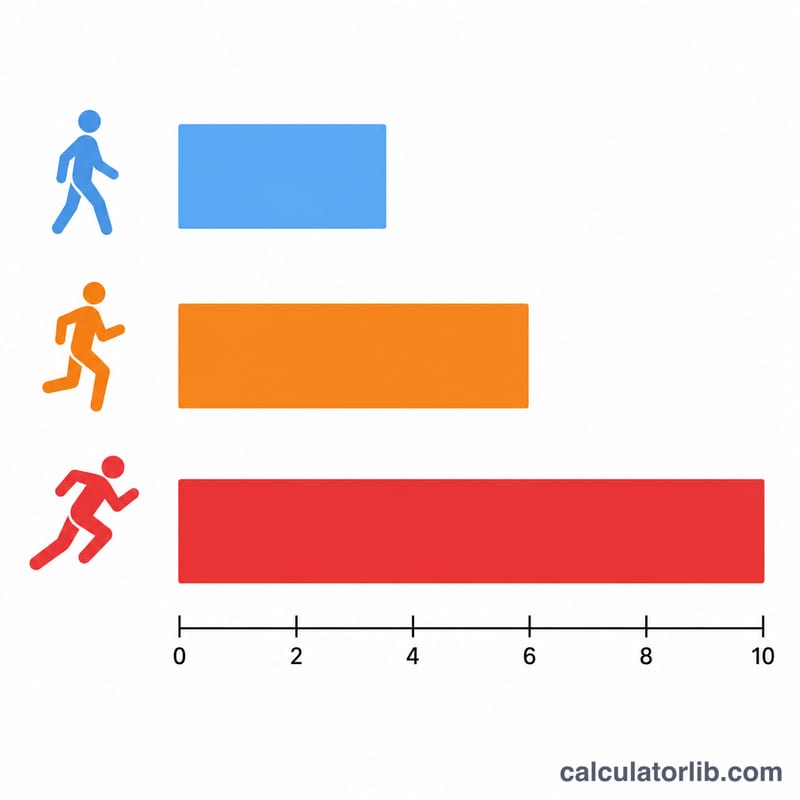
METs (metabolic equivalents) express an activity's energy cost as a multiple of resting energy use (1 MET ≈ sitting quietly). The values below are approximate and are rounded from the Compendium of Physical Activities (current edition: the 2024 Adult Compendium of Physical Activities). Actual values vary with speed, terrain, technique and the individual, so treat them as typical figures, not exact ones.
| Intensity group | Activity | Approx. METs |
|---|---|---|
| Sedentary / very light | Sitting quietly | 1.0 |
| Light (<3) | Cooking, light standing tasks | about 1.8–2.0 |
| Light (<3) | Stretching | about 2.3 |
| Light (<3) | Yoga (gentle) | about 2.5 |
| Light (<3) | Slow walking | about 2.8 |
| Moderate (3–5.9) | Normal-pace walking | about 3.0 |
| Moderate (3–5.9) | Housework such as vacuuming or cleaning | about 3.3 |
| Moderate (3–5.9) | Strength training, light to moderate effort | about 3.5 |
| Moderate (3–5.9) | Leisure cycling | about 4.0 |
| Moderate (3–5.9) | Brisk walking | about 4.3 |
| Vigorous (6+) | Strength training, vigorous effort | about 6.0 |
| Vigorous (6+) | Jogging | about 7.0 |
| Vigorous (6+) | Swimming, moderate effort | about 8.0 |
| Vigorous (6+) | Running (faster pace) | about 8–10 |
METs Intensity Categories
Physical activity is commonly grouped into three bands by METs. These bands are used by public-health bodies such as the WHO and the American College of Sports Medicine (ACSM).
| Category | METs range | Typical examples |
|---|---|---|
| Light | Below 3 METs | Slow walking, stretching, light household tasks |
| Moderate | 3 to 5.9 METs | Normal or brisk walking, leisure cycling, light strength training |
| Vigorous | 6 METs or more | Jogging, running, fast swimming, vigorous strength training |
Japan's Physical Activity and Exercise Guide for Health Promotion 2023 (Ministry of Health, Labour and Welfare) uses 3 METs or more as the threshold for "physical activity" in its guidance, and 3 METs or more for "exercise" (planned, structured activity). Its targets are expressed in METs·hours per week, where METs·hours = METs × hours. Other countries' guidelines use similar bands but may phrase the targets differently.
This is general reference information about how intensity is classified, not personal advice.
Calorie Burn Comparison by Weight and Activity
Each figure uses the calculator's formula for a 30-minute session:
$$\text{kcal} = \text{METs} \times \text{kg} \times \frac{30}{60} \times 1.05 = \text{METs} \times \text{kg} \times 0.525$$
Example: walking at 3 METs for a 60 kg person: \(3 \times 60 \times 0.5 \times 1.05 = 94.5\) kcal.
| Body weight | Walking (3 METs), 30 min | Cycling (4 METs), 30 min | Jogging (7 METs), 30 min |
|---|---|---|---|
| 50 kg | 78.75 kcal | 105 kcal | 183.75 kcal |
| 60 kg | 94.5 kcal | 126 kcal | 220.5 kcal |
| 70 kg | 110.25 kcal | 147 kcal | 257.25 kcal |
| 80 kg | 126 kcal | 168 kcal | 294 kcal |
Calorie burn scales linearly with weight, duration and METs: doubling any one doubles the result. These are estimates based on average METs values, so individual results will differ.
FAQ
Does this include resting metabolism? Yes. METs is a total figure, not "extra" burn. To estimate only the additional calories above rest, use \((\text{METs} - 1)\) in place of METs.
How accurate is it? It is an estimate. Actual expenditure varies with fitness, terrain, efficiency, and individual metabolism, so treat the number as a useful approximation.
What if my activity is not listed? Enter a custom METs value, which you can look up in the Compendium of Physical Activities for almost any task.