
What is the CURB-65 score?
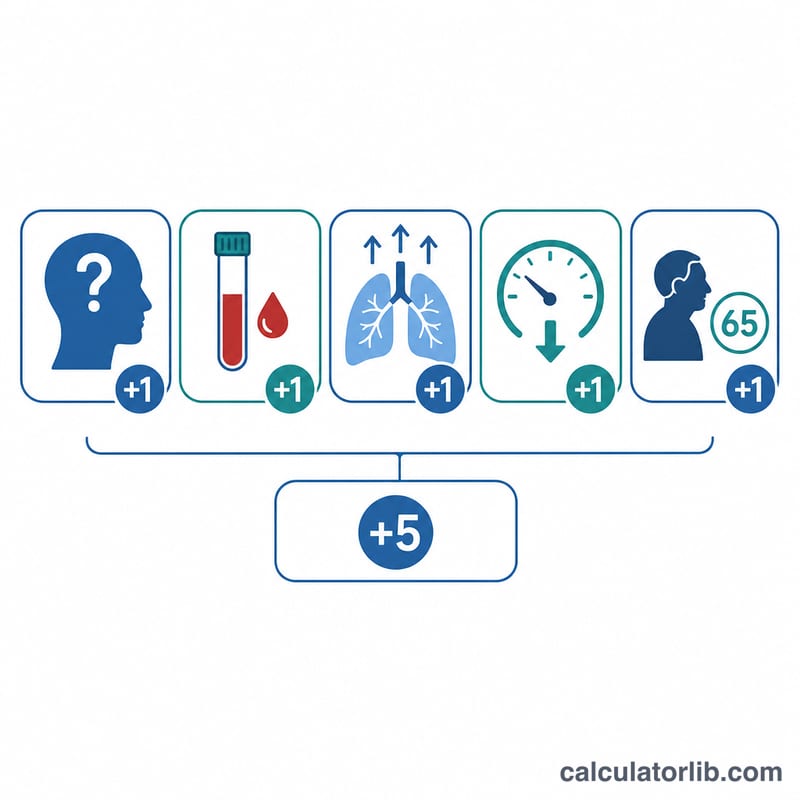
CURB-65 is a clinical prediction tool used to assess the severity of community-acquired pneumonia (CAP) and to help decide whether a patient can be treated at home or needs hospital admission. The acronym stands for Confusion, Urea, Respiratory rate, Blood pressure, and age 65 or older. Each criterion that is present scores one point, giving a total from 0 to 5.
How to use this calculator
Answer Yes or No for each of the five criteria. Confusion means new disorientation in person, place, or time. Urea refers to blood urea nitrogen (BUN) greater than 19 mg/dL (or urea > 7 mmol/L). Respiratory rate is counted as 30 breaths per minute or more. Low blood pressure means a systolic reading below 90 mmHg or a diastolic of 60 mmHg or less. The last point is awarded if the patient is 65 years of age or older. The calculator sums your answers and shows the corresponding risk category and approximate 30-day mortality.
The formula explained
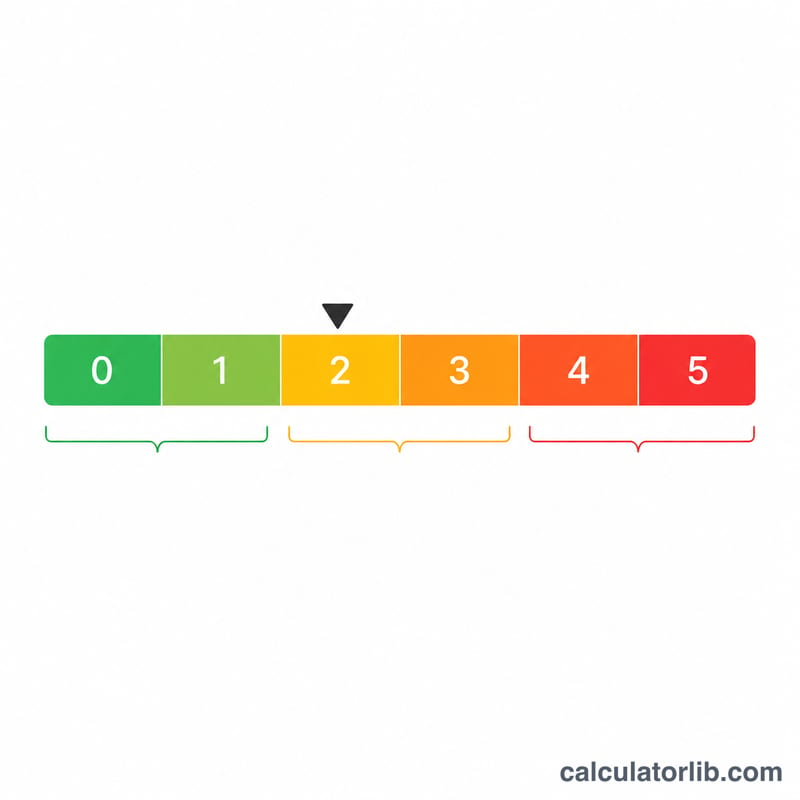
The score is simply the additive sum of binary criteria: $$\text{Score} = \text{Confusion} + (\text{BUN} > 19) + (\text{RR} \geq 30) + (\text{SBP} < 90 \text{ or } \text{DBP} \leq 60) + (\text{Age} \geq 65)$$ Higher totals correlate with higher mortality. A score of 0–1 is low risk (consider outpatient care), 2 is moderate risk (consider short hospital stay), and 3–5 is high risk (admit, possibly to intensive care).
Worked example
A 72-year-old patient is alert (no confusion), has a BUN of 25 mg/dL, a respiratory rate of 32, blood pressure of 110/70, and is over 65. Points: $$\text{Confusion } 0 + \text{Urea } 1 + \text{Respiratory } 1 + \text{Blood pressure } 0 + \text{Age } 1 = 3$$ This is high risk with an estimated 30-day mortality around 14%, suggesting hospital admission.
FAQ
Is CURB-65 a substitute for clinical judgment? No. It is a decision-support aid and should be combined with clinical assessment, oxygen saturation, comorbidities, and social factors.
What is CRB-65? A simplified version that omits the urea test, useful in primary care where blood tests are not immediately available.
What mortality do the scores predict? Roughly: \(0 \approx 0.6\%\), \(1 \approx 2.7\%\), \(2 \approx 6.8\%\), \(3 \approx 14\%\), and \(4–5 \approx 27.8\%\) 30-day mortality, based on validation cohorts.