
What is the Fatigue Severity Scale?
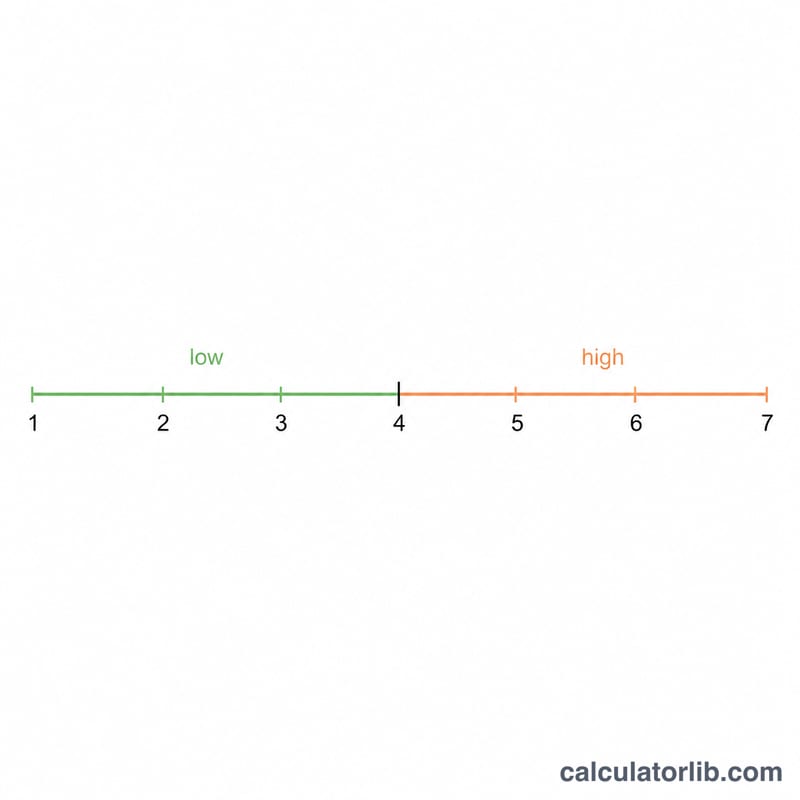
The Fatigue Severity Scale (FSS) is a widely used 9-item self-report questionnaire developed by Krupp and colleagues to measure the impact of fatigue on daily functioning. Each statement is rated from 1 (strongly disagree) to 7 (strongly agree), and the final score is the average of all nine responses. It is commonly applied in multiple sclerosis, lupus, chronic fatigue, sleep disorders, and general clinical research.
How to use this calculator
Read each of the nine statements and choose a number from 1 to 7 that reflects how strongly you agree, considering the past week. Enter all nine ratings and the calculator returns your mean FSS score along with the raw total. A higher score reflects greater fatigue severity.
The formula explained
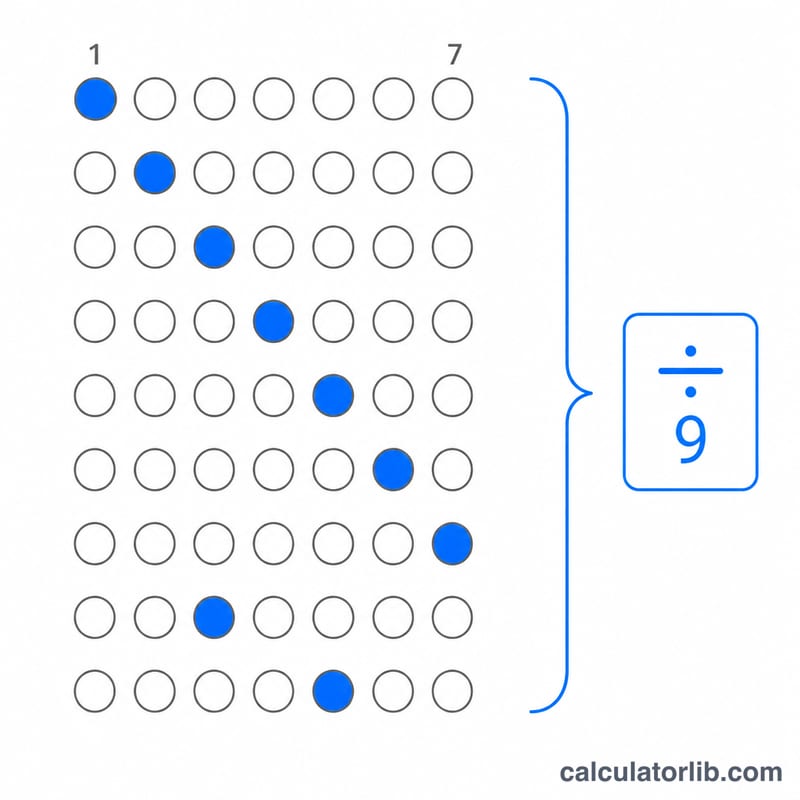
FSS is simply the sum of the nine item scores divided by 9. Because each item ranges from 1 to 7, the final score also ranges from 1 to 7. A mean score of 4 or higher is often used as a threshold suggesting significant or clinically relevant fatigue, though interpretation should always be made by a qualified professional.
$$\text{FSS} = \frac{1}{9}\sum_{i=1}^{9} Q_i = \frac{\text{Q1} + \text{Q2} + \text{Q3} + \text{Q4} + \text{Q5} + \text{Q6} + \text{Q7} + \text{Q8} + \text{Q9}}{9}$$
Worked example
Suppose someone answers all nine items with a 6. The total is \(6 \times 9 = 54\), and the FSS is $$\frac{54}{9} = 6.0$$ indicating severe fatigue. If the answers were 5, 6, 7, 4, 5, 6, 7, 5, 6, the total is 51 and the FSS is $$\frac{51}{9} \approx 5.67$$
FAQ
What score indicates fatigue? An average of 4.0 or above is frequently cited as the cut-off suggesting significant fatigue, but cut-offs vary across studies and conditions.
Is the FSS a diagnosis? No. It is a screening and tracking tool. It measures perceived fatigue impact but does not diagnose any condition.
Can I track changes over time? Yes. Many people repeat the FSS periodically to monitor how fatigue responds to treatment or lifestyle changes.