What is a 90-Minute Sleep Cycle?
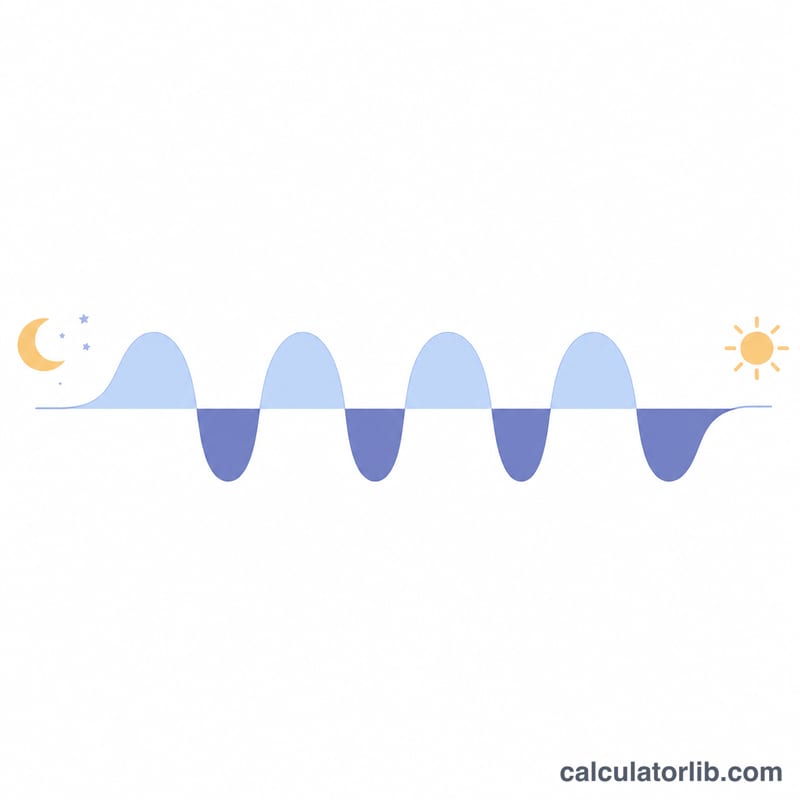
During sleep your brain moves through repeating cycles of light sleep, deep sleep and REM (dream) sleep. Each full cycle lasts roughly 90 minutes. Waking up at the end of a cycle — when sleep is lightest — tends to leave you feeling refreshed, while waking in the middle of deep sleep can leave you groggy. This calculator schedules your wake-up time to land at the end of complete 90-minute cycles.
How to Use This Calculator
Enter the time you plan to go to bed (24-hour hour and minute) and how long it usually takes you to fall asleep (the default is 14 minutes, a common average). The tool then shows ideal wake-up times for 4, 5 and 6 complete cycles — equivalent to about 6, 7.5 and 9 hours of actual sleep. Choose the option that fits how much rest you need.
The Formula Explained
The calculation is simple:
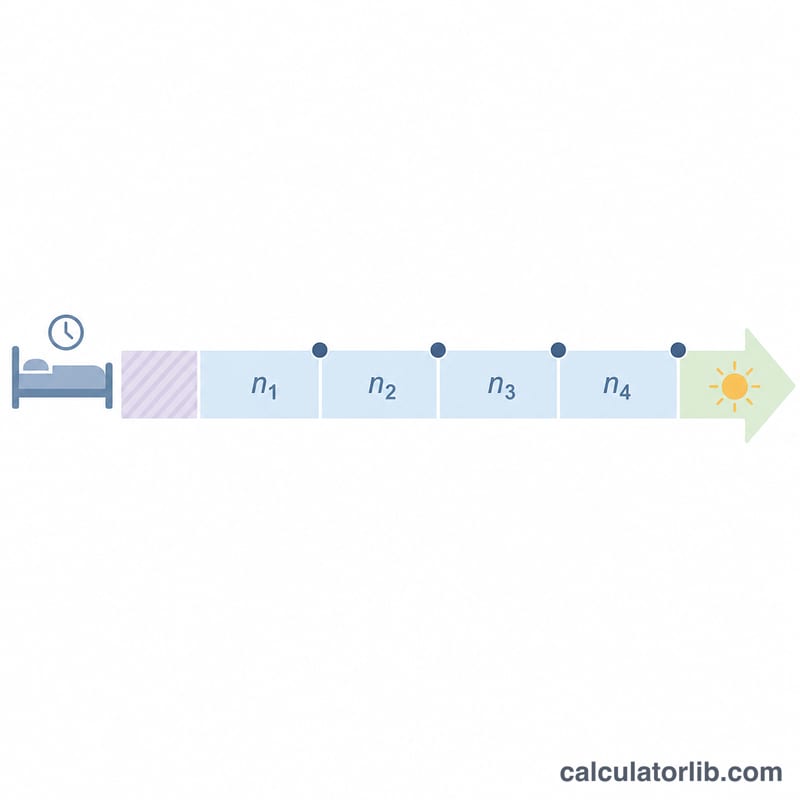
$$\text{Wake}_n = \text{Bedtime} + 14\,\text{min} + n \times 90\,\text{min}$$For example, if you go to bed at 22:30 and take 14 minutes to fall asleep, you are actually asleep at 22:44. Five cycles add \(5 \times 90 = 450\) minutes (7.5 hours), giving a wake-up time of 06:14.
Worked Example
Bedtime 22:30, fall-asleep time 14 minutes. Base = 22:44. For 5 cycles, add 450 minutes → 06:14 the next morning. For 6 cycles, add 540 minutes → 07:44.
Recommended Sleep Durations by Age
The amount of sleep a person needs changes across the lifespan. The ranges below reflect the National Sleep Foundation's expert consensus recommendations. Because one full sleep cycle averages about 90 minutes (1.5 hours), each range can also be expressed as an approximate number of complete cycles — a handy way to plan a bedtime that ends on a cycle boundary.
| Age group | Recommended sleep | Approx. 90-min cycles |
|---|---|---|
| Newborns (0–3 months) | 14–17 hours | ~9–11 |
| Infants (4–11 months) | 12–15 hours | ~8–10 |
| Toddlers (1–2 years) | 11–14 hours | ~7–9 |
| Preschoolers (3–5 years) | 10–13 hours | ~7–9 |
| School-age (6–13 years) | 9–11 hours | ~6–7 |
| Teenagers (14–17 years) | 8–10 hours | ~5–7 |
| Young adults (18–25 years) | 7–9 hours | ~5–6 |
| Adults (26–64 years) | 7–9 hours | ~5–6 |
| Older adults (65+ years) | 7–8 hours | ~5 |
For most adults, aiming for 5 to 6 full cycles (7.5–9 hours) hits the recommended range while letting you wake near the lighter end of a cycle. Note that the cycle counts are approximate: real cycles vary between roughly 70 and 120 minutes and lengthen toward morning, so treat them as planning estimates rather than exact targets.
This is general information, not medical advice. If you regularly struggle with sleep or daytime fatigue, consult a qualified healthcare professional.
FAQ
Why 90 minutes? Sleep researchers found a typical cycle averages about 90 minutes, though it varies between 70 and 110 minutes per person.
How many cycles should I aim for? Most adults do well with 5–6 cycles (7.5–9 hours). Four cycles (6 hours) is a minimum for short nights.
Is this medical advice? No. This is a general planning tool. Cycle length varies by individual, so treat the times as helpful estimates rather than exact science.