
What is the 3x3 Matrix Determinant Calculator?
This tool computes the determinant of a 3x3 matrix A from its nine real entries, and also reports the reciprocal of the determinant (\(1/\det A\)). The determinant is a single number that tells you whether a matrix is invertible: a non-zero determinant means the matrix has an inverse, while a zero determinant marks a singular (non-invertible) matrix.
How to use it
Enter each of the nine entries into the labelled grid, where a-row-col denotes the element in that row and column. Every cell accepts any real number (positive, negative, or decimal). Press calculate to see \(\det A\) as the primary result and \(1/\det A\) underneath. If the determinant is zero the reciprocal is reported as undefined.
The formula explained
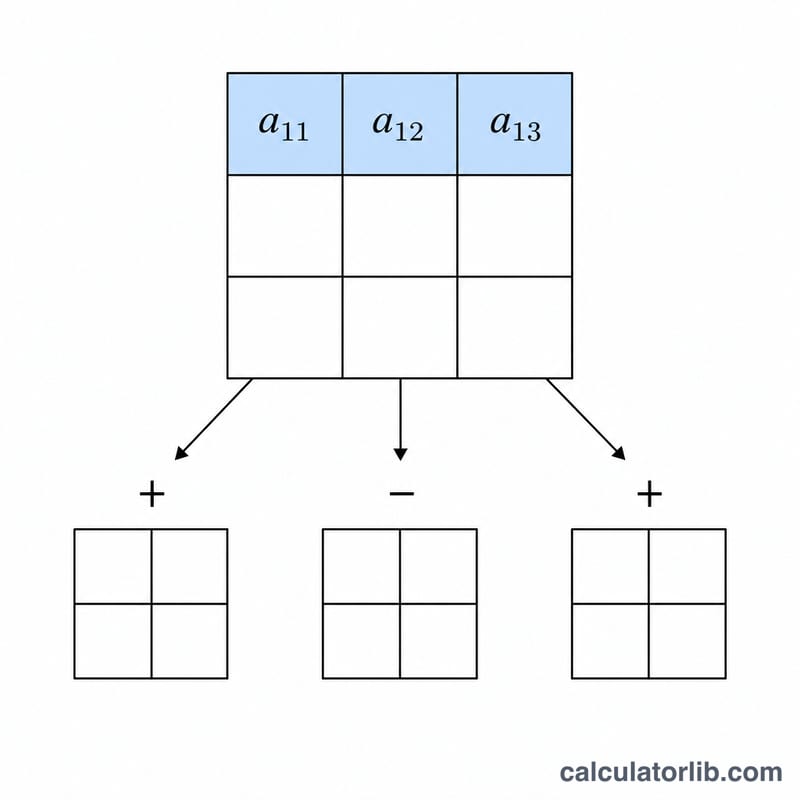
Using cofactor (Laplace) expansion along the first row:
$$\det A = a_{11}(a_{22}a_{33}-a_{23}a_{32}) - a_{12}(a_{21}a_{33}-a_{23}a_{31}) + a_{13}(a_{21}a_{32}-a_{22}a_{31})$$
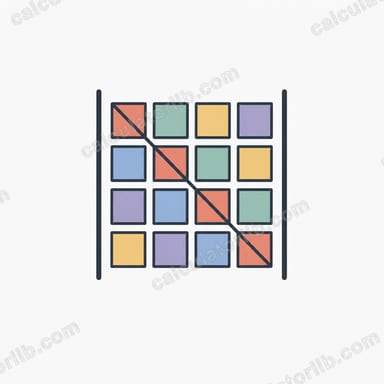
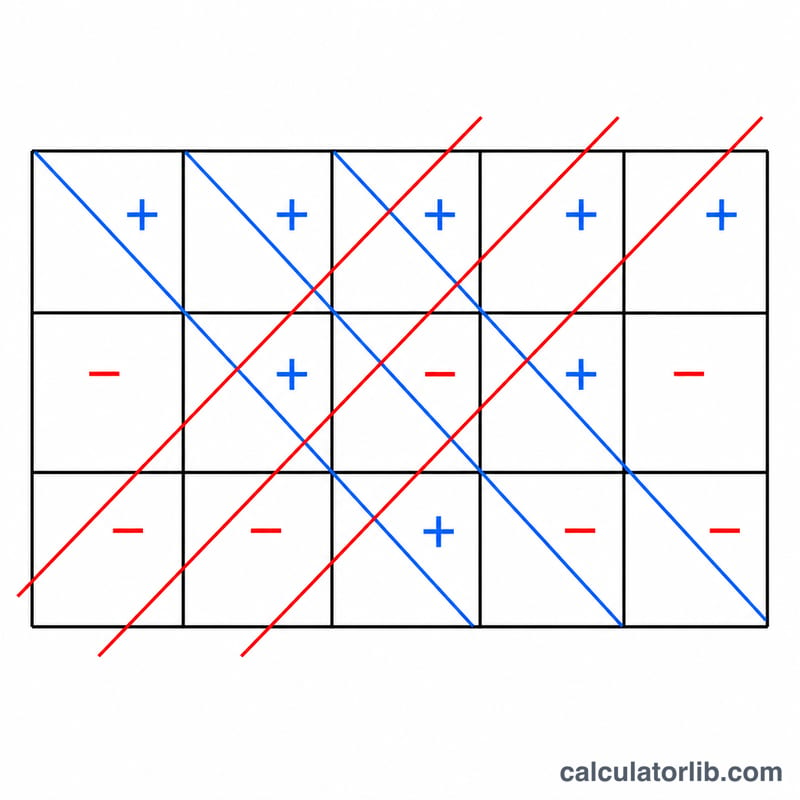
This is equivalent to the rule of Sarrus, which adds the three left-to-right diagonal products and subtracts the three right-to-left diagonal products. The result equals the signed volume-scaling factor of the linear transformation represented by A; a negative value indicates the transformation reverses orientation.
Worked example
For A = [[1,2,3],[4,5,6],[7,8,10]]: $$\det A = 1(5\cdot 10 - 6\cdot 8) - 2(4\cdot 10 - 6\cdot 7) + 3(4\cdot 8 - 5\cdot 7) = 1(2) - 2(-2) + 3(-3) = 2 + 4 - 9 = -3$$ The reciprocal is \(1/(-3) = -0.3333\ldots\) Since \(\det A\) is non-zero, the matrix is invertible.
More Worked Examples
Each example uses cofactor expansion along the first row:
$$\det A = a_{11}(a_{22}a_{33}-a_{23}a_{32}) - a_{12}(a_{21}a_{33}-a_{23}a_{31}) + a_{13}(a_{21}a_{32}-a_{22}a_{31})$$Example 1 — A singular matrix (det = 0)
Here the third row is exactly the sum of the first two rows, so the matrix is singular.
$$A=\begin{pmatrix}1 & 2 & 3\\ 4 & 5 & 6\\ 5 & 7 & 9\end{pmatrix}$$Expanding along the first row:
- \(1\,(5\cdot 9 - 6\cdot 7) = 1\,(45-42) = 3\)
- \(-\,2\,(4\cdot 9 - 6\cdot 5) = -2\,(36-30) = -12\)
- \(+\,3\,(4\cdot 7 - 5\cdot 5) = 3\,(28-25) = 9\)
Summing: \(3 - 12 + 9 = \) 0. Because \(\det A = 0\), the matrix is singular and the reciprocal \(1/\det A\) is undefined (no inverse exists).
Example 2 — Negative and decimal entries
$$A=\begin{pmatrix}2 & -1 & 0.5\\ -3 & 4 & 1\\ 0 & 2 & -2\end{pmatrix}$$Expanding along the first row:
- \(2\,(4\cdot(-2) - 1\cdot 2) = 2\,(-8-2) = 2\,(-10) = -20\)
- \(-\,(-1)\,((-3)\cdot(-2) - 1\cdot 0) = +1\,(6-0) = 6\)
- \(+\,0.5\,((-3)\cdot 2 - 4\cdot 0) = 0.5\,(-6-0) = -3\)
Summing: \(-20 + 6 - 3 = \) -17. The reciprocal is \(1/\det A = -1/17 \approx -0.0588\).
Example 3 — Upper-triangular matrix (det = product of diagonal)
$$A=\begin{pmatrix}3 & 5 & -2\\ 0 & 4 & 7\\ 0 & 0 & 2\end{pmatrix}$$Expanding along the first row (note the zeros in the lower-left make the off-diagonal cofactors vanish):
- \(3\,(4\cdot 2 - 7\cdot 0) = 3\,(8) = 24\)
- \(-\,5\,(0\cdot 2 - 7\cdot 0) = -5\,(0) = 0\)
- \(+\,(-2)\,(0\cdot 0 - 4\cdot 0) = -2\,(0) = 0\)
Summing: \(24 + 0 + 0 = \) 24, which equals the product of the diagonal entries \(3\cdot 4\cdot 2 = 24\). For any triangular matrix the determinant is simply the product of the diagonal.
Key Terms Explained
- Determinant (\(\det A\) or \(|A|\))
- A single scalar computed from a square matrix that encodes whether the matrix is invertible and how it scales volume. For a 3×3 matrix it is found by cofactor expansion.
- Minor (\(M_{ij}\))
- The determinant of the smaller matrix left after deleting row \(i\) and column \(j\). For a 3×3 matrix each minor is a 2×2 determinant.
- Cofactor (\(C_{ij}\))
- A signed minor: \(C_{ij} = (-1)^{i+j} M_{ij}\). The checkerboard sign pattern is \(\begin{smallmatrix}+&-&+\\-&+&-\\+&-&+\end{smallmatrix}\).
- Laplace / cofactor expansion
- A method that computes the determinant as the sum of each entry in a chosen row or column times its cofactor: \(\det A = \sum_j a_{ij}C_{ij}\). Choosing a row or column with zeros reduces the work.
- Rule of Sarrus
- A shortcut for 3×3 matrices only: add the three left-to-right diagonal products and subtract the three right-to-left diagonal products. It gives the same result as cofactor expansion.
- Singular matrix
- A matrix with \(\det A = 0\); it has no inverse because the rows (and columns) are linearly dependent.
- Invertible (non-singular) matrix
- A matrix with \(\det A \neq 0\); it has a unique inverse \(A^{-1}\).
- Adjugate (adjoint)
- The transpose of the cofactor matrix. It appears in the inverse formula \(A^{-1} = \frac{1}{\det A}\,\operatorname{adj}(A)\).
- Linear dependence
- When one row (or column) can be written as a combination of the others. Linear dependence forces \(\det A = 0\) and means the matrix maps 3D space onto a lower-dimensional set.
FAQ
What does a determinant of zero mean? The matrix is singular and has no inverse; its rows or columns are linearly dependent.
Can the determinant be negative? Yes. A negative determinant simply means the associated transformation flips orientation; its absolute value still gives the volume scaling factor.
Why show \(1/\det A\)? The reciprocal appears as a scalar factor in the closed-form matrix inverse (the adjugate divided by \(\det A\)), so it is a handy informational value.