
What is a 4×4 matrix determinant?
The determinant is a single scalar value that summarizes important properties of a square matrix. For a 4×4 matrix A, the determinant tells you whether the matrix is invertible (nonzero determinant) or singular (zero determinant), and it represents the signed scaling factor of the 4-dimensional volume under the linear transformation A. This calculator computes det(A) for any 4×4 matrix using exact cofactor expansion.
How to use the calculator
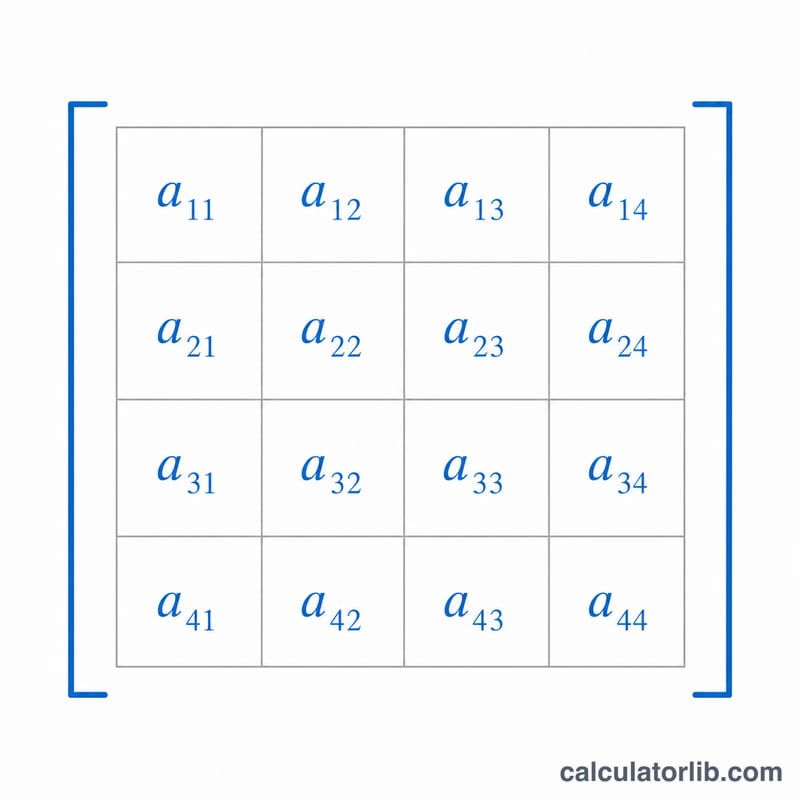
Enter all 16 entries of your matrix into the grid, where \(a_{ij}\) sits in row \(i\) and column \(j\). Decimal and negative values are allowed. Click calculate and the tool returns the determinant along with whether the matrix is invertible.
The formula explained
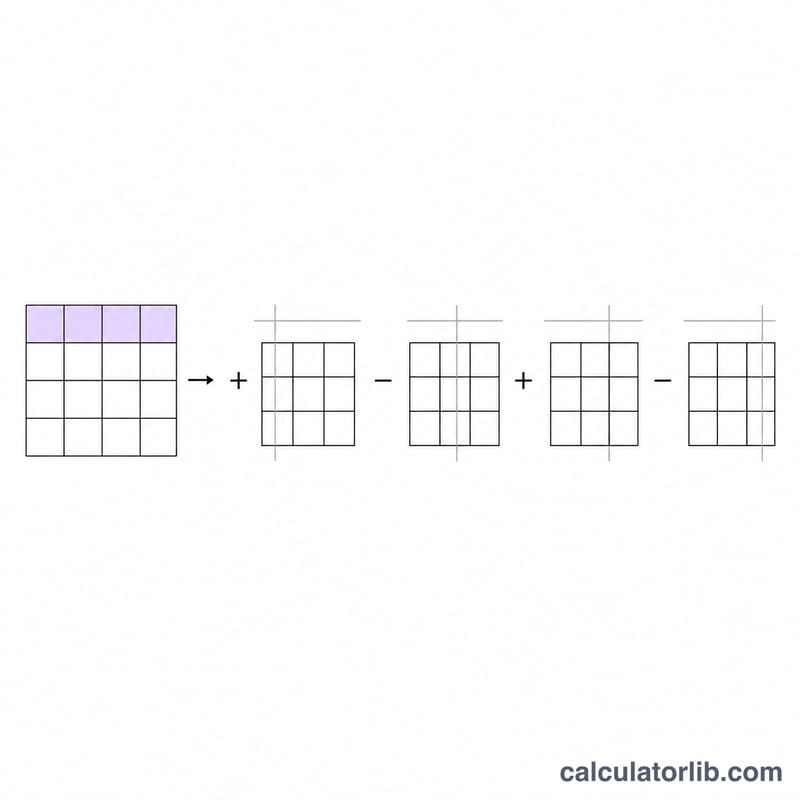
We use Laplace (cofactor) expansion along the first row:
$$\det(A) = a_{11}M_{11} - a_{12}M_{12} + a_{13}M_{13} - a_{14}M_{14}$$Each \(M_{1j}\) is the 3×3 determinant of the submatrix formed by deleting row 1 and column \(j\). The signs alternate (+, −, +, −) according to \((-1)^{1+j}\). Each 3×3 minor is itself expanded into 2×2 determinants, giving an exact result.
Worked example
For the identity matrix (1 on the diagonal, 0 elsewhere), every off-diagonal product cancels and \(\det = 1\times1\times1\times1 = 1\). For a diagonal matrix with entries 2, 3, 4, 5 the determinant is the product of the diagonal:
$$2\times3\times4\times5 = 120$$Interpreting Your Determinant
The determinant of a 4×4 matrix \(A\) is a single scalar that encodes how the linear transformation \(x\mapsto Ax\) reshapes four-dimensional space. Read your result as follows.
Sign — orientation
A positive determinant means the transformation preserves orientation (handedness) of the coordinate system; a negative determinant means orientation is reversed (a reflection is involved). The sign alone tells you nothing about how much space is stretched — only whether the basis is flipped.
Magnitude — 4D volume scaling
The absolute value \(|\det(A)|\) is the factor by which the transformation scales 4-dimensional (hyper)volume. The unit hypercube of volume 1 is mapped to a parallelotope of volume \(|\det(A)|\). For instance, \(|\det(A)|=20\) means hypervolumes are magnified 20-fold, while \(|\det|=0.5\) means they are halved.
det = 0 — singular and non-invertible
When \(\det(A)=0\) the matrix collapses 4D space onto a lower-dimensional subspace (a 3D or thinner "flat"), destroying volume. Such a matrix is singular: it has no inverse, the linear system \(Ax=b\) fails to have a unique solution, and at least one row (and one column) is a linear combination of the others.
Relation to the inverse and linear independence
A matrix is invertible if and only if \(\det(A)\neq 0\). When it is nonzero, the determinant of the inverse satisfies \(\det(A^{-1})=1/\det(A)\), so a small \(|\det|\) signals a nearly singular, numerically unstable inverse. A nonzero determinant is also exactly the condition that the four rows (equivalently, the four columns) are linearly independent and span the full 4-dimensional space.
Key Terms & Definitions
- Determinant
- A scalar value \(\det(A)\) associated with a square matrix that measures the signed volume-scaling factor of the corresponding linear map and indicates whether the matrix is invertible.
- Minor
- The determinant \(M_{ij}\) of the smaller (here 3×3) matrix obtained by deleting row \(i\) and column \(j\) from the original matrix.
- Cofactor
- A signed minor, \(C_{ij}=(-1)^{i+j}M_{ij}\). The alternating \((-1)^{i+j}\) sign produces the checkerboard pattern \(+\,-\,+\,-\) used in expansion.
- Laplace (cofactor) expansion
- The method of computing a determinant by expanding along a chosen row or column: \(\det(A)=\sum_{j} a_{ij}C_{ij}\). For a 4×4 matrix this reduces the problem to four 3×3 determinants.
- Singular matrix
- A square matrix whose determinant is zero; it has no inverse and its rows (and columns) are linearly dependent.
- Invertible (non-singular) matrix
- A square matrix with \(\det(A)\neq 0\), for which a unique inverse \(A^{-1}\) exists satisfying \(AA^{-1}=I\).
- Submatrix
- Any matrix formed by selecting a subset of the rows and columns of a larger matrix; deleting one row and one column yields the submatrix whose determinant is a minor.
- Scalar
- A single number (as opposed to a vector or matrix); the determinant of a matrix is always a scalar.
FAQ
What does a determinant of 0 mean? The matrix is singular — it has no inverse, its rows/columns are linearly dependent, and the transformation collapses volume to zero.
Does the expansion row matter? No. Expanding along any row or column gives the identical determinant; the first row is simply convenient.
Can I enter decimals or negatives? Yes. Any real numbers are accepted and the determinant is computed at full floating-point precision.