
What is angular velocity?
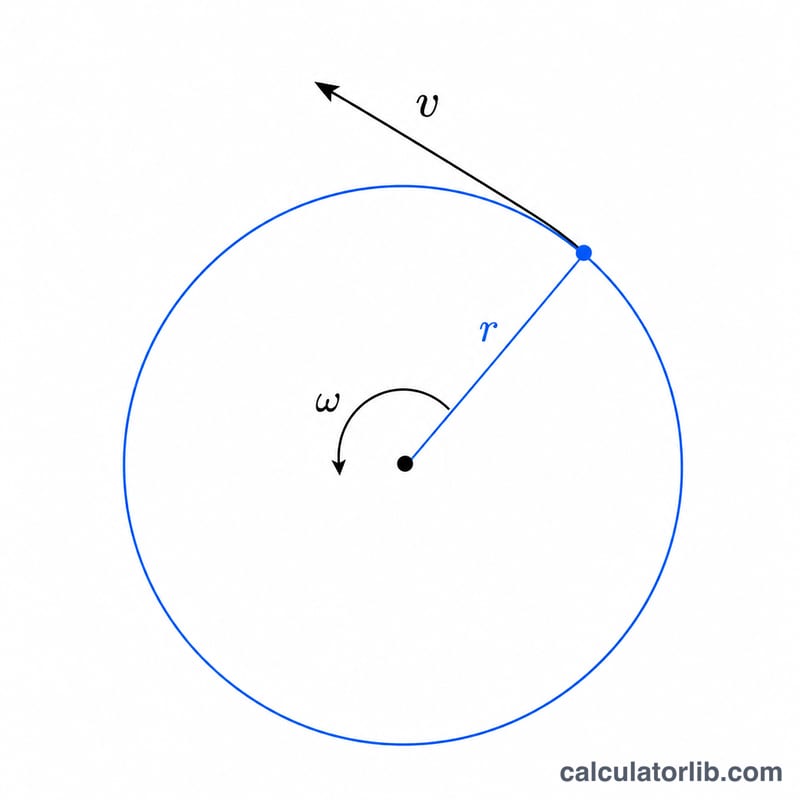
Angular velocity (ω) describes how fast an object rotates or revolves, measured in radians per second (rad/s). When a point moves along a circular path, its straight-line (tangential) speed v relates to its angular velocity through the radius r of the circle. This calculator converts a known linear velocity and radius into angular velocity, and also expresses the result in revolutions per minute (RPM).
How to use this calculator
Enter the linear velocity v in metres per second and the radius r in metres, then read off the angular velocity. The tool guards against a zero radius (which would be physically undefined) and provides the equivalent RPM for everyday rotating machinery.
The formula explained
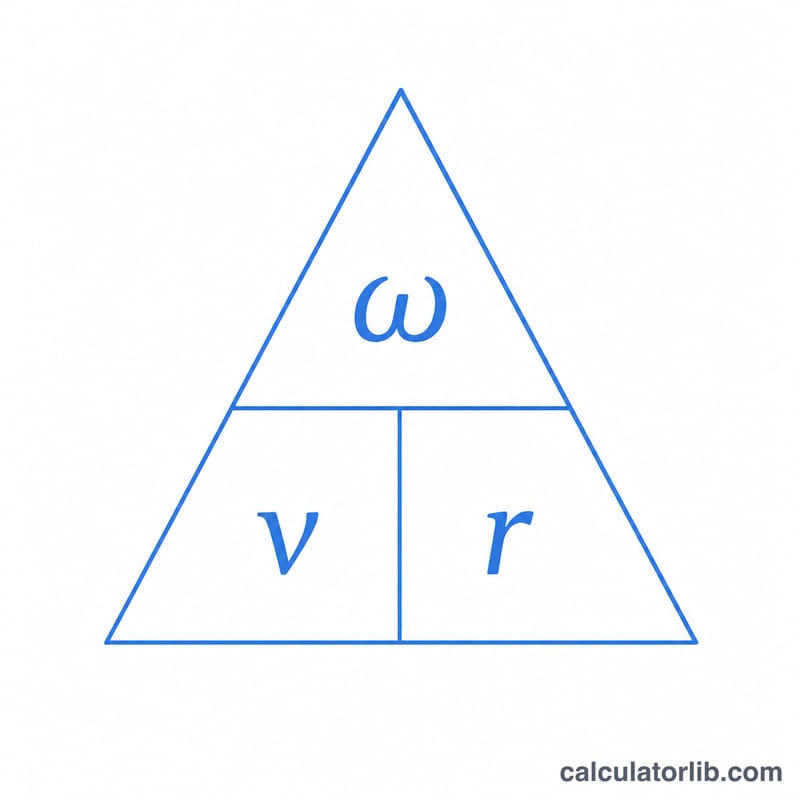
The core relationship is $$\omega = \dfrac{\text{Linear velocity } v}{\text{Radius } r}$$ Because one full revolution sweeps 2π radians, you can convert to RPM with \(\text{RPM} = \omega \times 60 / (2\pi)\). To go the other way, multiply: \(v = \omega \cdot r\). Both quantities use consistent SI units (metres, seconds) so the angular result comes out in rad/s.
Worked example
A car wheel of radius 0.3 m moves the car at 30 m/s. The angular velocity is $$\omega = 30 / 0.3 = 100 \text{ rad/s}$$ In RPM that is \(100 \times 60 / (2\pi) \approx 954.93\) RPM — the rate the wheel spins.
FAQ
What units should I use? Use metres for radius and metres per second for velocity to get radians per second directly. Any consistent length unit works as long as both inputs match.
Why radians? Radians make the relationship dimensionless and clean: arc length equals radius times angle, so \(v = r\omega\) naturally.
How do I convert rad/s to RPM? Multiply rad/s by 9.5493 (which is \(60 / 2\pi\)).