
What is RPM to Angular Velocity?
Rotational speed is often expressed in revolutions per minute (RPM), but most physics and engineering equations require angular velocity (\(\omega\)) in radians per second (rad/s). This calculator converts any RPM value to angular velocity, and also reports the equivalent degrees per second and frequency in hertz. It is a universal physics tool that applies to motors, wheels, turbines, fans, and any rotating system.
How to use it
Enter the rotational speed in RPM and press calculate. The result shows the angular velocity in rad/s, the rate of rotation in degrees per second, and the rotational frequency in hertz (revolutions per second).
The formula explained
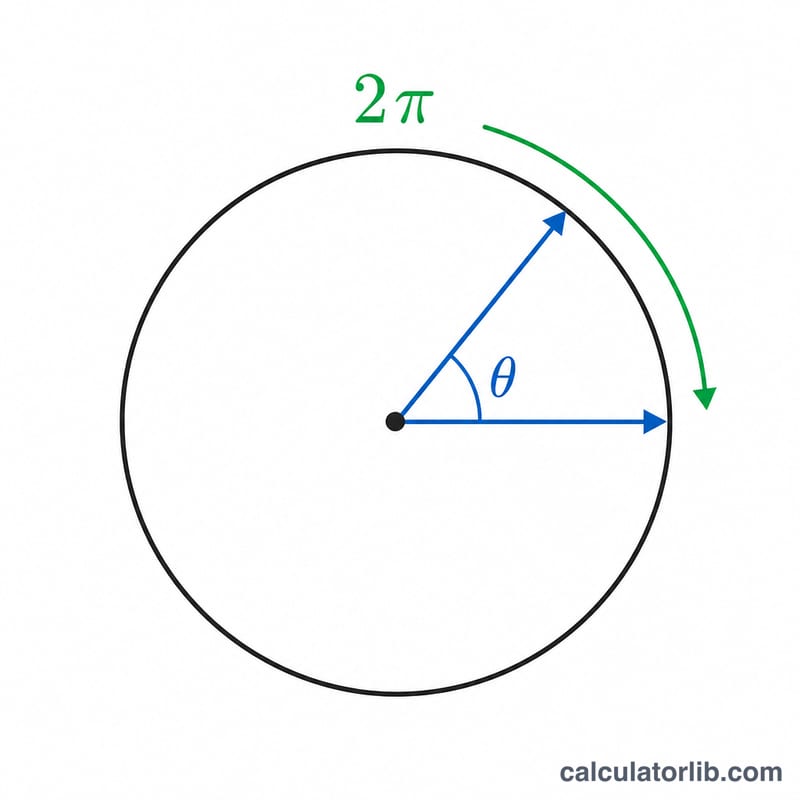
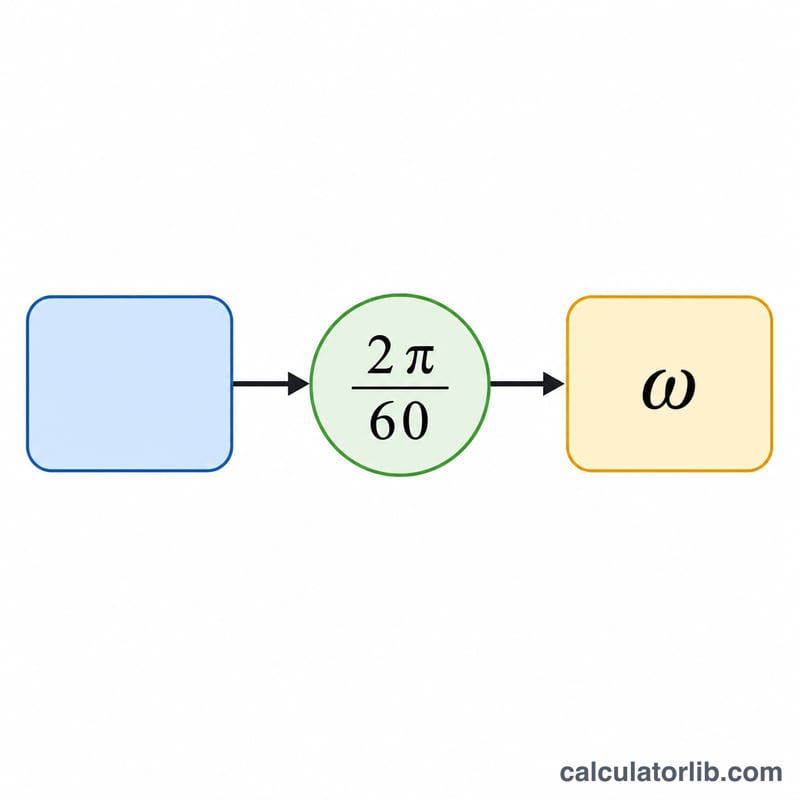
One full revolution equals 2π radians, and one minute equals 60 seconds. So to convert RPM to rad/s you multiply by 2π and divide by 60:
$$\omega = \frac{\text{RPM} \times 2\pi}{60}$$
Equivalently, \(\omega = \frac{\text{RPM} \times \pi}{30}\). The frequency in hertz is simply RPM ÷ 60, and degrees per second is RPM × 360 ÷ 60.
Worked example
Suppose a motor spins at 3000 RPM. Then $$\omega = \frac{3000 \times 2\pi}{60} = \frac{3000 \times 6.2832}{60} \approx 314.16 \text{ rad/s}.$$ The frequency is \(3000 \div 60 = 50\) Hz, and the rotation rate is \(3000 \times 6 = 18{,}000\) degrees per second.
FAQ
Why divide by 60? RPM is per minute, but angular velocity is per second, so we convert minutes to seconds by dividing by 60.
What is the difference between Hz and rad/s? Hertz counts complete revolutions per second, while rad/s measures the angle swept per second. They differ by a factor of 2π.
How do I convert back? \(\text{RPM} = \frac{\omega \times 60}{2\pi}\), so multiply rad/s by about 9.5493 to get RPM.