
What this tool does
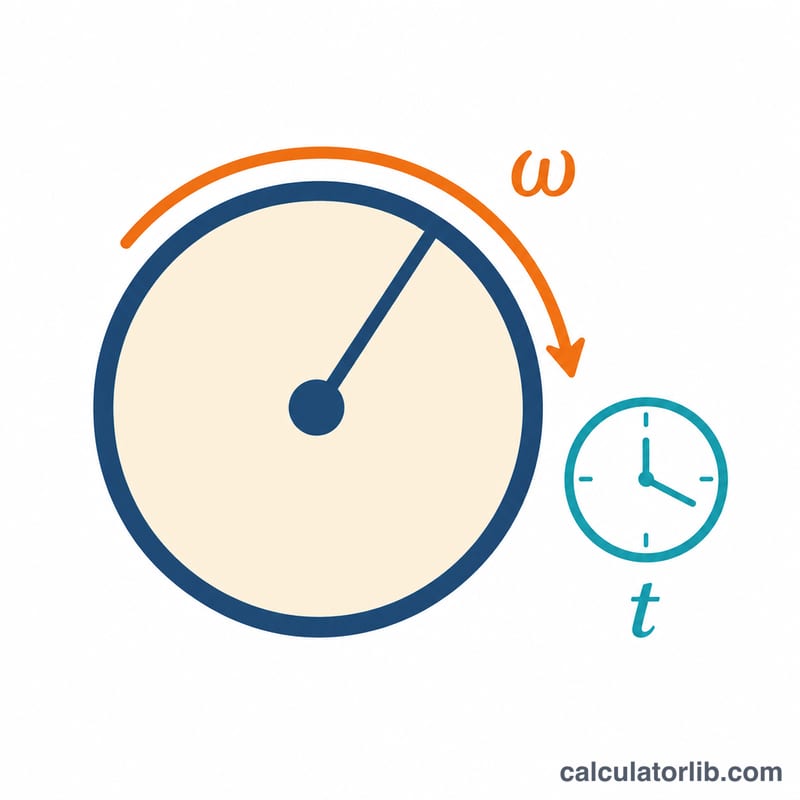
The Angular Velocity Unit Converter takes a single angular speed and expresses it in all twelve supported units at once: degrees, radians and revolutions, each per second, per minute, per hour and per day. Angular velocity describes how fast something rotates, and different fields prefer different units — engineers favor revolutions per minute (rpm), physicists use radians per second (rad/s), and astronomers often work in degrees or revolutions per day. This converter bridges them all using one consistent internal standard. It is a pure mathematical conversion, so it applies identically everywhere with no regional rules.
How to use it
Pick the unit of the value you already have from the dropdown, type that value into the Value field, and submit. The hero box shows the SI base result in radians per second, and the table lists every other unit. Negative values are valid and simply indicate the opposite direction of rotation; zero returns zero everywhere.
The formula explained
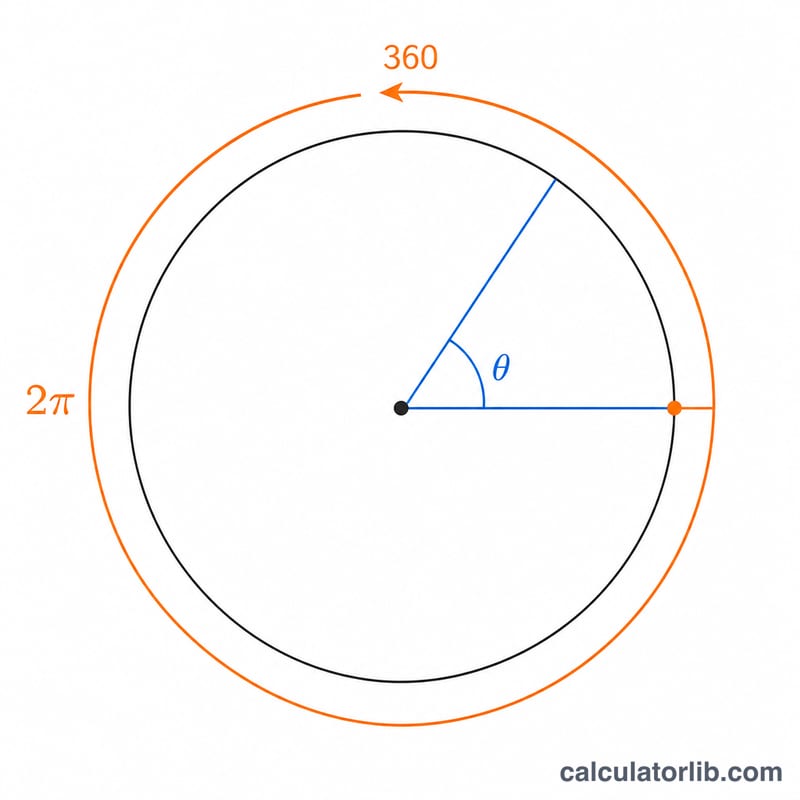
Every unit is assigned a factor that converts it to the SI base unit, radians per second (rad/s). These factors come from two facts: one revolution equals 2π radians equals 360 degrees, and per-minute, per-hour and per-day are the per-second rate divided by 60, 3600 and 86400. To convert, the tool first normalizes the input to rad/s with $$\omega_{\text{SI}} = \text{value} \times f_{\text{source}},$$ then divides by each target factor: $$\omega_{\text{target}} = \frac{\omega_{\text{SI}}}{f_{\text{target}}}.$$ The high-precision constant \(\pi\) (Math.PI) keeps degree and revolution conversions accurate.
Worked example
Enter 1 radian per day. Step 1: $$\omega_{\text{SI}} = 1 \times \frac{1}{86400} = 1.1574074074\text{e-}5 \text{ rad/s}.$$ Step 2 gives, among others, \(0.041666666667\) rad/h, \(6.6314559622\text{e-}4\) deg/s, \(57.295779513\) deg/d, \(0.0001105242660\) rpm and \(0.159154943092\) rpd — exactly the expected table.
Common Angular Velocities Compared
The table below lists familiar rotating objects expressed in three units. Conversions use \(\text{rad/s}=\text{rpm}\times2\pi/60\) and \(\text{deg/s}=\text{rpm}\times6\). Values are rounded for readability.
| Object | Approx. rate (rpm) | rad/s | deg/s |
|---|---|---|---|
| Clock second hand (1 rev/min) | 1 | 0.1047 | 6 |
| Earth rotation (1 rev/day) | 0.000694 | 0.0000727 | 0.00417 |
| Vinyl LP record (33⅓ rpm) | 33.33 | 3.491 | 200 |
| Vinyl single (45 rpm) | 45 | 4.712 | 270 |
| Car engine at idle (~800 rpm) | 800 | 83.78 | 4800 |
| Desktop hard drive (7200 rpm) | 7200 | 753.98 | 43200 |
| Kitchen blender (~20,000 rpm) | 20000 | 2094 | 120000 |
Constants Used
Every conversion in this tool is built from a small set of exact mathematical and time-based constants:
- \(\pi \approx 3.14159265359\)
- \(2\pi \approx 6.28318530718\) (radians in one full revolution)
- \(1\text{ rev} = 360^\circ = 2\pi\text{ rad}\)
- \(\pi/180 \approx 0.0174533\) (radians per degree)
- \(180/\pi \approx 57.29578\) (degrees per radian)
- 1 minute = 60 seconds
- 1 hour = 3600 seconds
- 1 day = 86400 seconds
The angular constants (\(\pi\), \(2\pi\), \(\pi/180\)) handle the deg ↔ rad ↔ rev relationship, while the divisors 60, 3600 and 86400 scale any "per second" rate down to per minute, per hour or per day. Because \(\pi\) is irrational, all factors except the pure ratios (such as rad/min = 1/60) are non-terminating decimals and are shown rounded.
FAQ
Is rpm the same as revolutions per minute? Yes. rpm is revolutions per minute; multiply by \(2\pi/60\) to get rad/s.
How do I convert deg/s to rad/s? Multiply by \(\pi/180\) (about \(0.0174533\)).
Can I enter negative or zero values? Yes. Negative means reverse rotation and zero converts to zero in all units.